The Unilever McCormick deal is one of the biggest food transactions in years—but its significance goes well beyond the $65 billion headline.
Unilever is combining its food business with McCormick & Company in a move that reshapes both companies in very different ways. Unilever walks away with $15.7 billion in cash and a majority economic stake in the combined business. McCormick, meanwhile, gains scale overnight.
Markets, however, were not convinced. Both Unilever stock and McCormick stock fell after the announcement—suggesting that while the strategy has logic, the deal itself may be asking investors to accept more uncertainty than they expected.
A deal designed to simplify—on paper
At its core, the transaction appears straightforward—even if the mechanics are not.
Unilever is separating its food division and merging it with McCormick using a Reverse Morris Trust, a tax-efficient structure that allows it to step away from direct ownership without triggering a large tax bill. When the deal closes, expected around mid-2027, Unilever shareholders will own just over half of the combined company, with McCormick shareholders holding the rest. Unilever itself will retain a smaller stake, which it plans to sell down over time.
But the simplicity is largely structural, not economic.
This is not a clean disposal. It is a staged exit—one that keeps Unilever exposed to the upside while freeing up capital in the near term, but also leaves investors with a more layered ownership structure and a less direct line to the underlying business.
Why Unilever is stepping back from food
For decades, food has been part of Unilever’s identity. Brands like Hellmann’s and Knorr are not just profitable—they are deeply embedded in global consumer habits.
But they are not where the growth is.
In recent years, Unilever’s food division has lagged behind its beauty and personal care businesses. While margins remained strong, growth has been harder to sustain. The unit generated more than €10 billion in annual revenue and over €2.5 billion in operating profit—substantial figures, but not enough to shift the company’s overall growth trajectory.
That highlights the core issue. The food business is not underperforming—it is simply growing more slowly than the categories investors increasingly value.
This deal reflects that shift. Under Fernando Fernandez, Unilever has been moving steadily toward a narrower focus on beauty, hygiene, and wellness—areas where demand is rising, pricing power is stronger, and valuations tend to be higher.
In that sense, the decision is less about food being weak, and more about capital being redirected toward where it is expected to generate the highest returns over the next decade.
A bigger bet for McCormick
If this looks like a retreat for Unilever, it is the opposite for McCormick & Company.
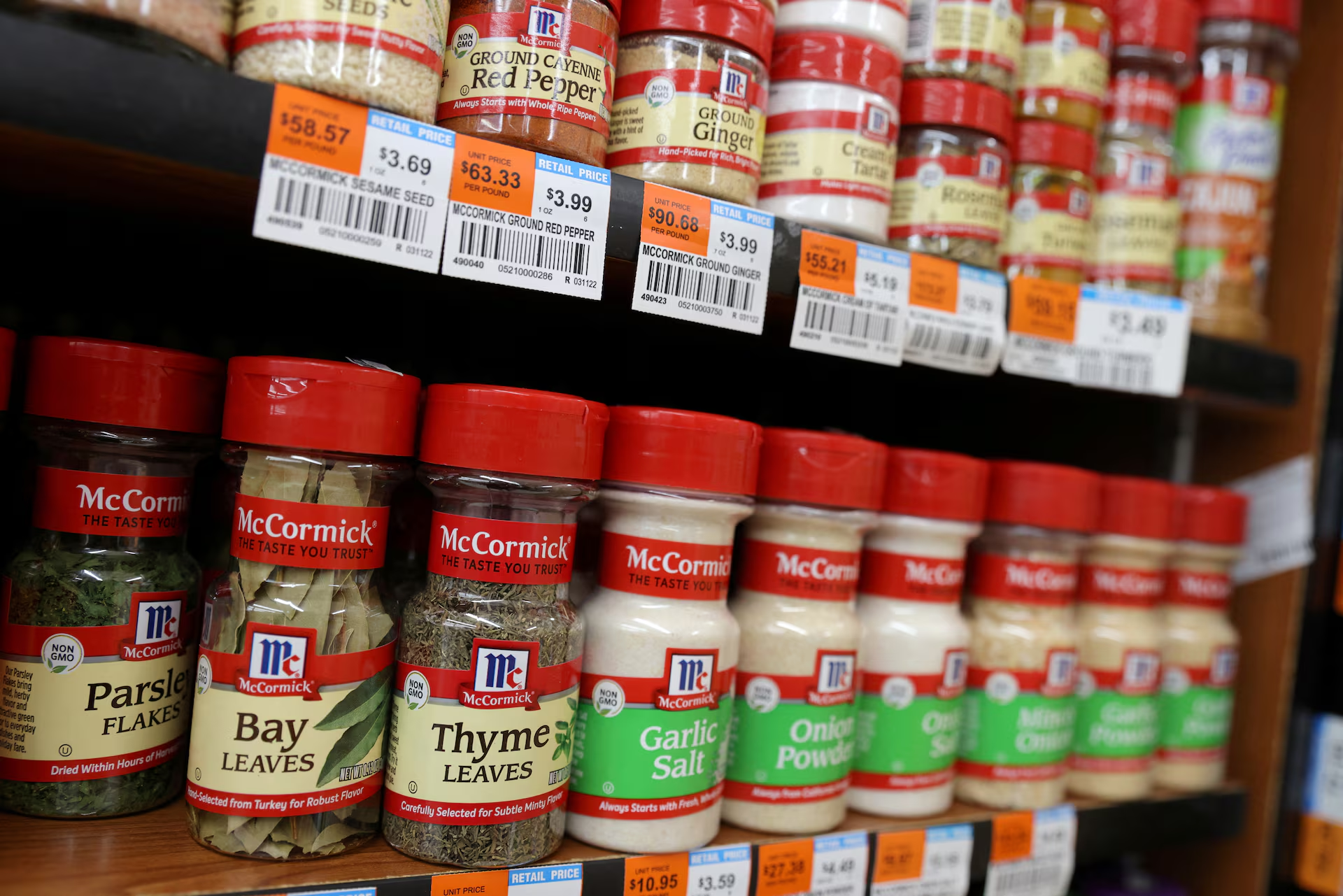
The deal creates a combined business built around some of the most recognisable names in packaged food. Alongside its own portfolio, McCormick will now incorporate major Unilever food brands, including Knorr and Hellmann’s, as well as established McCormick brands such as French’s and Cholula.
That brings the combined group to roughly $20 billion in annual revenue, significantly expanding McCormick’s global reach and deepening its position in condiments, seasonings, and cooking products.
But scale alone is not the prize—it is what scale enables.
In a category where growth is modest, size can translate into stronger pricing power, better shelf positioning, and more efficient marketing and distribution. The logic is that a larger portfolio allows McCormick to extract more value from categories that are otherwise difficult to grow.
At the same time, that makes this a more execution-dependent strategy. The combined company will need to deliver on integration, cost synergies, and brand expansion to justify the scale it is acquiring.
In that sense, while Unilever is simplifying its exposure, McCormick is increasing its reliance on execution—making this not just an expansion, but a higher-stakes bet on its ability to deliver growth from a larger, more complex business.
The tension behind the deal
Despite the strategic logic on both sides, the market reaction points to a more complicated reality.
The core issue for investors is not the strategy itself, but the trade-off it creates.
Unilever is effectively giving up a business that generated more than €10 billion in annual revenue and over €2.5 billion in operating profit. In return, it receives cash, buybacks, and a minority stake in a more complex combined entity.
That exchange shifts the balance from certainty to potential. Instead of a fully owned, predictable earnings stream, investors are left with indirect exposure and a structure that depends heavily on future execution.
In simple terms, Unilever is swapping a predictable business for a promise—and markets are rarely comfortable pricing promises.
This is where the tension becomes financial. The deal does not remove risk—it changes its form, replacing visible, recurring earnings with a more uncertain path to future value.
For McCormick, the challenge is different but equally significant. The combined company is expected to carry higher leverage at the outset, and the success of the deal will depend on integration—delivering cost savings, aligning operations, and sustaining growth across a larger, more complex organisation.
Markets rarely misprice clarity. When both sides fall on announcement, it usually reflects uncertainty about who is gaining—and who is giving up more.
This is not a question of whether the strategy works in theory, but whether the value being given up today is fully compensated by what is promised tomorrow.
A signal about where the industry is heading
The deal also reflects a broader shift in the food sector.
Packaged food is no longer the reliable growth engine it once was. Private-label competition has intensified, consumer preferences are shifting toward fresher and more health-oriented options, and even the rise of GLP-1 weight-loss drugs has begun to influence how investors think about long-term demand.
But the more important change is how markets value that growth.
In an environment where capital is increasingly directed toward higher-growth, higher-margin categories, slower-moving food businesses are becoming less central to large consumer groups—even when they remain profitable.
Against that backdrop, companies are rethinking how they are structured.
Some are doubling down on core categories. Others are separating or divesting slower-growth divisions. What they have in common is a move away from the traditional “everything under one roof” model toward more focused, more easily valued businesses.
In that sense, this is not just a deal—it is part of a wider reallocation of capital across the sector.
Unilever’s decision fits squarely into that trend.
What this means in practice
For investors, this is less a clean value unlock and more a repositioning with trade-offs.
Unilever becomes simpler and potentially easier to value, but also more exposed to fewer categories and more reliant on delivering growth in areas where expectations are already higher. The upside depends not just on strategy, but on whether markets are willing to reward that shift with a higher valuation.
In effect, investors are being asked to trade a known earnings stream for a more uncertain path to future growth.
For McCormick & Company investors, the opportunity is clearer but more execution-heavy. The company gains scale and brand strength, but must absorb integration risk, deliver on synergies, and manage higher debt levels—all while maintaining momentum in relatively slow-growing categories.
That makes success less about the deal itself, and more about what happens after it closes.
For consumers, the impact will be gradual. Products like Hellmann’s and Knorr will remain on shelves, even as ownership and strategy evolve behind the scenes. Any real change will come over time, through pricing, product innovation, and how the combined company chooses to position its brands.
Strategic bottom line
This is not just a merger. It is a reallocation of risk.
Unilever is betting that a narrower, higher-growth portfolio will command a better valuation. McCormick & Company is betting that scale will unlock growth that would not be achievable alone.
Both bets have logic.
But the question is not whether the strategy makes sense—it is whether investors are being asked to give up too much certainty to achieve it.
The deal may ultimately succeed. But it replaces a straightforward, fully owned business with a more layered structure, a delayed exit, and a greater reliance on execution.
In that sense, the risk has not disappeared—it has simply moved from the business itself to how it is structured and delivered.
That is why the reaction has been cautious. Not because the strategy lacks logic—but because the value is now less immediate, and more dependent on what happens next.