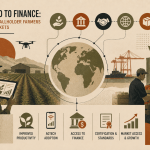
World Bank economist Bakhrom Ziyaev discusses infrastructure gaps, investment trends, and the real potential behind the region’s transit corridors.
As 2022 begins, global supply chains are still adjusting to the disruptions caused by the COVID-19 pandemic. Shipping delays, rising transport costs, and renewed geopolitical tensions have pushed multinational companies to rethink their dependence on a single manufacturing hub, especially China. This shift has sparked a global search for new, more resilient production and logistics locations.
Against this backdrop, Central Asia is emerging as a region with growing strategic importance. Located at the crossroads of Europe, China, and South Asia, it has been investing in new infrastructure, trade corridors, and economic reforms. To understand whether Central Asia could realistically position itself as a new link in the global supply network, Finance Monthly speaks with Bakhrom Ziyaev, Country Economist at the World Bank, co-author of multiple Europe and Central Asia Economic Updates, Public Expenditure Reviews, and Debt-Sustainability Analyses.
As a lead author and co-author of major economic reports and analytical publications on Central Asia the expert shares his perspective on the region’s logistics potential, investment prospects, and the steps needed to strengthen its role in global value chains.
— Bakhrom, as a Country Economist at the World Bank and co-author of several flagship economic updates on Central Asia, how would you describe the region’s current infrastructure and logistics? Is Central Asia ready to position itself as an alternative hub to China?
— Central Asia has made clear progress over the past decade. Border procedures are faster, road and rail networks are improving, and governments are cooperating more closely than before. Kazakhstan and Uzbekistan, for example, have invested heavily in logistics hubs and rail connections.
That said, the region is not yet ready to serve as a real alternative to China. The scale, reliability, and manufacturing depth simply cannot be compared. What Central Asia can offer today is a complementary transit corridor — a land bridge that helps diversify routes between Europe and Asia. To become more competitive, the region will need lower logistics costs, better customs coordination, and stronger industrial capacity.
— The World Bank’s publication “The Eurasian Connection” in 2014 highlighted the challenges of being landlocked. How much progress has been made since then, and what still prevents Central Asia from joining global supply chains more fully?
— There has been meaningful progress in customs modernization and corridor development. Several countries introduced electronic customs systems, risk-based inspections, and single-window platforms. New infrastructure, such as dry ports, modernized highways, and upgraded rail lines, has reduced transit times across major routes.
However, big constraints remain. Logistics performance is still below international standards, especially in mountainous countries like Tajikistan and the Kyrgyz Republic. Border procedures can vary greatly from one crossing to another, which creates delays. These inefficiencies raise transport costs and make the region less attractive for companies that rely on predictable delivery times.
— Bakhrom, you have provided policy advice and analytical support to Central Asian governments. How realistic is Central Asia’s ability to benefit and which countries are best positioned to attract investment?
— Central Asia could benefit, but only if reforms continue. Its location gives it a natural advantage, and the emergence of new transport corridors, such as the Middle Corridor, is creating fresh opportunities.
Kazakhstan and Uzbekistan are currently the strongest candidates. Kazakhstan offers more advanced infrastructure, while Uzbekistan has a young labor force and a government committed to economic reform. Both countries are attracting attention in sectors like agro-processing and light manufacturing.
To fully capitalize on this momentum, Central Asia needs to strengthen skills, improve the investment climate, and better coordinate policies across borders. Without these steps, the region will remain more of a transit route than a production hub.
— Drawing on your experience as a peer reviewer for international journals in economics and public policy, what strategies should Central Asian governments adopt to finance supply-chain infrastructure while keeping fiscal risks under control?
— Countries need to be selective. Not every infrastructure project is worth the cost. Governments should prioritize investments that clearly reduce trade barriers or support private-sector development.
Second, concessional financing from development partners can help reduce debt burdens. Public-private partnerships can also play a role, but only if they are well-designed and risks are transparent.
Finally, all borrowing decisions should be based on updated debt-sustainability analyses. Many countries entered the pandemic with already-elevated debt levels, so careful planning is essential. With the right safeguards, it is possible to invest in infrastructure while maintaining fiscal stability.
— You have participated in regional policy forums and national conferences. How do regional cooperation and external partnerships influence the region’s potential to become a growth hub?
— They are essential. No country in Central Asia can succeed alone. The more the region harmonizes customs rules, transport standards, and border procedures, the more attractive it becomes to investors.
External partners also play a major role. China’s Belt and Road Initiative has brought substantial infrastructure investment. Turkey supports the development of westward corridors through the South Caucasus. The European Union provides both technical assistance and market access.
A combination of strong regional coordination and strategic global partnerships is the best pathway to building a competitive supply-chain hub.
— Based on your analytical work, including the “Europe and Central Asia Economic Updates”, which sectors show the most promise for integrating Central Asia into global supply chains?
— Several sectors stand out. Light manufacturing has potential in Uzbekistan and Kazakhstan due to competitive labor costs and improving infrastructure.
Agro-processing is also promising. With better cold-chain logistics and higher standards, the region could strengthen its position in processed fruit and nut exports.
Renewable energy, especially hydropower in Tajikistan and the Kyrgyz Republic, offers long-term opportunities. Clean energy is becoming a competitive advantage globally, and the region has significant potential.
Digital services are growing quickly as well, with tech hubs emerging in Almaty, Tashkent, and Bishkek.
These sectors can help the region move beyond raw-material exports and into higher-value economic activity.
"Disclaimer: This article reflects the personal views of Bakhrom Ziyaev and does not necessarily correspond to the official stance of any organization or institution he is associated with."