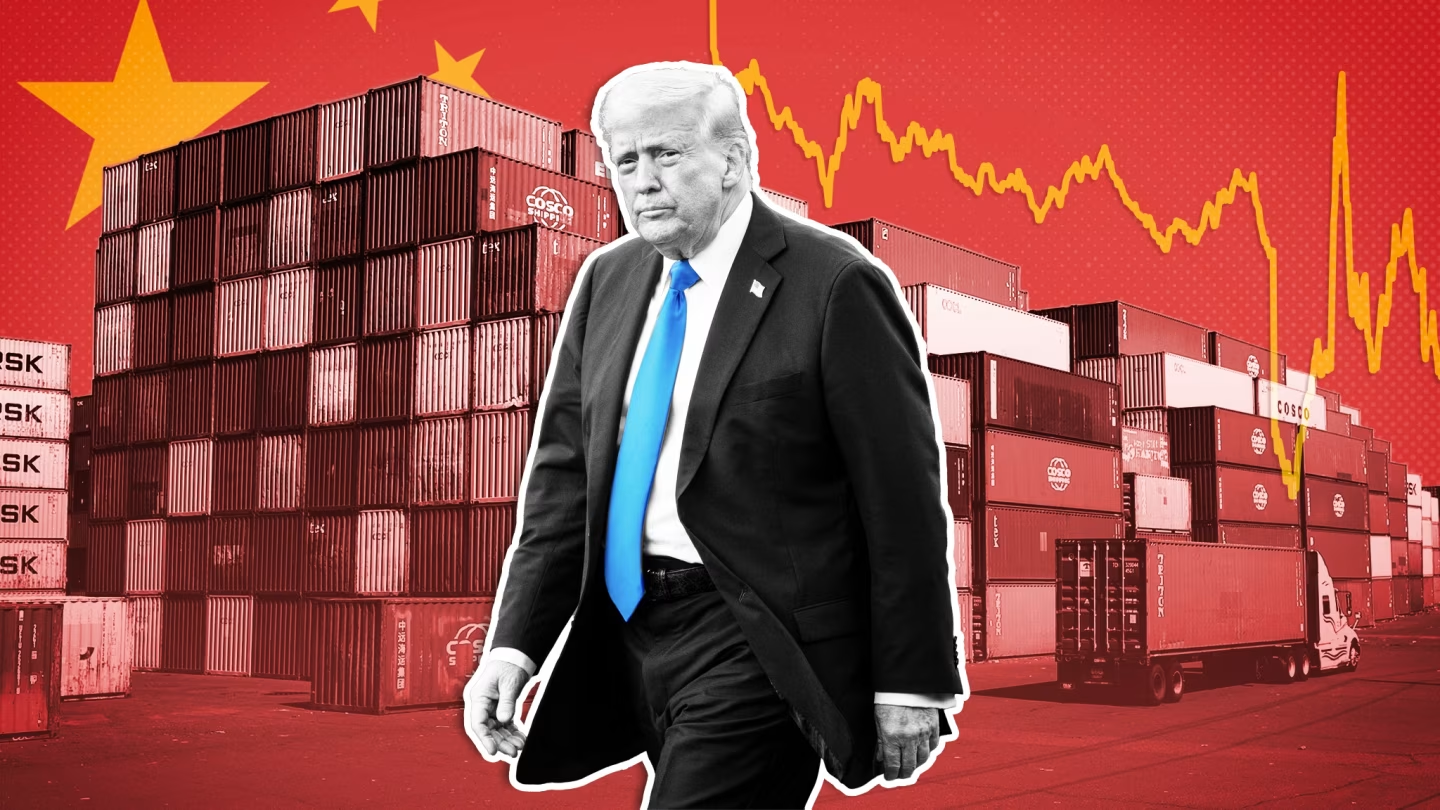
The $800B Tariff-Driven Liquidity Trap (2026 Update): This phenomenon arises from the combination of US tariffs, removal of the $800 de minimis exemption, and new bonus depreciation rules under the One Big Beautiful Bill Act (OBBBA). Corporate treasurers and CFOs must manage liquidity, compliance, and capital allocation while mitigating operational, tax, and M&A risks.
Tariff-Driven Reporting, Liquidity, and Fiduciary Challenges for Mid-Market CFOs
Reporting exposure is now the primary concern for mid-market CFOs as the US Supreme Court prepares to rule on the legality of the 1977 International Emergency Economic Powers Act. If the Court strikes down the current tariff regime, firms face a multi-year administrative nightmare regarding duty refunds and retroactive tax adjustments. Accounting teams must establish contingency protocols to track every dollar of tariff expenditure back to the point of origin. Executive takeaway: Ensure cross-department cash-flow reconciliation and legal compliance tracking.
Liquidity friction has intensified following the January 13 announcement of a 25% penalty on nations maintaining trade relations with Iran. Treasurers must immediately audit international payment flows to prevent subsidiary transactions from inadvertently triggering aggressive secondary sanctions. Maintaining high cash reserves is essential to buffer against sudden, non-linear baseline duty impositions.
Capital market volatility remains elevated as institutional investors weigh the 3.1% global growth forecast against the unexpected 4.3% US domestic surge. This divergence complicates debt issuance as inflation expectations fluctuate alongside the 100% tariff on patented pharmaceuticals. Fixed-income desks are pricing in higher risk premiums for companies unable to relocate manufacturing facilities domestically. Executive takeaway: Reassess debt and hedging strategies across all subsidiaries.
Synergy realization in the M&A sector is threatened by the 25% levy on foreign-made engines and heavy-duty trucks. Deal leads must discount targets reliant on cross-border movement of automotive components between Mexico and Canada. Acquisition due diligence now requires granular assessment of "tariff-neutral" supply chain alternatives to preserve projected margin expansions.
Statutory risk has expanded to the retail sector with the elimination of the $800 "de minimis" exemption for small-package imports. Online retailers must navigate fixed-fee structures between $80 and $200 per parcel or face ruinous duties based on origin. Compliance officers should anticipate increased operational costs as platforms restructure logistics.
Fiduciary liability for boards has shifted toward accurate forecasting of "pass-through" costs for American consumers. Firms like Walmart and Target have signaled price increases, but long-term impacts on spending elasticity remain unmodeled. Directors must authorize comprehensive domestic sourcing reviews to mitigate the 50% metal surcharge currently affecting industrial manufacturing.
Operational Audit: Inventory, Liquidity, and Fixed-Fee Challenges
Inventory front-loading is underway as firms stockpile components ahead of the 50% steel and aluminum surge. While this delays immediate consumer price increases, it creates massive working capital tie-ups. Treasurers must manage carrying costs in a 4.3% Treasury yield environment, which makes short-term financing significantly more expensive.
Operational friction is acute in the small-package segment following the August 29 suspension of the $800 duty-free exemption. All international postal shipments now trigger $80–$200 import charges during the six-month implementation window. CFOs must decide whether to absorb these penalties or risk transaction volume collapse from price-sensitive consumers.
Liquidity friction has escalated as US Customs and Border Protection (CBP) mandates formal entry for millions of previously exempt packages. Logistics providers report a 54% drop in low-value parcel volumes as firms shift to bulk US-based warehousing. Supply chain leads must prioritize "Delivery Duty Paid" (DDP) couriers to bypass flat-rate postal penalties.
Capital allocation shifts are visible as manufacturers replace high-cost metal inputs with cardboard or plastic to mitigate the 50% surcharge. For steel-dependent industries like heavy equipment and automotive, COGS has jumped ~20% since the June 4 rate hike. Financial officers must audit "supplier-of-supplier" networks to identify hidden aluminum derivatives that could trigger secondary tariffs.
Reporting exposure is critical for firms using the Automated Commercial Environment (ACE) to file customs entries. Misclassifying goods to avoid the 25% automobile parts levy can result in administrative audits and loss of trade exemptions. Corporate treasurers should leverage real-time nowcasting models to adjust intra-month cash flow as baseline duties are activated.
Operational scalability is being redefined by "in-house banks" (IHBs) centralizing global cash pooling. About one-third of major corporates now operate IHBs to minimize borrowing costs and maintain immediate money-market access, enabling near real-time liquidity pivots as tariff exclusions adjust.
Capital Market Implications: M&A Surge and Recession Risks
Capital market volatility has reached historic highs, with the S&P 500 experiencing a 10% "tariff correction" in early 2025 before late-year recovery. Institutional investors navigate a "Tariff Paradox" where high protectionist barriers triggered a $2.3 trillion domestic M&A surge. Corporations pivot from panic to calculated "buy-and-build" strategies using high cash reserves to acquire domestic competitors and bypass import duties.
Fiduciary liability intensifies as J.P. Morgan and Goldman Sachs assign a 35–45% probability of a U.S. recession entering 2026. Although 4.3% annualized growth occurred in Q3 2025, analysts note it was largely driven by inventory front-loading and AI-driven capex. Asset managers must discount "winner-take-all" stocks lacking domestic manufacturing footprints.
Reporting exposure in pharmaceuticals has spiked due to the 100% tariff on branded drug imports. Foreign-dependent firms like Novartis and Roche face projected annual losses >$800M without domestic expansions. Domestic leaders like Eli Lilly and AbbVie benefit from the "Pharma Reshoring" mandate, capturing market share as foreign competitors are priced out.
Liquidity friction arises as the dollar weakens alongside falling stock prices—a decoupling defying traditional flight-to-safety behavior. BIS analysts attribute this to aggressive FX hedging and concerns over U.S. fiscal sustainability. Treasurers must manage potential 25–30% dollar depreciation affecting foreign-denominated debt servicing.
Asset impairment risk is high for tech heavyweights with narrow market breadth. The de minimis exemption removal has hit companies relying on high-velocity logistics, like Shein and Temu. M&A leads should prioritize targets offering tax shields under OBBBA, allowing 100% bonus depreciation for domestic R&D and hardware.
Yield curve shifts are driven by sticky inflation (~2.7–3.0%), capping Federal Reserve rate cuts to 2–3 in 2026. Bond vigilantes monitor the projected $2.2T tariff revenue for its impact on federal debt and GDP, with global retaliation potentially reducing long-run growth by 0.7%.
M&A and Private Equity Outlook: Foothold Acquisitions and Tax Shields
Acquisition risk now centers on "Supply Chain Sovereignty" as PE firms target domestic manufacturing to bypass 15–25% duties. Mid-market firms with localized production command record multiples. Deal leads must recognize U.S. production floors as critical tax-optimization assets.
Synergy realization is redefined by OBBBA, allowing 100% bonus depreciation for domestic R&D and hardware investments. Tax shields transform distressed industrial targets into attractive acquisitions for cash-rich tech conglomerates. Institutional investors should prioritize deals where capex offsets the 100% tariff on foreign-patented components.
Creditworthiness for LBOs hinges on "Tariff-Adjusted EBITDA." Lenders are skeptical of firms relying on Canadian or Mexican automotive parts, despite USMCA exemptions, due to potential 10% supplemental tariffs. Financial sponsors must model full supply chain on-shoring within 18 months to maintain debt covenants.
Exit strategy viability favors U.S. foothold IPOs and dual listings capturing the 4.3% growth premium. European and Japanese firms are spinning off North American units to insulate from 15% baseline duties. M&A leads should monitor carve-out opportunities for strategic advantage.
Operational scalability is constrained by high domestic wage costs. While hardware qualifies for 100% bonus depreciation, labor inflation (~2.7%) complicates margin-expansion theses. Boards must weigh immediate tax benefits against long-term operating expense increases.
Asset impairment risk is high for "Aggregator" models lacking unified domestic logistics. Portfolio companies reliant on the old $800 de minimis exemption face liquidity crises under the $80–$200 per-package fees. PE teams must stress-test all holdings for survival under a 25% permanent import cost increase.
Key Questions Executives Ask
How does the 100% bonus depreciation under the OBBBA work for M&A?
It allows acquiring firms to immediately deduct the full cost of domestic capital investments, providing a tax shield against tariff-driven cost increases.
Are U.S. companies eligible for refunds if the Supreme Court rules tariffs illegal?
Yes, but administration warnings indicate years of litigation may be required to determine eligibility and timing of repayments.
What is the "Fentanyl Tariff" applied to China and Mexico?
An additional 25% penalty levied on countries failing to curb illegal flow of fentanyl ingredients into the U.S.
Why is the UK exempt from the 50% steel and aluminium tariffs?
The UK negotiated a 25% rate instead of 50%; plans to eliminate these charges were delayed following the September state visit.
How does the $80-$200 flat fee affect Shein and Temu imports?
It replaces the $800 duty-free exemption, forcing per-package fees that erode profit margins on low-cost goods.
How should mid-market firms model Tariff-Adjusted EBITDA for LBOs?
Include potential domestic sourcing, labor cost inflation, and bonus depreciation impacts on operational margins.
What operational KPIs protect against liquidity friction during tariff surges?
Cash conversion cycles, inventory front-loading metrics, and real-time cross-border payment monitoring.
How can corporate boards mitigate fiduciary liability under new tariff regimes?
Mandate scenario modeling, cross-departmental reporting, and proactive compliance audits.
Financial Insight: 👉The $15B Liquidity Pivot: IRS Form 4547, Trump Accounts, and Corporate Fiduciary Risk👈
High-Intent SEO Tags: #OBBBATaxShields2026, #USMCATariffExemptions, #DomesticManufacturingM&A, #TariffRefundLegalStrategy, #DeMinimisExemptionRemoval, #TariffDrivenLiquidity2026, #InventoryFrontLoadingRisk, #CorporateTreasuryStrategy, #TariffAdjustedEBITDA, #SupplyChainSovereignty