Indonesia’s $80 Billion Market Shock Signals a Deeper Test of Capital Access
Indonesia’s recent market rout was not driven by earnings risk, valuation compression, or a sudden deterioration in corporate fundamentals. It was driven by a far more sensitive variable in global capital markets: confidence in how easily capital can enter, move within, and exit the system without distortion.
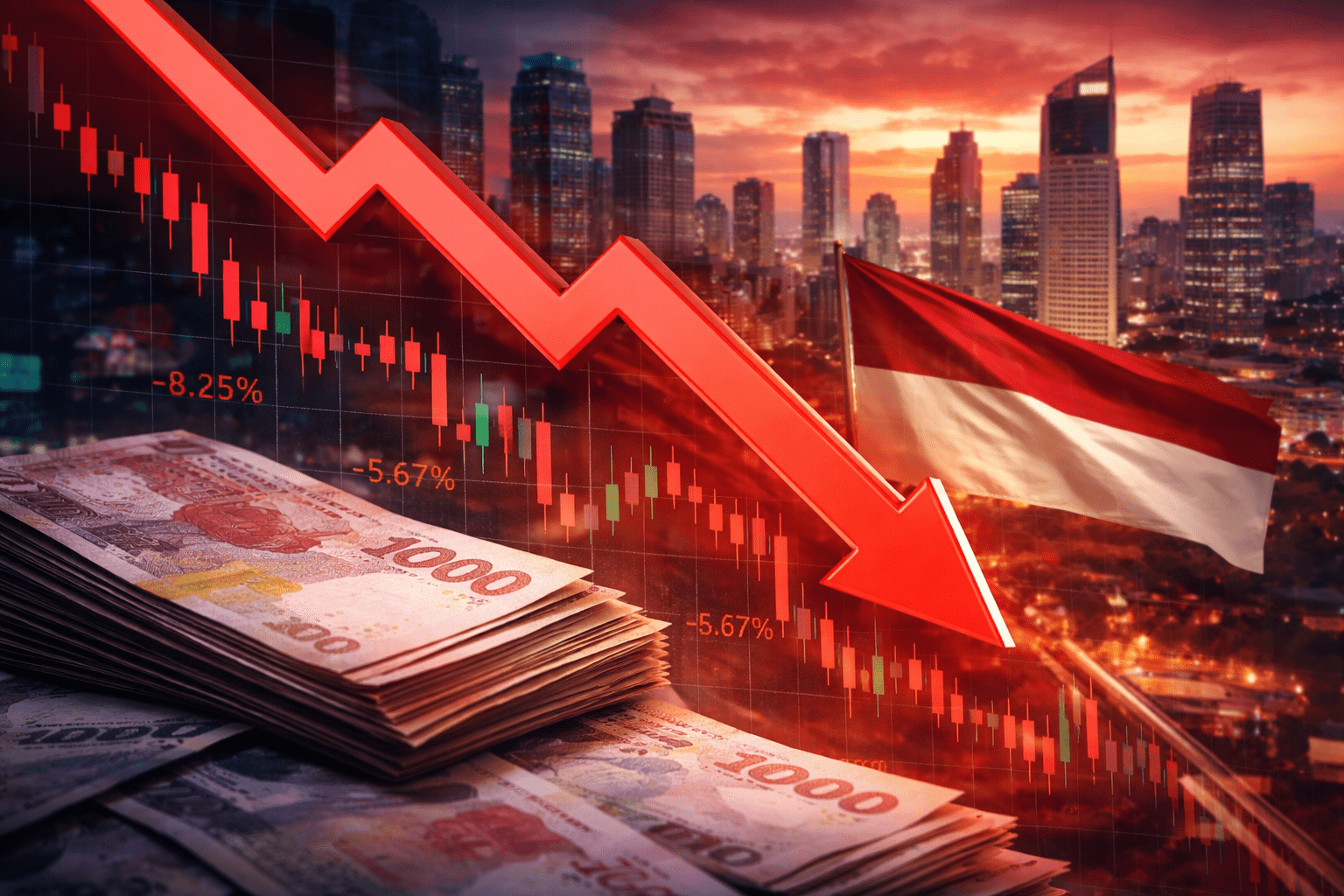
The loss of roughly $80 billion in equity value over two trading sessions reflected a reassessment of market accessibility rather than economic outlook.
Once that distinction became clear, selling accelerated with little discrimination. Passive funds, benchmark-aligned managers, and currency hedgers reacted to the same signal at the same time, producing a rapid contraction in liquidity rather than a slow repricing of risk.
What made the episode notable was not the speed of the decline but its origin. The initial catalyst was procedural rather than financial. Concerns raised around ownership transparency and tradability reframed Indonesia’s market from one offering exposure to growth into one demanding caution over execution. In a system where access conditions matter as much as returns, that shift alone was sufficient to trigger exits.
This was not a crisis of belief in Indonesia’s economy. It was a reminder that modern capital moves first on rules, not narratives.
Market Access, Not Market Confidence
The distinction between market confidence and market access is subtle but decisive. Confidence relates to expectations about future performance. Access relates to whether capital can be deployed and withdrawn under predictable conditions. In 2026, access dominates confidence when the two come into conflict.
Large pools of global capital operate under mandates that are benchmark-constrained. For these investors, index eligibility is not a vote of confidence but a gatekeeper. When eligibility comes under review, even temporarily, exposure becomes conditional. Funds cannot wait for final determinations or completed consultations. They are required to manage risk during the review period itself.
That dynamic explains the intensity of the sell-off. Once questions emerged about ownership structure and free-float adequacy, the issue ceased to be whether Indonesia remained attractive. The question became whether it remained compliant with the mechanical requirements that govern index inclusion. That is not a debate active managers resolve through judgement. It is a constraint passive capital enforces through flows.
The scale of benchmark-linked assets has grown significantly over the past decade. As a result, the proportion of capital that reacts automatically to index signals has increased. This has reduced the buffer once provided by discretionary investors who could absorb volatility while awaiting clarity. When uncertainty touches eligibility, that buffer thins quickly.
Currency markets responded in parallel. The pressure on the rupiah was not driven by a sudden reassessment of trade balances or inflation trajectories. It reflected hedging demand linked to anticipated equity outflows. As hedging costs rise, the attractiveness of maintaining exposure falls further, reinforcing the loop between equity selling and currency weakness.
Regulatory responses helped slow the pace of decline, but they did not reset expectations. Markets now distinguish sharply between announced measures and implemented ones. Stabilisation depends less on intent than on verifiable change.
Why Traditional Stabilisation Tactics Fell Short
In earlier market cycles, reassurance from policymakers and incremental regulatory adjustments often succeeded in calming investors. That approach relied on an assumption that markets were primarily reacting to uncertainty about future policy direction. Once clarity was offered, confidence returned.
That assumption no longer holds in the same way. Global capital has become more rules-driven, more benchmark-anchored, and less tolerant of ambiguity during review periods. Transparency standards, ownership disclosure, and governance consistency are now treated as prerequisites rather than aspirations.
This shift has altered how markets interpret intervention. Measures intended to demonstrate responsiveness can, under stress, be read as confirmation that underlying structures were insufficient. When reforms are announced in response to external scrutiny, they may stabilise conditions at the margin but also reinforce the perception that compliance is being negotiated rather than embedded.
The result is a credibility lag. Markets wait not for promises but for proof that changes have been implemented, enforced, and internalised. During that interval, capital remains cautious. Liquidity does not fully return until the risk of reversal or partial compliance is judged to be low.
There is also a broader context. Global liquidity conditions are tighter and more selective than in previous years. Investors have less incentive to tolerate governance risk when alternative exposures exist. This raises the threshold markets apply when assessing whether to maintain or increase allocations during periods of uncertainty.
In that environment, announcement-led stabilisation is less effective. What matters is whether the rules governing participation are durable, predictable, and aligned with external standards that investors already trust.
Contagion Beyond Equities
Although equities bore the initial impact, the effects extended beyond the stock market. Currency dynamics, sovereign perception, and funding assumptions adjusted alongside equity pricing.
For asset managers, the episode prompted reassessment not just of equity exposure but of overall country risk. Even without immediate rating actions, the widening of perceived risk altered internal models. Higher volatility assumptions feed into capital allocation decisions across asset classes.
Banks adjusted positioning based on scenario analysis rather than forecasts. The possibility of sustained outflows, even if not the base case, was sufficient to warrant caution. Insurance groups and pension funds, whose mandates emphasise stability and exit certainty, quietly reduced exposure where uncertainty appeared likely to persist.
This form of contagion is incremental rather than dramatic. It does not rely on panic or headlines. It emerges from the cumulative effect of small, mandate-driven adjustments made by different actors responding to the same signal.
Sovereign credibility is affected through this process, even in the absence of new fiscal data. When capital becomes more selective, funding costs rise at the margin. Currency volatility adds another layer of uncertainty, influencing how investors perceive policy capacity and resilience.
What matters is not whether these effects are immediately visible, but whether they persist long enough to influence medium-term allocation decisions. If uncertainty extends into key rebalancing periods, the impact can last longer than the initial shock.
The Policy Signal Markets Are Waiting For
Investors are no longer looking for reassurance. They are looking for alignment between domestic frameworks and the external standards that govern market participation.
Ownership disclosure needs to be comprehensive, consistent, and enforceable. Free-float rules must be applied uniformly rather than flexibly. Governance structures must signal continuity and insulation from short-term political considerations.
There is also a monetary dimension. Perceptions of central bank independence remain closely linked to currency stability. When those perceptions weaken, even subtly, capital becomes more cautious. Restoring confidence requires more than statements of intent. It requires observable separation between fiscal ambition and monetary execution.
Time is a critical variable. The longer uncertainty persists, the more likely it is to influence not just short-term flows but strategic allocation decisions. Markets can absorb volatility. They are less forgiving of prolonged ambiguity.
A Narrow Window for Resetting the Narrative
Indonesia retains the capacity to stabilise its standing with global investors, but the window is narrowing. The task is not to convince markets that the economy remains strong. It is to demonstrate that the rules governing access are clear, durable, and aligned with global expectations.
Durable reform matters more than speed, but speed determines whether reforms are believed in time to matter. Markets will judge credibility based on whether changes are embedded in formal frameworks rather than communicated through temporary measures.
If clarity arrives too late, the cost will not be a single episode of volatility but a sustained liquidity premium. That premium would affect funding costs, currency stability, and the willingness of long-term capital to commit.
The lesson from this episode is not that Indonesia is uniquely vulnerable. It is that in modern capital markets, access conditions are priced continuously. When those conditions are questioned, the response is immediate.
Restoring stability requires not persuasion, but proof.
What People Are Asking About
Why did Indonesia’s stock market fall?
Investors reacted to concerns over market access, ownership transparency, and potential index eligibility risk, triggering rapid capital outflows.
What is index eligibility and why does it matter?
Index eligibility determines whether global funds can invest. When eligibility is questioned, benchmark-tracking funds may be forced to sell.
Do passive funds increase market volatility?
Yes. Passive funds move capital automatically when benchmarks change, amplifying market swings during periods of uncertainty.
Why did the rupiah weaken during the sell-off?
The rupiah fell as investors hedged against expected equity outflows, not because of sudden economic deterioration.
Can regulators quickly restore investor confidence?
Confidence usually returns only after reforms are implemented and verified, not when they are first announced.
Is Indonesia at risk of a market downgrade?
A downgrade is not certain, but the review process alone can influence investor behaviour and capital flows.
How long can the impact last?
If uncertainty continues into portfolio rebalancing cycles, market effects can persist beyond the initial sell-off.
Does this affect everyday businesses?
Prolonged volatility can raise funding costs and reduce investment appetite, affecting companies over time.