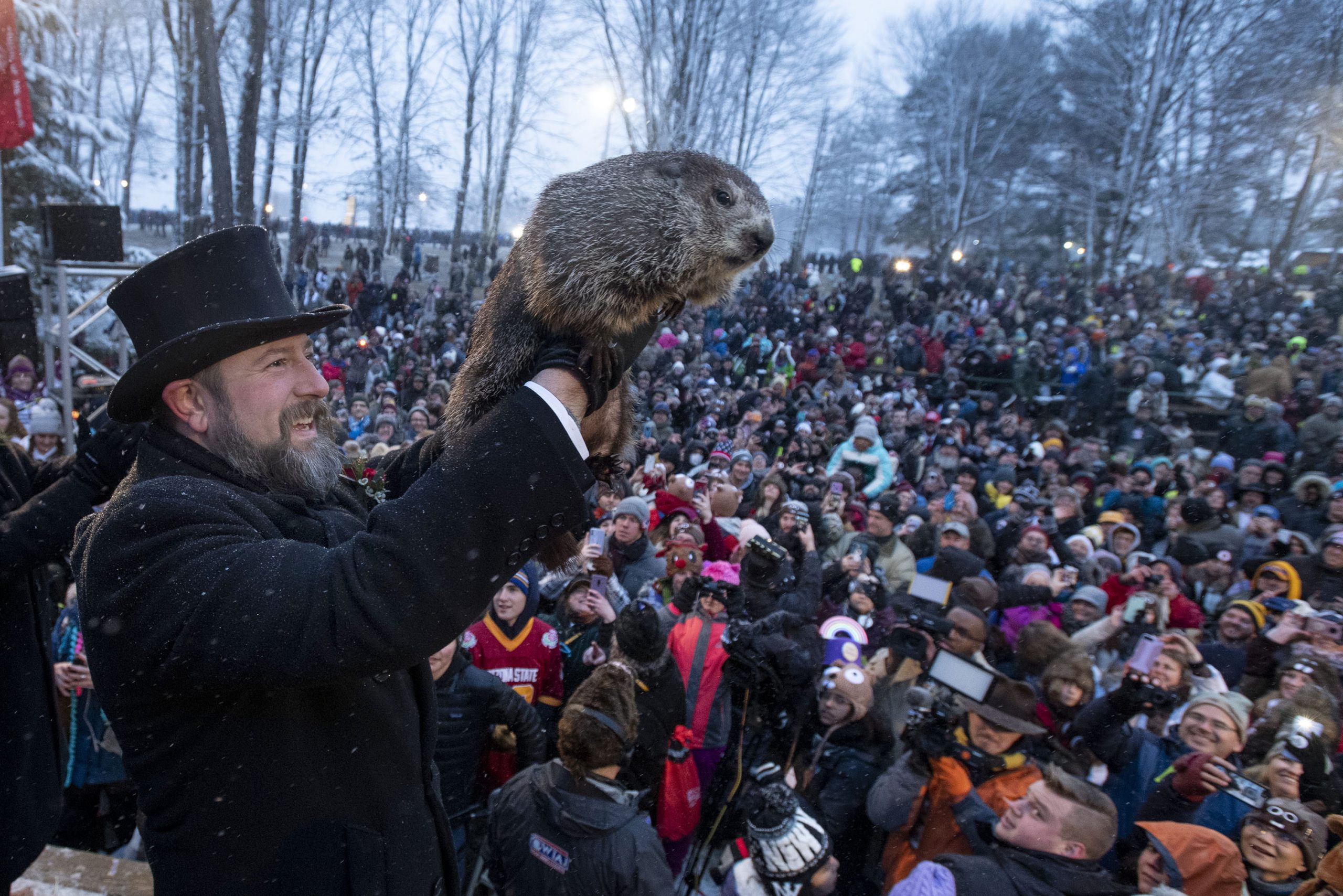
Punxsutawney, Pennsylvania — The world paused on Monday morning, February 2, 2026, as Punxsutawney Phil, the globe’s most famous groundhog, emerged from his burrow on Gobbler’s Knob to make his seasonal prediction. Fans, media crews, and curious onlookers braved the winter chill to witness the ritual that has captivated generations, now in its 140th celebration. The moment promised either six more weeks of winter if Phil saw his shadow or an early arrival of spring if the skies remained overcast.
This year, as the crowd held its collective breath, Phil emerged to a cloudy sky and did not see his shadow — signaling an early spring. The revelation sparked cheers from spectators bundled in heavy coats and scarves, bringing a sense of optimism to those enduring a harsh winter across much of the United States.
For many, this spectacle is more than folklore. It’s a shared cultural experience, a way for communities to mark the midpoint between harsh winter and the first hints of warmth. Phil’s appearance at 7:00 a.m. Eastern Time may seem whimsical, but it has become a symbol of continuity, curiosity, and hope in the middle of the cold season.
Why Groundhog Day Falls on February 2
The choice of February 2 is far from arbitrary. This date represents one of Earth’s cross-quarter days, positioned halfway between the winter solstice and the spring equinox. Ancient traditions recognized these days as subtle markers of seasonal change, long before modern meteorology. Phil’s prediction today, occurring on this historically symbolic date, carries the weight of centuries-old seasonal rituals.
Groundhog Day coincides with Candlemas, a Christian holy day observing light’s return, which aligns with historical beliefs about weather predicting the harvest and agricultural cycles. Other cross-quarter days include the March equinox, May Day, June solstice, Lammas on August 1, the September equinox, Halloween on October 31, and the December solstice. Each represents an inflection point in the year, connecting human rituals to the Earth’s natural rhythms.
Interestingly, the astronomical midpoint for 2026 actually falls on February 3 due to the slight wobble in Earth’s axial tilt, known as the precession of the equinoxes. Yet tradition locks the celebration to February 2, illustrating the tension between precise science and communal ritual. Even with this slight discrepancy, Phil’s forecast is embraced as a communal touchstone, blending modern observation with historical continuity.
Phil’s Forecast: Tradition Meets Spectacle
Despite decades of attention, Phil’s track record is famously inconsistent. While predictions are often celebrated or lampooned in the media, they offer a tangible focal point for anticipation, community gatherings, and regional pride. Onlookers often describe the experience as both intimate and theatrical — from the muffled crunch of snow underfoot to the crisp winter air, the scent of cocoa wafting from nearby stands, and the chatter of excited families and reporters alike.
The ritual is a blend of folklore, ceremony, and spectacle. Phil, a member of the marmot family, is hoisted into the light of day by handlers in traditional top hats, bridging centuries of superstition and modern pageantry. For many in attendance, it’s a moment to pause, reflect, and engage with a tradition that transcends generations.

Punxsutawney Phil makes his 2026 Groundhog Day prediction, captivating spectators with a glimpse of the iconic groundhog up close.
The Science Behind the Seasons
The planet’s 23.5-degree axial tilt causes uneven sunlight across the hemispheres, generating solstices, equinoxes, and the cross-quarter days. Groundhog Day, then, is not just a quirky tradition — it is a symbolic recognition of Earth’s orbit and its impact on life cycles. Farmers, historians, and weather enthusiasts alike note that this midpoint offered early insight into seasonal patterns before instruments and satellites were commonplace.
This interplay between science and tradition heightens interest in Phil’s annual prediction. Even as meteorologists provide precise forecasts, Phil’s ritual reminds us of humanity’s historical desire to interpret nature, blending spectacle with subtle seasonal insight.
Cultural Resonance: More Than a Shadow
For the general public, Groundhog Day has become part of the emotional calendar, amplified by popular culture. The 1993 film “Groundhog Day” made the event a metaphor for reflection, repetition, and renewal, giving it a philosophical dimension in addition to its weather-forecasting roots.
Communities from Punxsutawney to other U.S. towns continue to embrace the tradition, using it as a vehicle for tourism, storytelling, and family bonding. For children, it’s a first introduction to folklore; for adults, it’s a reminder of continuity in a rapidly changing world.
Curiosity and Conversation
As Phil emerged in 2026, questions lingered beyond winter or spring: Will this year’s weather match the shadow’s prediction? How do modern calendars reconcile ancient traditions with astronomical precision? Why does a small groundhog in Pennsylvania command global attention? These questions fuel media coverage and social conversation, making Groundhog Day an enduring subject of fascination.
Even with science at our fingertips, the public continues to seek meaning in ritual. The pageantry, the crowds, and the playful tension of the moment combine to create an emotional connection to the Earth’s cycles, bridging history, science, and human curiosity.
An Unresolved Magic
Ultimately, Groundhog Day endures because it leaves a question open — one that is personal and collective. Whether Phil sees his shadow or not, the celebration is a reminder of humanity’s attempt to anticipate, understand, and mark the passage of time. For attendees and viewers alike, the day is both spectacle and reflection, winter and hope, ending without resolution but full of shared wonder.