NASA has delayed the launch of its new moon rocket to at least March after fuel leaks disrupted a critical prelaunch test, reopening questions about how much risk the agency is prepared to absorb as it moves closer to flying astronauts.
The leaks surfaced during a full-scale fueling rehearsal at Kennedy Space Center, forcing teams to halt operations and reassess readiness. The exposure is immediate: this was not a simulation failure on paper, but a breakdown during the final stages of a launch sequence.
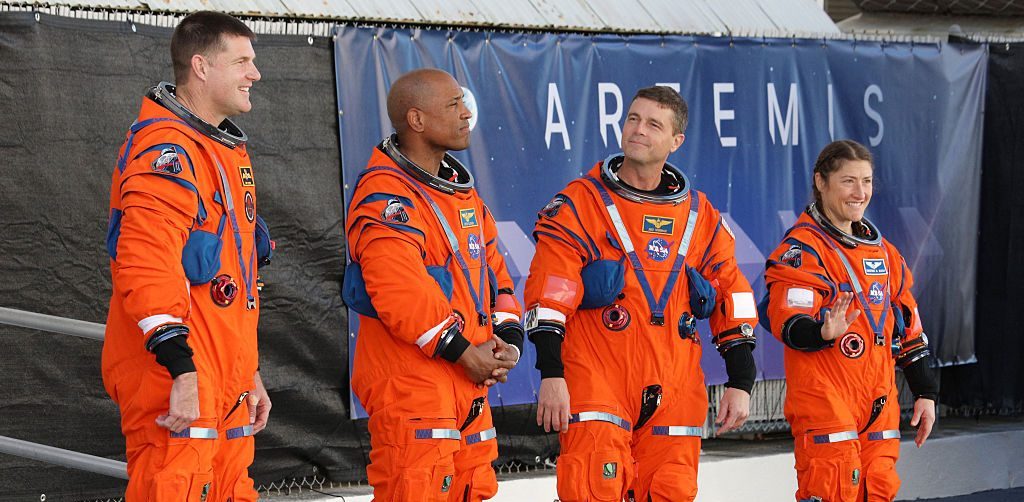
This time, the rocket is not being prepared for cargo or an uncrewed demonstration. It is intended to carry four astronauts on a mission designed to push the limits of human spaceflight beyond low Earth orbit. That context has sharpened scrutiny around a system that has struggled with similar issues before.
At the center of the episode is NASA, an institution under pressure to prove that years of redesigns, delays, and investment have produced a vehicle capable of safely carrying people around the moon. The Artemis program is meant to restore U.S. lunar flight after more than half a century, but recurring technical setbacks have turned progress into a pattern of near-misses rather than clean milestones.
The immediate failure emerged early in Monday’s rehearsal. As engineers began loading more than 700,000 gallons of super-cooled hydrogen and oxygen into the 322-foot rocket, excessive hydrogen accumulated near its base. Fueling had to be paused multiple times as controllers attempted workarounds first developed during earlier countdowns.
NASA later confirmed additional delays tied to close-out procedures and recurring audio dropouts affecting ground crew communications.
None of those issues automatically signal catastrophe. Hydrogen is volatile, complex, and difficult to manage in extreme conditions. But the repetition matters. Similar hydrogen leaks plagued the rocket’s delayed debut years ago, raising the question of how decisively those vulnerabilities were resolved—or whether they were merely contained well enough to proceed.
NASA has emphasized caution in its response. Officials say the delay will allow teams to review data, mitigate each issue, and conduct another full wet dress rehearsal before committing to a launch date. No specific target within March has been identified, underscoring how unresolved the technical picture remains.
The astronauts assigned to the mission have been released from quarantine, with plans to re-enter isolation closer to the next launch window.
What failed here is not a single valve or seal, but the assumption that known vulnerabilities could be managed without compounding. Artemis has only a few viable launch days each month, and February’s window was already shortened by extreme cold. Each scrub compresses schedules further, narrowing the space between careful testing and the pressure to move forward.
For the public, the concern is less about the chemistry of rocket fuel and more about decision-making under constraint.
Artemis is a flagship program, carrying national prestige, international partnerships, and long-term plans for a sustained lunar presence. Delays are expensive, politically visible, and difficult to explain. That environment makes it harder to draw a firm line between acceptable risk and unacceptable exposure.
The implications extend beyond this mission. Artemis is designed as the backbone for future lunar flights, not a one-off experiment.
If foundational systems struggle during rehearsals, it raises concerns about what risks might persist as missions grow longer and more complex. The upcoming flight will not attempt a landing, but it will send astronauts past the moon and back, relying on life-support, navigation, and communications systems that must function flawlessly.
The accountability gap sits between engineering judgment and institutional pressure. NASA does not operate alone; contractors, suppliers, and oversight bodies all influence program decisions.
When problems recur, responsibility diffuses across layers of management, making it difficult to identify who has the authority to declare a pause, mandate a redesign, or reset expectations. No single office is clearly responsible for deciding when recurring technical risk becomes unacceptable.
That ambiguity now drives the central tension around Artemis. Supporters argue that the testing process is doing exactly what it should—surfacing problems before launch. Critics counter that repeating the same failures suggests deeper structural issues that testing alone cannot fix. The question is not whether delays are prudent, but whether the underlying system is converging toward reliability or circling familiar ground.
In the weeks ahead, NASA will face intensified internal and external review as it prepares for another rehearsal. The agency has signaled that procedures will tighten and communication issues will be addressed alongside fuel-system fixes. What remains unclear is whether those steps will restore confidence or simply reset the countdown clock.
For now, the Artemis rocket remains grounded, emblematic of a program caught between ambition and restraint. The fuel leaks have not ended the mission, but they have reopened a fundamental question that shadows every major spaceflight: how much uncertainty is acceptable when human lives and institutional credibility are on the line.
Once public trust in a system’s readiness begins to erode, control becomes harder to reclaim. This delay is not just about timing. It is about whether oversight can keep pace with aspiration before risk turns into consequence.