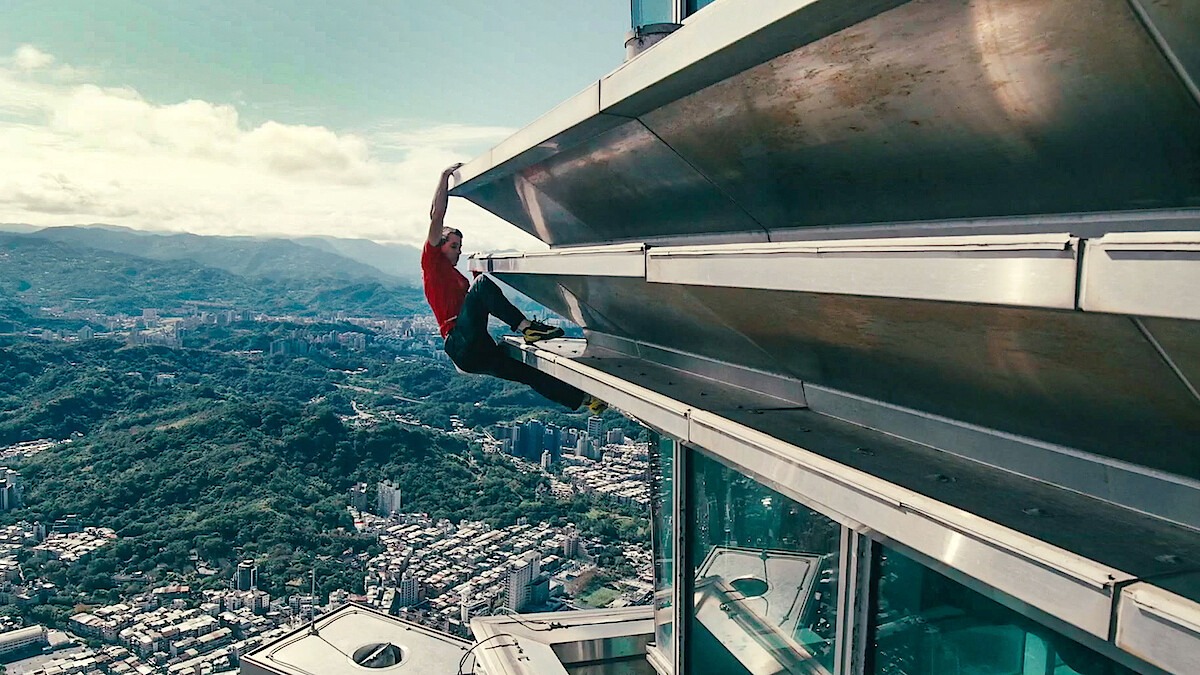
Netflix moved forward with its first major live extreme stunt knowing one thing could not be controlled. On January 25, the platform broadcast Free Solo climber Alex Honnold scaling Taipei 101 without ropes, fully aware that a mistake would unfold in real time, in front of millions. Once the cameras went live, there was no rewind, no edit, and no protection from the outcome.
For viewers, Skyscraper Live was framed as spectacle. For Netflix, it was a test of how much risk a global platform can absorb before control breaks down. The pressure was not about ratings alone, but about what happens when a human life becomes inseparable from a broadcast signal.
Honnold was not treated like a contestant or a performer. He was treated like a single point of failure. Every decision around the production was built on the assumption that something could go wrong and that the world would be watching when it did.
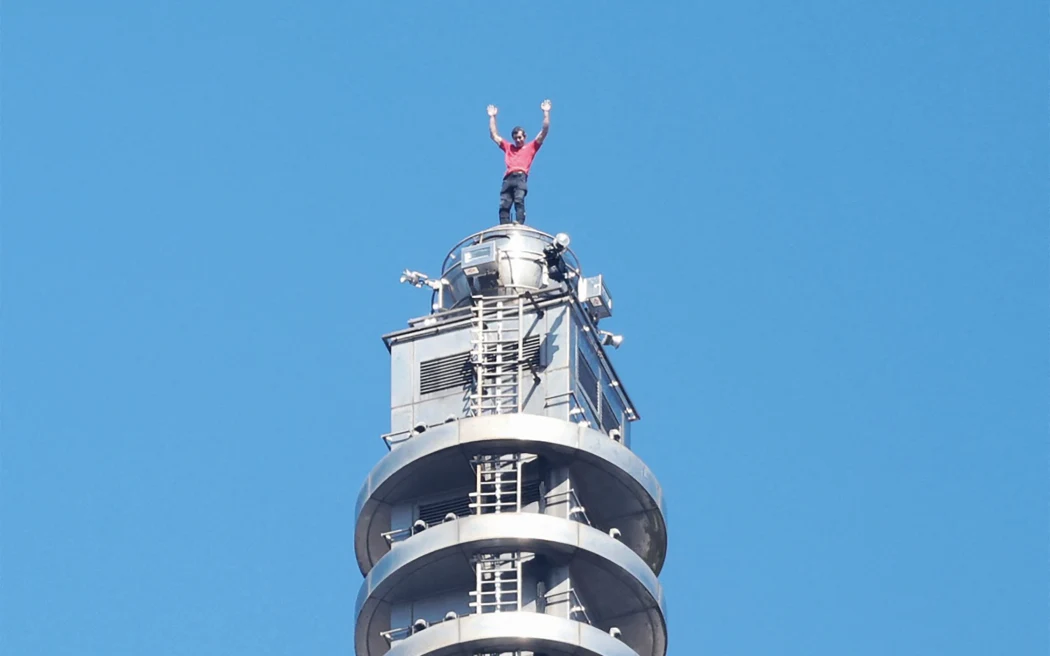
Alex Honnold reaches the top of Taipei 101, celebrating a successful and historic free climb that captivated viewers worldwide.
Inside Netflix’s Worst-Case Planning
Behind the scenes, Netflix had already accepted that success and catastrophe were separated by inches. Executives involved in the broadcast described the event less as sports and more as an endurance experiment, where the tension came from knowing there was no safety net once Honnold left the ground.
The most difficult question was not whether viewers would tune in. It was what the platform would do if he slipped.
Netflix quietly prepared multiple response layers without ever advertising them to the audience. Internal teams mapped out camera cutaways, emergency holds, and broadcast interruption protocols designed to prevent the worst possible moment from being replayed endlessly. None of these plans could stop an accident, but they could shape what the world saw next.
Sources familiar with the production said there were strict instructions about how long cameras could linger if something went wrong. The goal was not to sanitize reality but to avoid turning a potential death into viral footage that would circulate forever. The network understood that once a moment is live, it becomes permanent.
The Human Risk Behind the Numbers
The pressure was compounded by Honnold’s personal life. He is no longer the solitary figure audiences remember from Free Solo. He is a father of two, a detail that changed how Netflix framed the risk internally, even if it was barely mentioned on air.
The live format meant Netflix could not rely on the usual ethical buffer of post production. There would be no chance to debate what to include after the fact. Every second would be a decision made under extreme uncertainty.
Skyscraper Live delivered massive numbers in its first week, drawing more than six million views and hundreds of millions of social impressions. That success came with an unspoken truth. Those numbers only existed because the worst case scenario did not.
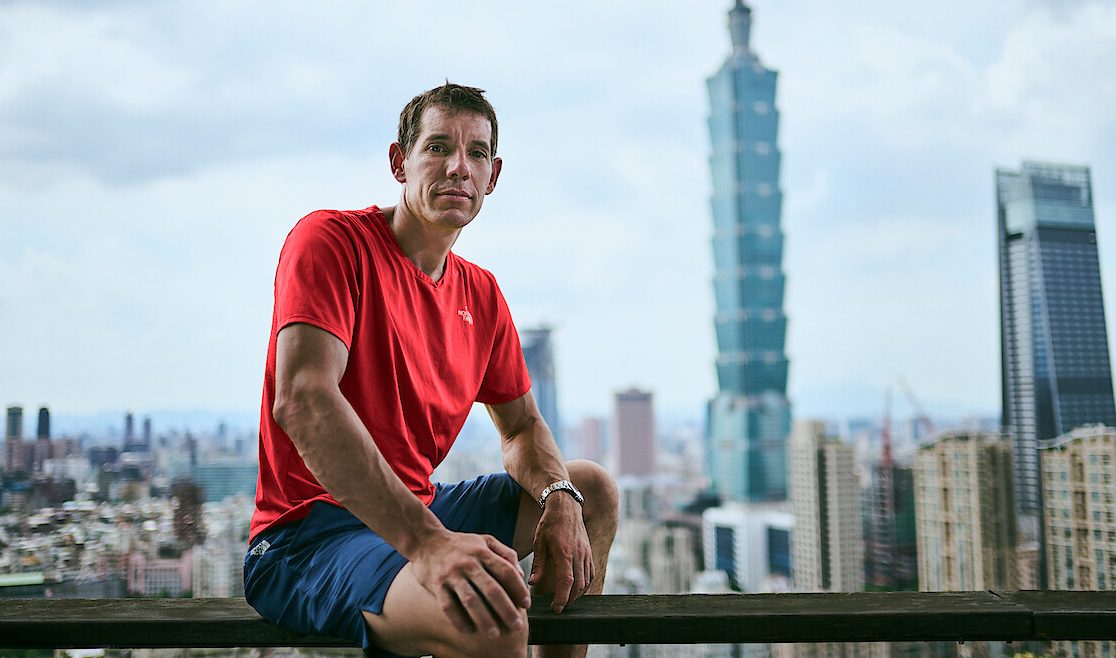
Alex Honnold pauses above the Taipei skyline during a high-rise climb, a setting that reflects the physical exposure behind Netflix’s live event.
When Entertainment Becomes Exposure
Executives later acknowledged that contingency planning extended beyond the broadcast itself. Crisis response teams were prepared for a media backlash, regulatory scrutiny, and internal fallout if the climb ended badly. Legal and communications teams were positioned to act immediately, not days later.
What made the situation uniquely volatile was that Netflix had no direct control over Honnold once he began climbing. This was not a stunt coordinated beat by beat. It was a human body navigating gravity in real time.
The platform’s role shifted from producer to witness. That shift carries consequences few companies are comfortable confronting. Broadcasting risk is one thing. Broadcasting irreversible loss is another.
The Precedent Netflix May Have Set
There is also the question of precedent. Skyscraper Live signaled that Netflix is willing to place itself closer to danger than most traditional networks. Live risk creates attention, but it also erodes the distance between entertainment and liability.
Similar experiments in live programming have historically relied on controlled environments. This one did not. It relied on trust in a climber whose entire career is defined by removing protection.
Some industry insiders see this as a turning point. Live programming is increasingly the battlefield for streaming platforms seeking cultural relevance. Risk, not comfort, is what cuts through a crowded feed.
Others quietly wonder how far this can go before the cost outweighs the reward. At what point does contingency planning become an admission that a line has already been crossed.
For Netflix, Skyscraper Live worked because nothing went wrong. That fact is inseparable from its success. The relief was invisible but deeply felt inside the company.
The unanswered question is what happens next time. Risk escalates when repetition dulls fear. Audiences demand bigger moments, and platforms respond by inching closer to the edge.
When the broadcast ended, Honnold walked away safely. Netflix walked away with numbers, headlines, and a new understanding of how exposed it is willing to be.
The system held this time. But it is now in motion, and the margin for error is permanently smaller.