ICE Near Polling Sites? White House Refusal to Guarantee Sparks Voter Fear
When the White House said it could not guarantee that U.S. Immigration and Customs Enforcement agents would not be near polling places during the 2026 midterm elections, the response was immediate — anxiety, confusion, and a sense that something fundamental about Election Day security had quietly shifted.
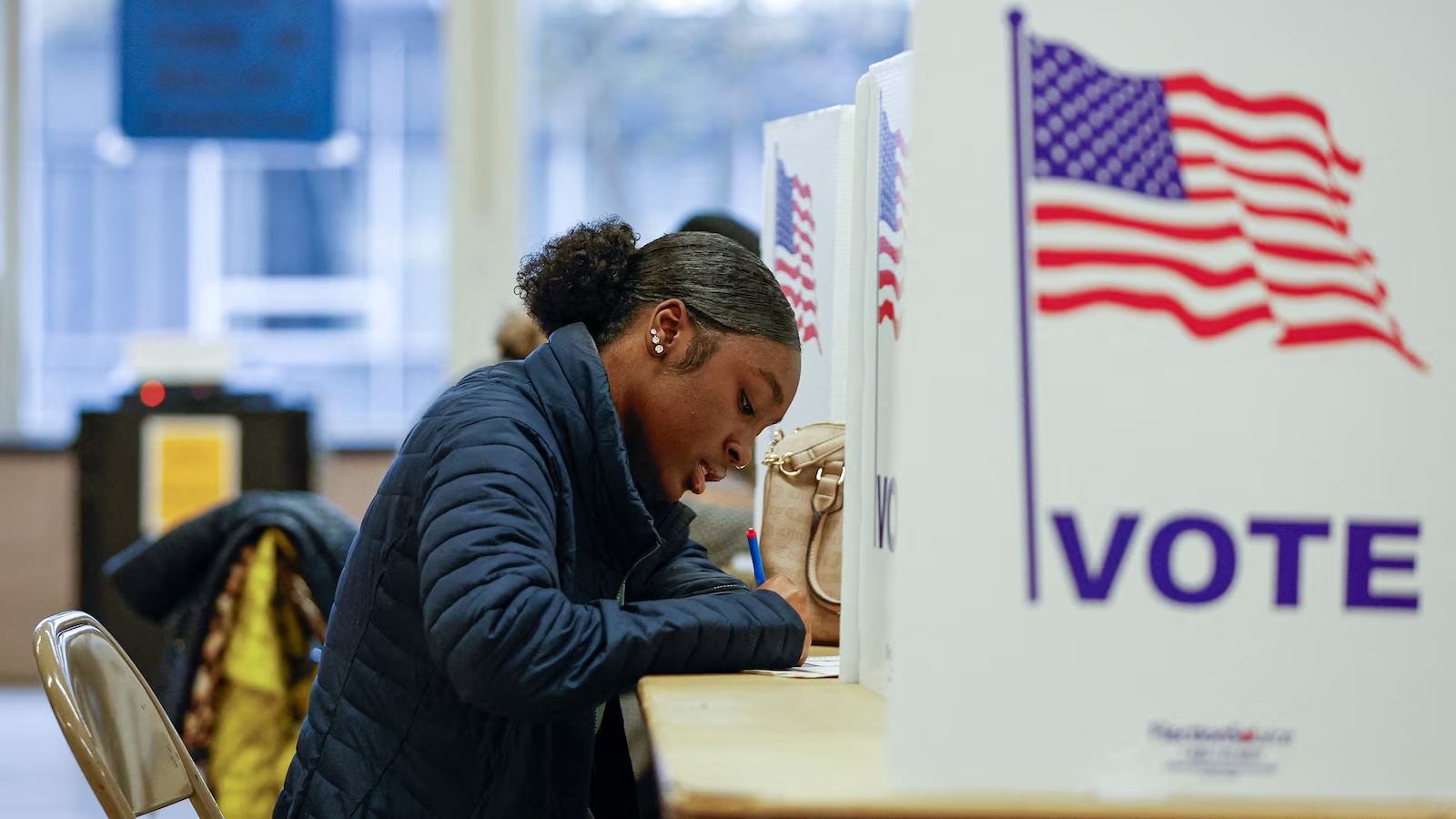
For voters, especially immigrant communities and mixed-status families, the issue was not political strategy. It was fear. Fear that simply showing up to vote could carry consequences the government was unwilling — or unable — to rule out.
Most coverage focused on what was said at the podium. Far less attention was paid to why the refusal to give a guarantee mattered so much — and what it revealed about the limits of control over federal enforcement once Election Day arrives.
What the White House Said — and Why It Didn’t Calm Anyone
At a February briefing, White House press secretary Karoline Leavitt said she was unaware of any “formal plans” by Donald Trump to deploy ICE agents at polling sites. She then declined to guarantee that agents would not be present near voting locations, characterising the scenario as hypothetical while stopping short of ruling it out.
Those statements may sound procedural. To voters, they landed as something else entirely: an admission that the administration could not — or would not — draw a clear line.
“No formal plan” addresses intent at the top. Refusing to give a guarantee acknowledges something more unsettling — that enforcement authority already exists below that level.
Who Actually Controls ICE on Election Day
ICE does not receive election-specific marching orders. It operates within the Department of Homeland Security, where national leadership sets priorities but regional field offices retain day-to-day discretion.
Unless explicitly restricted by policy guidance or court order, that authority does not pause on Election Day. There is no automatic “stand down” tied to voting hours.
That structure is the source of the unease. Even without a White House directive, agents retain lawful authority to operate in public spaces — including areas near polling locations — unless told otherwise.
What the Law Clearly Forbids — and What It Leaves Open
Federal law draws a hard line on one thing: the use of military forces at polling places. That is explicitly barred. Civilian law enforcement agencies like ICE are not covered by that prohibition.
There is no statute that flatly bans ICE agents from being near polling sites. The legal risk emerges only when conduct crosses into voter intimidation, interference, or obstruction.
In other words, presence alone is not automatically illegal. Impact is what matters. And that distinction is exactly what alarms election-protection advocates.
Why “Near a Polling Site” Is Doing So Much Work
Legally, “at the polls” and “near polling places” are not the same. Many polling locations are inside schools, churches, or municipal buildings where law enforcement may already appear for unrelated reasons.
The anxiety spikes when enforcement activity looks visible, targeted, or timed in a way that could discourage turnout — especially among vulnerable communities.
That grey zone is where fear grows. And it is why the lack of a clear federal assurance matters far more than whether a formal deployment plan exists.
What History Tells Us — and Why It’s Not Reassuring Enough
In past elections, federal agencies have largely avoided visible enforcement near polling sites. But that restraint has been driven more by internal norms and political convention than by hard law.
Those norms are not binding. They can change quietly, without legislation, and without warning. Past restraint offers no legal guarantee for future elections.
That fragility is what turned a single unanswered question into a national flashpoint.
What States Can — and Cannot — Do If Agents Appear
States run elections, but they do not command federal agents. If enforcement activity interferes with voting, states can seek emergency court orders or bring civil rights claims. They can enforce state-level anti-intimidation laws.
What they cannot do is order federal agents to leave. Any meaningful restriction typically requires rapid judicial intervention — which is why Election Day enforcement disputes can escalate fast.
What Would Actually Reduce the Fear
Several developments would immediately change the risk calculus: clear guidance from DHS or DOJ restricting enforcement near polling places; court rulings defining boundaries before Election Day; or executive action explicitly limiting federal presence around voting sites.
Absent those steps, uncertainty remains — not because a plan exists, but because authority already does.
The Bottom Line
The White House accurately described the absence of a formal deployment plan. What it did not resolve is the deeper concern: that existing federal enforcement powers remain legally intact as Election Day approaches.
For voters, the fear is not theoretical. It is about whether casting a ballot could carry unintended consequences. Until the boundaries are clarified, that anxiety is likely to grow — not because of what has been announced, but because of what has not been ruled out.