SEC compliance is central to a financial firm's operations, protecting investors and keeping in step with the evolving regulatory landscape.
Here are seven strategies to build SEC resilience and reduce risk.
Establish Robust Policies and Procedures
Effective policies and procedures establish an organisation's compliance expectations in all aspects, including disclosures, recordkeeping, and dealings with clients or others.
They must also clearly delineate the roles and responsibilities of all participants.
Update policies when regulations change, such as regulations for cybersecurity or marketing.
Assign responsibility to individuals within the organisation and obtain signed acknowledgements from employees responsible for each policy.
Incorporate testing techniques, such as departmental walkthroughs, to help identify common issues and show due diligence during review processes.
Actionable SEC Compliance Steps
High up in any compliance program, implementing actionable SEC compliance steps bridges policy with practice.
Consider starting with a complete gap analysis of current practices against key rules, including the Investment Advisers Act and Regulation Best Interest.
Finally, if there are daily checklists like supervising a trade and filing by a deadline, automate the alerts, and train quarterly with simulations so people remember what to do.
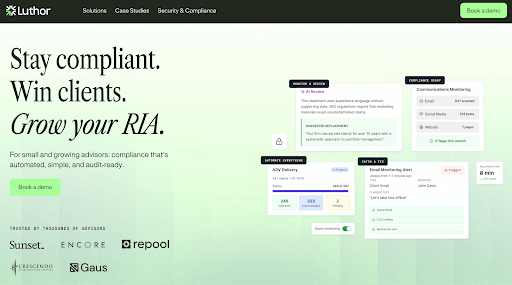
Luthor.ai can help optimise marketing content review processes to ensure they meet standards without overwhelming marketing teams.
Tracking metrics like completion rates and audit scores helps improve the process over time.
Prioritize Cybersecurity and Data Safeguards
Cybersecurity regulations, such as the Regulation S-P, require companies to protect customer data, implement multi-factor authentication, encrypt sensitive data, and develop incident response plans to respond to security breaches quickly.
Conduct vulnerability management through regular assessments and penetration tests while ensuring good vendor management practices by reviewing service agreements and contractual obligations for data processing, and requiring a security certification.
Create formal, board-level reporting on cyber risk and track metrics such as training completion and response drill frequency.
This will build confidence in your defences among clients beyond providing just compliance.
Strengthen AML and Sanctions Programs
For anti-money laundering systems, you should use risk-based programs based on your clients and transaction types, real-time screening against sanctions lists, and alerting systems that flag atypical or suspicious cases for further review.
Controls are audited every year by independent reviewers, with suspicious activity being reported and documented promptly.
Employees are trained to identify red flags such as instances of structuring or high-risk geographies.
AML implementation as a component of onboarding and active monitoring, combined with data analytics to identify high-risk activity, discourages bad actors and meets increased examiner scrutiny for due diligence.
Master Marketing and Advertising Rules
All advertising claims must be substantiated at the level of performance measures and third-party ratings.
Advertisements and other marketing communications must not contain misleading content.
Review websites, proposals, and social media posts.
Require pre-approval of all communications with clients, and recording of gifts, entertainment and testimonials.
Prepare Form ADVs so that they reflect your funds' actual practices, as substantiated by contracts.
Audit cycles catch drifts. Hypotheticals or past performance have clear disclaimers.
Compliant marketing expands markets and protects both sides from enforcement.
Excel in Recordkeeping and Reporting
Books, records, and bookkeeping records (including emails, blotters, and approvals) must be accessible from and retained on centralised systems that offer search and version control.
Create ADV, CRS, and 13F filing calendars with time buffers to accommodate amendments.
Reconcile valuations and fees and investigate exceptions to determine the root cause.
Mock submissions are used to test the integrity of submissions taken.
Prepare Diligently for Examinations
Exams often focus in high risk areas.
Keep your documents (policies, client files, supervision logs) concise.
Create responses for deficiencies and practice interviewing staff to show confidence.
Internally, conduct mock exams to find and quickly rectify issues.
Externally, monitor risk alerts in private funds, broker-dealers, and investment advisers.
Debriefing after testing captures lessons learned for future program updates.
Advanced preparation turns scrutiny into validation opportunities.
Embed Training and Culture
Make compliance everyone's responsibility.
Annual rule and ethics training, in particular, is tailored for specific functions and for hot topics like AI scrutiny or fee transparency.
Anonymous reporting approaches reporting.
Ejusdem generis leadership cascades information.
Training features compliance modules and quizzes, updated for major rule changes.
Metrics are used to integrate compliance into performance reviews; this human element ensures sustainability beyond mere checklists.
Integrating Strategies for Maximum Impact
The methods are linked: strong policies encourage training, and strong cyber defences enable good recordkeeping practices for firms that use them in their daily routines.
Quarterly program reviews report effectiveness and emergent priorities like operational resiliency.
Senior leadership oversight ensures risks are addressed with the necessary resources.
Advanced Tactics for High Performers
Enhancing Supervision and Testing
Supervision logs every action, such as trading a product or allocating assets, and the rationale.
Anomaly detection using automation reduces the need for human oversight.
Leveraging Technology Wisely
Dashboards track metrics such as training progress and exception resolution, while AI governance ensures compliance with the tool's described capabilities.
Board and Leadership Engagement
Frequent updates give decision-makers the resources to challenge risks, with a top-down commitment through the organisation.
Thus, firms that are successful in this respect avoid sanctions and, through repetition, acquire trust and a sustainable advantage over their competitors.