

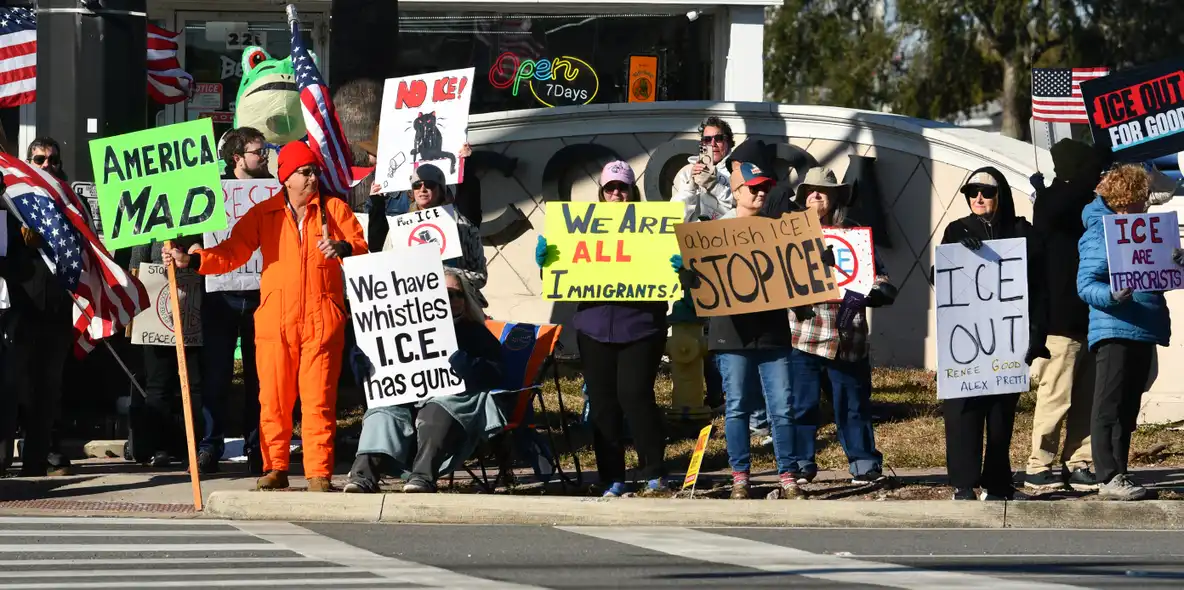
Students in Brevard County, Florida, are already facing disciplinary action for participating in walkouts against Immigration and Customs Enforcement this week.
The school district is enforcing standard attendance and punishment policies even as photos and posts about the protests spread online.
Florida’s education commissioner, Anastasios Kamoutsas, reiterated that students have a right to peaceful expression, but his guidance does not prevent the district from disciplining participants.
Families and students are now caught between conflicting rules, with immediate consequences disrupting daily school life.
Brevard Students Caught Between State Rules and School Discipline
The conflict highlights a clear breakdown between state guidance and district enforcement. The Florida Department of Education emphasized that students have the right to peaceful protest outside school hours, but Brevard administrators prioritized uninterrupted instructional time.
Oversight mechanisms designed to balance student rights with operational needs were not applied, and disciplinary rules were enforced uniformly, leaving students caught between conflicting expectations.
The consequences are immediate and tangible: students face attendance penalties and potential marks on their records, parents are left uncertain about how to advise their children, and educators must enforce rules while navigating constitutional rights.
Communities observing the situation are raising broader concerns about consistency and fairness across Florida schools, questioning whether similar disciplinary actions in other states could occur elsewhere.
Who’s Really Responsible?
Responsibility for the disciplinary actions remains unclear. Commissioner Kamoutsas outlined the legal framework for student expression, but local school boards hold enforcement authority, and Brevard administrators acted decisively even when it conflicted with state guidance.
Students and families are now exposed to immediate consequences without a clear path for recourse, and the lack of alignment between state and district policy undermines trust in both institutions.
The situation also highlights a broader tension between institutional control and individual rights. Should districts prioritize uninterrupted learning even when students exercise constitutionally protected expression, or should civic engagement receive leeway even if it disrupts school operations?
The decentralized authority of Florida’s school system amplifies these questions and raises concerns about whether the fallout could have been avoided with clearer guidance and coordination.
What Happens to Students and Families Now
Brevard administrators have made it clear that walkouts during instructional hours will be disciplined, and the state urges families to guide students on responsible civic participation.
Media coverage and community reactions are already shaping how people view the district, and other schools may face similar conflicts as enforcement decisions draw public scrutiny.
The situation also highlights how fragile trust can become when guidance and enforcement diverge. Once students and families see inconsistency in how rules are applied, restoring confidence is difficult.
The penalties already in effect serve as a tangible reminder that institutional credibility depends on how policies are enforced in practice, not just on what is written in guidance letters.