

What’s happening — in plain English
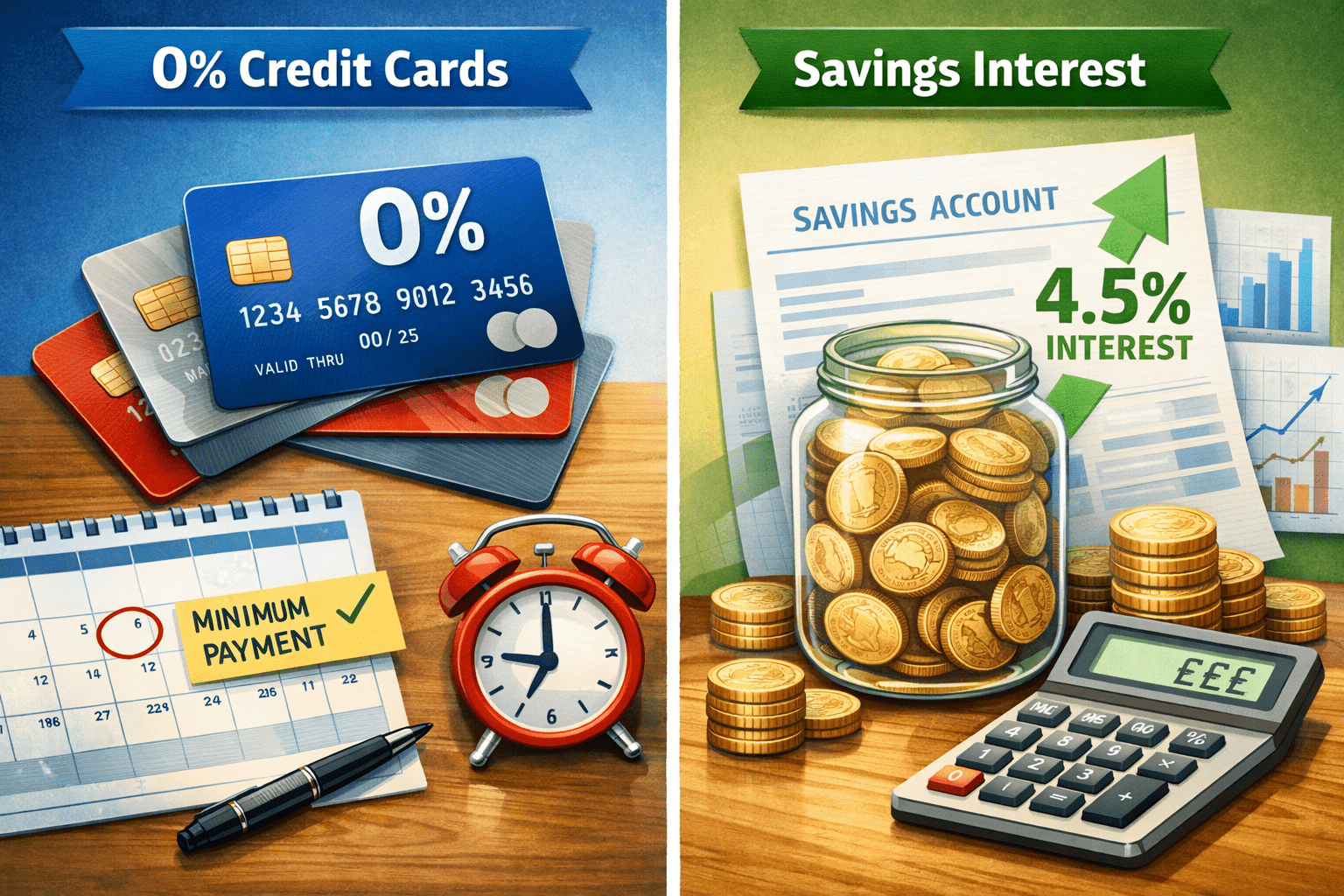
Credit card “stoozing” is back in the spotlight as higher savings rates make 0% credit card deals more attractive. The idea is simple: instead of paying cash for a purchase, people use a 0% credit card, keep the cash in a savings account, and earn interest while repaying the card slowly.
People are paying attention now because the gap between 0% borrowing and positive savings rates has widened. What used to be a marginal tactic has become meaningful for households and small businesses that are organised, cash-buffered, and comfortable managing credit.
Why this matters now for households and small firms
When savings accounts pay little, stoozing barely moves the needle. But with rates materially higher than zero, time itself becomes valuable. Holding cash while deferring repayment can generate hundreds or even thousands of pounds over a year or two, without changing spending patterns on paper.
For business owners and professionals, the appeal is often cash-flow flexibility rather than lifestyle spending. Delaying outflows while keeping liquidity on hand can soften short-term pressure, especially during periods of uneven income or rising costs.
What’s actually driving the upside
The benefit does not come from credit cards themselves. It comes from the interaction between three things: interest-free borrowing, disciplined repayment, and positive returns on idle cash.
If the 0% period holds, minimum payments are met, and the money is genuinely kept aside rather than spent, the maths works. Remove any one of those conditions and the advantage narrows quickly.
Where uncertainty and exposure creep in
The risk is not abstract. Miss a payment, exceed a limit, or fail to clear the balance before the 0% period ends, and the economics flip. Standard credit card interest can erase months of gains in a single statement cycle.
There is also behavioural uncertainty. Several experienced users acknowledge that deferred payment can subtly loosen spending discipline. The strategy relies less on financial sophistication than on administrative accuracy and restraint over long periods.
How this affects credit profiles in practice
Stoozing does not automatically damage a credit score, but it can change how lenders see you. High credit utilisation, even when interest-free, can reduce access to new credit or balance-transfer offers.
For borrowers planning a mortgage or refinancing, timing matters. Lenders assess overall exposure and repayment behaviour, not just whether interest is being charged.
What changes — and what doesn’t
What has changed is the rate environment. That has turned a niche tactic into a mainstream conversation. What has not changed is the structure of credit reporting or card terms.
0% deals remain conditional, temporary, and revocable. They are not a substitute for savings, and they are not free money without careful execution.
How responsibility is typically assessed
Oversight of consumer credit in the UK sits with the Financial Conduct Authority, but responsibility for outcomes remains individual. Credit card providers apply terms mechanically, based on timing, balances, and payments, not intent.
There is no automatic protection for “strategies” that go wrong. Outcomes depend on behaviour, accuracy, and the ability to adapt if conditions change.
Open questions still hanging over stoozing
As rates fluctuate, the margin that makes stoozing worthwhile may shrink again. There is also an open question about how long lenders will continue to offer generous 0% terms if utilisation patterns rise.
For now, stoozing sits in a grey zone between cash-flow management and consumer leverage. It rewards precision, punishes complacency, and remains sensitive to forces outside any individual’s control.