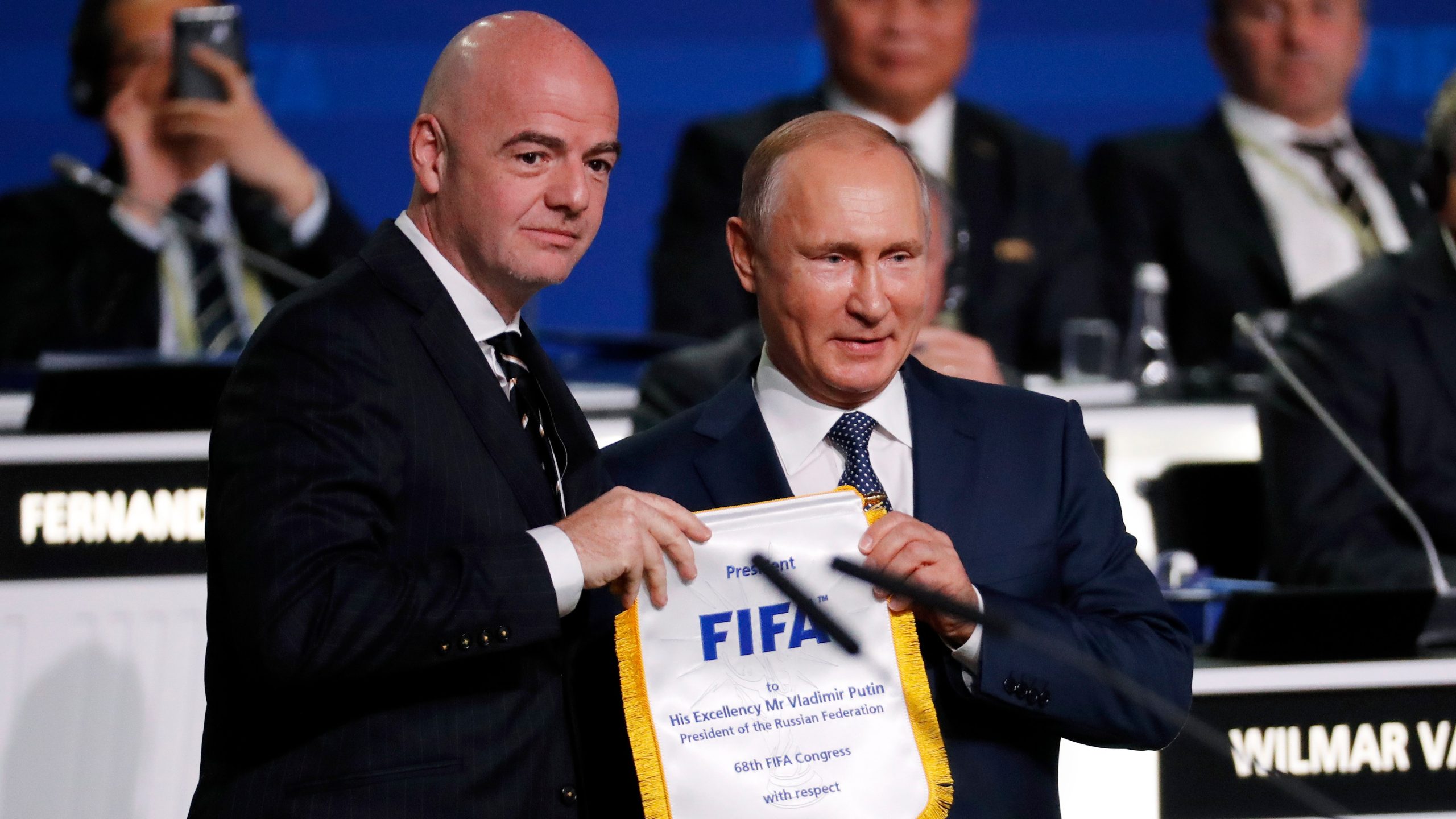
Global football’s system of exclusions shifted this week after Gianni Infantino publicly renewed support for lifting Russia’s ban from international competitions.
The remarks reopened eligibility questions that many federations had treated as settled, reintroducing uncertainty into planning cycles for tournaments, youth events, and cross-border coordination. No rule has changed, but the assumption of continued exclusion no longer holds uniformly.
The immediate disruption sits with governing bodies and national associations that must now plan without clarity on access.
Competition schedules, eligibility frameworks, and administrative preparations are already in motion for upcoming youth tournaments. Infantino’s comments inject friction into systems that rely on fixed participation rules well in advance.
The trigger came during remarks in London, where Infantino said the ban “has achieved nothing” and should at least be reconsidered for youth categories. He framed the issue as an operational and developmental concern rather than a political decision.
While FIFA has not announced a formal policy change, the statement signals a shift at the leadership level ahead of key governance meetings.
Russia has been suspended from FIFA and UEFA competitions since February 2022 following the invasion of Ukraine ordered by Vladimir Putin. The suspension applied across senior and youth competitions and was imposed without a defined end date.
Since then, qualification pathways, tournament formats, and regional competitions have been structured around Russia’s exclusion.
The scale of the system affected is extensive. FIFA oversees 211 member associations, all of which are formally eligible to participate in youth and senior competitions under its statutes.
In December, the FIFA Council approved plans for new under-15 festivals in 2026 and 2027, stating the events would be “open to all” member associations. That language now sits alongside an unresolved suspension, creating administrative ambiguity over eligibility and enforcement.
The issue does not resolve quickly because authority is divided. UEFA controls access to European competitions and has previously resisted easing restrictions. In 2023, it briefly moved to allow Russian under-17 teams to return before reversing course following opposition from member federations.
That reversal highlighted the difficulty of aligning central governance decisions with regional enforcement.
Operational dependencies compound the tension. Youth competitions require visa approvals, travel clearances, security coordination, and host-nation consent.
Even partial reinstatement would demand synchronized action across federations, governments, and organizers. Without unified enforcement, eligibility decisions risk remaining theoretical rather than operational.
Observed responses remain cautious. UEFA leadership has reiterated that Russia’s return is tied to the end of the war, while FIFA continues to plan events using inclusive membership language.
National federations are left adjusting schedules and eligibility frameworks without confirmation of which rules will ultimately apply. The result is a holding pattern rather than resolution.
The unresolved tension is structural: whether inclusion language adopted at the global level can coexist with enforcement authority held by regional bodies and national associations.
If pressure to ease restrictions continues, youth competitions are likely to become the first testing ground, forcing rapid coordination. If resistance holds, the suspension framework remains, but with growing uncertainty around events already announced as open.
In either case, access and enforcement remain unsettled rather than conclusively decided.