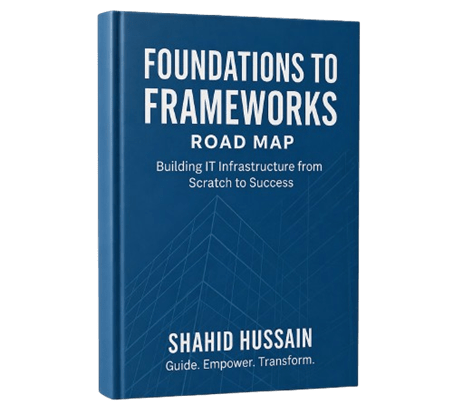
In the dynamic modern business world, IT is not simply a support function. It's a critical enabler of business success, stability, and growth. Shahid Hussain's framework, Foundations to Frameworks Road Map: Building IT Infrastructure from Scratch to Success, published in 2024, delves into how businesses can leverage IT as a strategic weapon by building resilient infrastructure, security, and governance frameworks.
Published in 2024, the framework tackles key issues confronting IT managers. Whether it's the complexities of infrastructure management, securing digital assets, ensuring business continuity, or anticipating the challenges of the future, Hussain offers practical guidance for establishing scalable, resilient, and secure IT frameworks. It is a much-needed and timely guide for business leaders, IT practitioners, and decision-makers in various sectors
A Strategic Perspective on IT Leadership
The underlying key message of Hussain’s framework is the need for enterprise IT to move from being a support function to becoming a strategic enabler of business growth. The framework emphasizes that IT infrastructure should be designed to thrive in a state of constant change, not just to “run,” with a focus on scalability, security, and resilience. By focusing on these areas, organizations can create IT systems that not only support today’s operations but also set them up for long-term success in an ever-changing digital landscape.
The unique aspect of this framework is the simple step-by-step process of building a strong IT foundation. Hussain takes readers on a journey from understanding core IT principles to mastering advanced frameworks and architectures. If you are an IT professional or business leader, this roadmap offers practical strategies to transform how IT functions as the backbone of organizational success.
Navigating the Challenges of Security and Business Continuity
Security is no longer optional; it is essential in an age where cyber threats are ubiquitous. One of the framework's major themes is the importance of building security into every level of an IT system rather than as a bolt-on. “Resilient infrastructure starts with strong security frameworks, which are the bedrock of business continuity,” Hussain argues.
Disaster recovery and business continuity planning are also stressed by Hussain. He stresses the need for organizations to be ready for the unexpected, including having secure backup systems and failover strategies in place. This framework gives a peek into how to design systems that can survive disruption and keep running without much downtime. For businesses that can’t afford an operational disruption, like healthcare, manufacturing, or finance, this guidance is invaluable.
A Roadmap to Scalable and Resilient IT Systems
This framework is particularly helpful for IT leaders who are interested in scaling their systems well. Hussain details how companies can create IT architectures that grow with their needs while also maintaining security and performance. The emphasis on scalability is significant since organizations have to ensure that their IT systems can manage increasing workloads, new technological breakthroughs, and the rising demands of contemporary business operations.
Hussain's approach to scalability has a significant strength in his integration of governance and security. He offers readers a roadmap to ensure they do not lose sight of security, compliance, and performance when it comes to scaling. He references ITIL, COBIT, and ISO standards and gives practical tips on how to integrate these standards into IT practices. As a result, this framework is indispensable for enterprises seeking to improve IT performance and security while scaling.
Impact on the Industry and Future-Proofing IT
The Foundations to Frameworks Road Map is more than just a practical tool. With the ongoing digital transformation of all industries and the adoption of innovative technologies, like artificial intelligence and automation, it is crucial to develop an IT infrastructure that is flexible and future-ready. Hussain's research offers a model for future-proofing IT systems to meet new challenges while being adaptable to future needs.
This proactive approach is crucial in a rapidly evolving technological landscape. Hussain talks about how businesses can avoid systems becoming obsolete by embracing a culture of constant improvement and adaptation. This not only helps IT but also the business as a whole by ensuring sustainability and growth opportunities.
The Broader Impact on Society
Hussain's framework has ramifications beyond the business world. In our digital economy, the resilience and security of IT systems are vital in safeguarding individuals' data, enabling essential services, and ensuring business continuity. Hussain's efforts to improve IT infrastructure in organizations help ensure a more robust and resilient IT industry and economy.
By incorporating lessons from the Foundations to Frameworks Road Map, companies will not only enhance their own practices but also help create a more secure and stable digital environment. This, in turn, benefits the community as a whole by safeguarding individuals' data, ensuring services are accessible, and businesses can work with confidence, even in the face of adversity.
A Must-Read for IT and Business Leaders Alike
In an increasingly competitive environment where businesses must upgrade their IT systems while tackling security and business resilience, Shahid Hussain's framework offers the insights and tools to overcome these challenges. Through the combination of practical guidance, best practices, and a visionary outlook, the Foundations to Frameworks Road Map is an essential read for IT professionals and business leaders seeking to turn their organizations into more agile, flexible, and secure operations.
For those seeking to grasp how to use IT to their advantage, this framework is essential. It enables them to harness their IT infrastructure as a business-critical resource to thrive in the digital economy.