

Jim Carrey was already one of Hollywood’s most bankable stars when he signed on to play the Grinch, yet the role almost ended his involvement after a single day. The revelation has resurfaced as renewed interest surrounds Carrey’s career, his legacy performances, and behind-the-scenes stories that continue to captivate audiences decades later.
Long before commanding record-breaking salaries, Carrey’s life was defined by financial instability. Raised in Ontario by a factory worker father who later became a janitor, Carrey experienced homelessness as a teenager after his father lost his job. The family survived by cleaning offices at night, a period that left a lasting psychological imprint. That early exposure to insecurity shaped his relationship with money, work, and fear, even after fame arrived.
By the mid 1990s, Jim Carrey’s rise was historic. He earned $350,000 for Ace Ventura Pet Detective before his fees surged to $7 million for Dumb and Dumber. In 1996, he became the first actor to secure a $20 million upfront salary for a single film, setting a new industry benchmark. By the time How the Grinch Stole Christmas entered production, Carrey had already earned roughly $80 million, the equivalent of more than $150 million today.
Yet financial success did not prepare him for what awaited inside the Grinch costume.
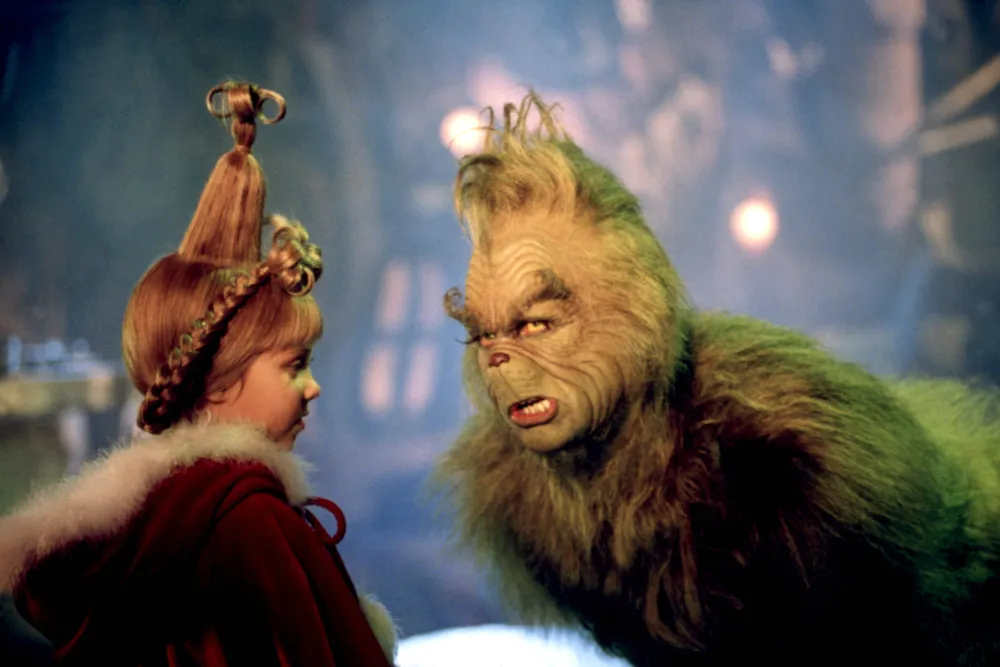
The Grinch’s tender exchange with Cindy Lou Who — a scene that helped turn the film into a Christmas goldmine and cemented the role that earned Jim Carrey a massive salary and ongoing residual payouts every holiday season.
Inside the Role That Pushed Jim Carrey to Breaking Point
Playing the Grinch required an extreme physical transformation that went far beyond standard movie makeup. Carrey spent up to eight hours each day encased in prosthetics, including a tightly sealed facial mask that restricted breathing and forced him to mouth-breathe. His full body suit was covered in coarse yak hair that caused relentless itching throughout filming.
Oversized prosthetic teeth altered his speech, elongated finger extensions limited movement, and full-eye contact lenses created tunnel vision. The cumulative effect triggered severe anxiety. Director Ron Howard later recalled finding Carrey lying on the floor between takes, struggling to control panic attacks brought on by claustrophobia and sensory overload.
After just one day of filming, Carrey told producers he could not continue. He even offered to return his entire $20 million salary, a move that stunned the production team. The offer was not a negotiating tactic, but a genuine attempt to escape an experience that had become psychologically overwhelming.
With the film entirely built around Carrey’s performance, the studio faced an existential crisis. Recasting was impossible and shutting down production would have resulted in enormous financial losses. The solution was highly unconventional. The filmmakers hired a specialist trained in helping military and intelligence personnel endure extreme confinement and stress.
Through coping techniques designed to interrupt panic responses, Carrey gradually adapted. The makeup process was shortened, anxiety management strategies were implemented, and filming continued. The result was a film that became the highest-grossing domestic release of 2000 and a permanent fixture in holiday television schedules worldwide.
The story remains one of the most striking examples of how even the biggest Hollywood paydays cannot shield performers from the psychological toll of demanding roles.

A close-up of the Grinch in his Santa hat — the iconic look that powered a global box-office hit and secured Jim Carrey one of the most profitable roles of his entire career.
What People Are Searching About Jim Carrey and The Grinch
Did Jim Carrey really offer to give back his $20 million Grinch salary
Yes, according to director Ron Howard and multiple cast accounts, Jim Carrey genuinely offered to return his $20 million salary after one day. The physical and psychological strain of the Grinch costume triggered severe anxiety, making the role feel unbearable despite the historic paycheck.
Why was the Grinch makeup so difficult for Jim Carrey
The Grinch makeup involved restrictive prosthetics, forced mouth breathing, painful contact lenses, and a full body suit made from yak hair. The combined sensory overload created claustrophobia and panic, requiring professional intervention to help Carrey complete the film.
How did the Grinch impact Jim Carrey’s career
The film reinforced Jim Carrey’s status as a global box office draw and expanded his appeal to family audiences. Despite the difficult production, it became one of his most enduring roles, generating ongoing revenue and cementing his place in holiday movie history.
Jim Carrey’s near-exit from The Grinch remains a powerful reminder that behind Hollywood’s biggest performances are often unseen battles. The story continues to resonate because it reveals the human cost behind one of cinema’s most beloved holiday classics.