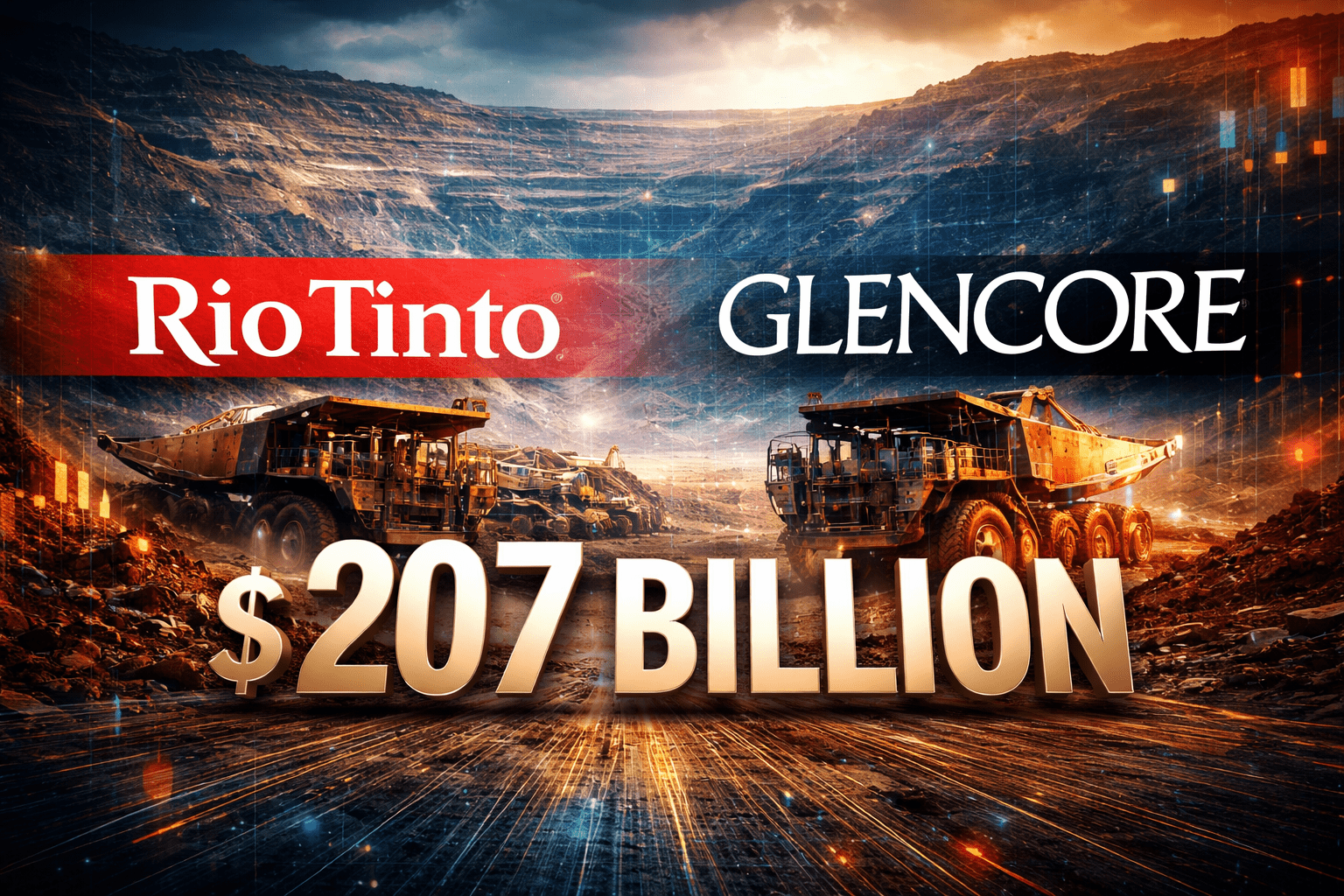
Asset scarcity in the global copper market is no longer a theoretical future risk — it is now dictating aggressive capital allocation decisions at the very top of the mining sector. Exponential demand growth from AI infrastructure, hyperscale data centers, and electrification has transformed copper from an industrial input into a strategic financial weapon. Against this backdrop, Rio Tinto’s preliminary move toward acquiring Glencore in an all-share transaction — creating a combined entity valued at approximately $207 billion — represents far more than a conventional mega-merger. It signals a structural shift in how liquidity, risk, and control are priced across global commodity markets.
Rio Tinto’s current market capitalization of roughly $142 billion already reflects premium valuation support from iron ore stability, disciplined capital management, and long-standing dividend credibility. An all-share bid that forces a significant premium for Glencore’s base-metal portfolio introduces immediate dilution risk — particularly if the acquisition embeds Glencore’s volatile marketing arm and carbon-heavy legacy assets onto Rio’s traditionally conservative balance sheet. Public market skepticism has been swift and decisive, with Rio Tinto’s Australian-listed shares falling more than six percent in the days following confirmation of preliminary discussions.
Institutional investors are not questioning copper’s long-term demand trajectory. They are questioning execution risk. The concern is that Rio Tinto may overpay for complexity at precisely the moment when operational simplicity and capital discipline are most rewarded. Integrating Glencore’s opaque trading operations, navigating forced ESG divestitures, and clearing antitrust barriers across China, Europe, and the UK introduces friction that directly undermines the premise of liquidity neutrality in mining M&A.
Capital Recovery Risk in a $207 Billion Mining Merger
Negotiating a combined valuation north of $200 billion requires near-perfect assumptions around synergy realization, cost rationalization, and asset optimization. History suggests those assumptions rarely survive commodity downturns. While Rio Tinto offers iron ore cash-flow stability, Glencore brings a trading-driven earnings profile that amplifies volatility rather than dampens it. S&P Global has repeatedly warned that mergers combining asset-heavy extraction businesses with opportunistic marketing divisions often experience delayed capital recovery, particularly when price cycles reverse.
Institutional lenders and long-only equity holders are acutely aware that mining mega-mergers tend to occur near cycle peaks. Atlas Funds Management notes that shareholder dilution is frequently justified using aggressive long-term demand forecasts while underestimating integration costs and balance-sheet strain. In this case, copper demand projections — often cited as rising 50% by 2040 — are being used to rationalize near-term valuation premiums that must be serviced immediately.
Goldman Sachs analysts have already flagged that administrative synergies alone will not justify the premium implied in current market discussions. Without rapid and decisive portfolio purification, the risk is that capital recovery stretches well beyond investor tolerance windows — particularly for funds with strict mandate horizons.
ESG Divestment Pressure and Legacy Coal Exposure
Statutory and regulatory risks surrounding Glencore’s thermal coal assets represent one of the most immediate threats to deal viability. Australian and European institutional investors have made it clear that continued exposure to high-emission coal operations is incompatible with their long-term mandates. Funds such as AustralianSuper, Norges Bank, and major European pension schemes cannot hold equity that violates their ESG frameworks — regardless of copper upside.
Any delay in divesting Glencore’s coal portfolio risks triggering forced selling, index exclusion, and a permanent valuation discount on the combined entity. S&P Global and RBC Capital Markets both anticipate that thermal coal divestiture would be a de facto condition for regulatory and institutional approval. However, executing asset sales under time pressure typically compresses realized value, further complicating capital recovery math.
The irony is stark: a merger pitched as a strategic pivot toward future-facing metals immediately absorbs some of the most carbon-intensive assets in the global mining system. Without surgical execution, ESG compliance could become the transaction’s defining bottleneck.
Antitrust Risk and China’s Regulatory Chokepoint
The most formidable regulatory obstacle sits in Beijing. China’s State Administration for Market Regulation (SAMR) has historically resisted mergers that consolidate unilateral pricing power over strategically essential materials. Copper, cobalt, and nickel — all critical to China’s industrial and technological ambitions — sit squarely in that category.
A Rio-Glencore combination would command unprecedented influence over global base-metal supply chains. RBC Capital Markets has cautioned that SAMR approval would almost certainly require forced divestitures of high-margin copper assets, potentially stripping away the very growth drivers used to justify the deal. Any such divestment under regulatory duress would dilute long-term earnings power while leaving integration risk intact.
Complicating matters further is Chinalco’s 11.2% stake in Rio Tinto. While this shareholding provides a diplomatic bridge, it also heightens scrutiny. Beijing will not approve a transaction that undermines domestic supply security, regardless of shareholder alignment.
Liquidity Lock-Up Risk Under UK Takeover Rules
Beyond asset and regulatory risk lies a less visible but equally damaging issue: liquidity velocity. Under UK Takeover Panel rules, capital deployed in an all-share transaction of this magnitude becomes effectively immobilized during the regulatory review period. JPMorgan estimates that liquidity velocity across the mining sector could stall for up to twelve months as counterparties wait for deal clarity.
For corporate treasurers, this lock-up environment constrains optionality. Capital that might otherwise be deployed into high-return internal projects remains trapped in low-yield accounts or escrow structures. The opportunity cost is material, particularly during a period of elevated inflation and rising cost of capital.
Trading Book Complexity and Cultural Collision
Glencore’s marketing and trading division introduces a fundamentally different risk profile from Rio Tinto’s operationally driven model. LSEG data highlights that commodity trading requires significant working capital buffers to manage margin calls, exchange collateral, and price volatility. Rio Tinto has historically avoided this exposure by design.
The cultural integration challenge is non-trivial. Glencore’s high-velocity trading DNA contrasts sharply with Rio’s engineering-centric, safety-first ethos. Talent flight from key trading hubs such as Zug or London could materially impair realized pricing outcomes, particularly during volatile commodity cycles. Fitch Ratings has already warned that opaque trading structures could trigger negative credit-rating scrutiny post-merger.
Strategic Outcome Matrix: The 2026 Mining Reallocation
Legacy Funding Model: Tier-1 iron ore dominance delivered predictable cash flows and stable dividends for decades.
Strategic Trigger: AI-driven infrastructure expansion accelerates demand for copper, nickel, and grid-critical metals.
2026 Institutional Reality: ESG-mandated decoupling from thermal coal complicates balance-sheet integration while investor skepticism toward mega-mergers compresses valuation multiples.
Low-leverage growth strategies that once preserved pristine credit ratings now collide with dilution risk from massive equity issuance. Conservative operating models are being forced into geopolitical arbitrage as miners seek security through scale amid global trade fragmentation.
Structural CapEx, Integration Costs, and Reporting Burden
Rio Tinto’s existing capital commitments at projects such as Oyu Tolgoi and Simandou already strain forward free cash flow assumptions. Inflationary pressures on deep-tier mining operations continue to escalate, raising long-term maintenance and sustaining capital requirements. Jefferies analysts have cautioned that integration CapEx is frequently underestimated in transactions of this scale.
Compliance complexity will also increase materially. Dual reporting obligations across the LME, HKEX, LSE, and ASX introduce transparency risk at a time when institutional trust is paramount. Fitch Ratings has signaled that any opacity surrounding Glencore’s marketing earnings could prompt rating-outlook revisions.
Margin Exposure, Covenants, and Market Volatility
A combined trading and mining entity of this scale must satisfy margin requirements across multiple global exchanges simultaneously. JPMorgan warns that the sheer size of the consolidated trading book could attract aggressive short-selling strategies, amplifying volatility during periods of price stress. Covenant integrity becomes critical when margin calls coincide with regulatory capital constraints.
Simon Trott’s stated ambition of creating a leaner, faster Rio Tinto collides with the structural reality that adding $65 billion of complex assets rarely simplifies an organization. S&P Global notes that environmental liabilities alone could reach record levels if coal divestments are delayed.
Strategic Irony: Scale as a Source of Fragility
The central irony of the proposed consolidation is that a merger intended to create agility may instead entrench rigidity. Investors such as Wilson Asset Management, Allan Gray, and Argo Investments have consistently argued for simplicity, transparency, and capital discipline. This transaction introduces unprecedented jurisdictional exposure, operational opacity, and regulatory dependency at precisely the moment when mining liquidity is becoming politicized.
C-Suite Strategy: How Rio Tinto Avoids a Valuation Trap
To preserve long-term shareholder value, execution must be immediate and uncompromising across three non-negotiable pillars. Incrementalism will not be rewarded by markets confronting a once-in-a-generation consolidation at the top of the global mining hierarchy.
Portfolio Purification:
Thermal coal assets must be spun off or trade-sold rapidly to preserve ESG eligibility across global pension funds, sovereign wealth vehicles, and passive index mandates. Retaining these assets — even temporarily — risks permanent multiple compression as ESG-restricted capital exits the register. For a company positioning itself as a cornerstone supplier to the energy transition and AI-driven infrastructure build-out, carbon-heavy legacy exposure undermines strategic credibility at precisely the wrong moment.
Antitrust Navigation:
Early and continuous engagement with China’s State Administration for Market Regulation (SAMR) is essential. Management must assume that forced divestitures will be a condition of approval and proactively model multiple asset-sale scenarios before regulators dictate the terms. Given Chinalco’s 11.2% stake in Rio Tinto, the board must balance diplomatic leverage against heightened scrutiny. Transparency around potential revenue dilution will be critical to maintaining investor trust through a prolonged approval cycle.
Cultural Containment:
The greatest long-term IRR risk lies not in commodity prices, but in organizational friction. Rio Tinto’s asset-heavy engineering culture and Glencore’s high-velocity trading DNA operate on fundamentally different incentive systems. Establishing an autonomous marketing and trading hub in Zug preserves Glencore’s margin-capture capability while insulating Rio’s operational discipline from excessive balance-sheet volatility. Integration without containment would almost certainly destroy value.
Institutional Power Brokers and Voting Dynamics
The final outcome of this transaction will be shaped by a concentrated group of capital holders whose voting power, regulatory influence, and mandate constraints leave little room for strategic miscalculation.
-
Aluminum Corporation of China (Chinalco): Rio Tinto’s largest shareholder at 11.2%, with outsized influence over regulatory sentiment in Beijing.
-
Ivan Glasenberg: Former Glencore CEO, retaining approximately 10% ownership and representing private-wealth and legacy shareholder interests.
-
BlackRock and Vanguard: Together holding nearly 13% of Rio Tinto, focused on dividend stability, carbon alignment, and governance clarity.
-
Qatar Holding: An 8.5% Glencore stakeholder with a long-term interest in commodities marketing and liquidity stability.
-
JPMorgan and Goldman Sachs: Lead advisers managing an estimated $11 billion in transition liquidity across equity issuance, working capital, and regulatory escrow.
-
Wilson Asset Management and Allan Gray: Vocal minority shareholders in Australia and the UK, guarding aggressively against acquisition overpayment and cycle-peak dilution.
Key Takeaways for Institutional Investors
-
Copper scarcity has transformed mining liquidity from a neutral input into a strategic constraint.
-
ESG divestment pressure is immediate, binary, and unavoidable.
-
Antitrust risk in China represents the single largest threat to deal completion.
-
Trading-book complexity undermines balance-sheet predictability during volatile cycles.
-
Execution speed — not deal size — will determine whether scale creates resilience or fragility.
The Biggest Questions About The Rio Tinto–Glencore Merger
Will Rio Tinto buy Glencore in 2026?
Preliminary discussions were confirmed in January 2026, with a firm-offer deadline expected in early February under UK Takeover Panel rules. Completion remains contingent on regulatory approvals, particularly in China and Europe.
Why are Rio Tinto shares falling?
Shares declined following the announcement due to concerns over dilution from an all-share structure, ESG exposure linked to Glencore’s coal assets, and the complexity of integrating a global trading operation.
What happens to Glencore’s coal assets?
Most analysts expect mandatory divestiture or spin-off to satisfy ESG-mandated institutional investors and avoid long-term valuation penalties.
Is copper demand driving this merger?
Yes. AI data centers, electrification, and energy-transition infrastructure are projected to drive a roughly 50% increase in global copper demand by 2040, making Tier-1 copper assets strategically scarce.
How big would the combined company be?
The merged entity would carry an estimated market value of approximately $207 billion, surpassing BHP to become the world’s largest diversified mining company.
Final Assessment: Liquidity Is No Longer Passive
The proposed Rio Tinto–Glencore consolidation marks a structural inflection point for the global mining sector. What was once a capital-intensive but operationally predictable industry has entered a phase where liquidity itself carries embedded geopolitical, regulatory, and ESG risk. Scale is no longer a defensive attribute by default; it is a multiplier of execution error.
For Rio Tinto, the transaction is not a question of strategic ambition but of strategic discipline. The pursuit of copper dominance in an AI-driven global economy is rational. Absorbing carbon exposure, trading complexity, and jurisdictional friction in a single stroke is not. Markets have already signaled that this distinction matters, and they will continue to price the gap between intent and execution relentlessly.
If executed with speed, transparency, and ruthless portfolio clarity, the deal could redefine the upper boundary of mining resilience for the next two decades. If delayed, diluted, or compromised by regulatory concessions and cultural misalignment, it risks becoming a case study in how scale transforms from advantage to liability.
The era of mining liquidity as a neutral asset has ended. Capital is now conditional, politicized, and unforgiving. In this environment, the winners will not be the largest consolidators — but the operators that understand that control, not size, is the ultimate source of value.
Financial Insight: 👉M&A 2026: Navigating the $4.8T Capability Tax and Acquisition Risk👈
High-Intent SEO Tags: #MiningConsolidation2026 #RioTintoGlencoreMerger #CopperSupplyDeficit #SimonTrottStrategy #GlobalMiningM&A #ChinalcoStakeholders #ResourceSecuritization