

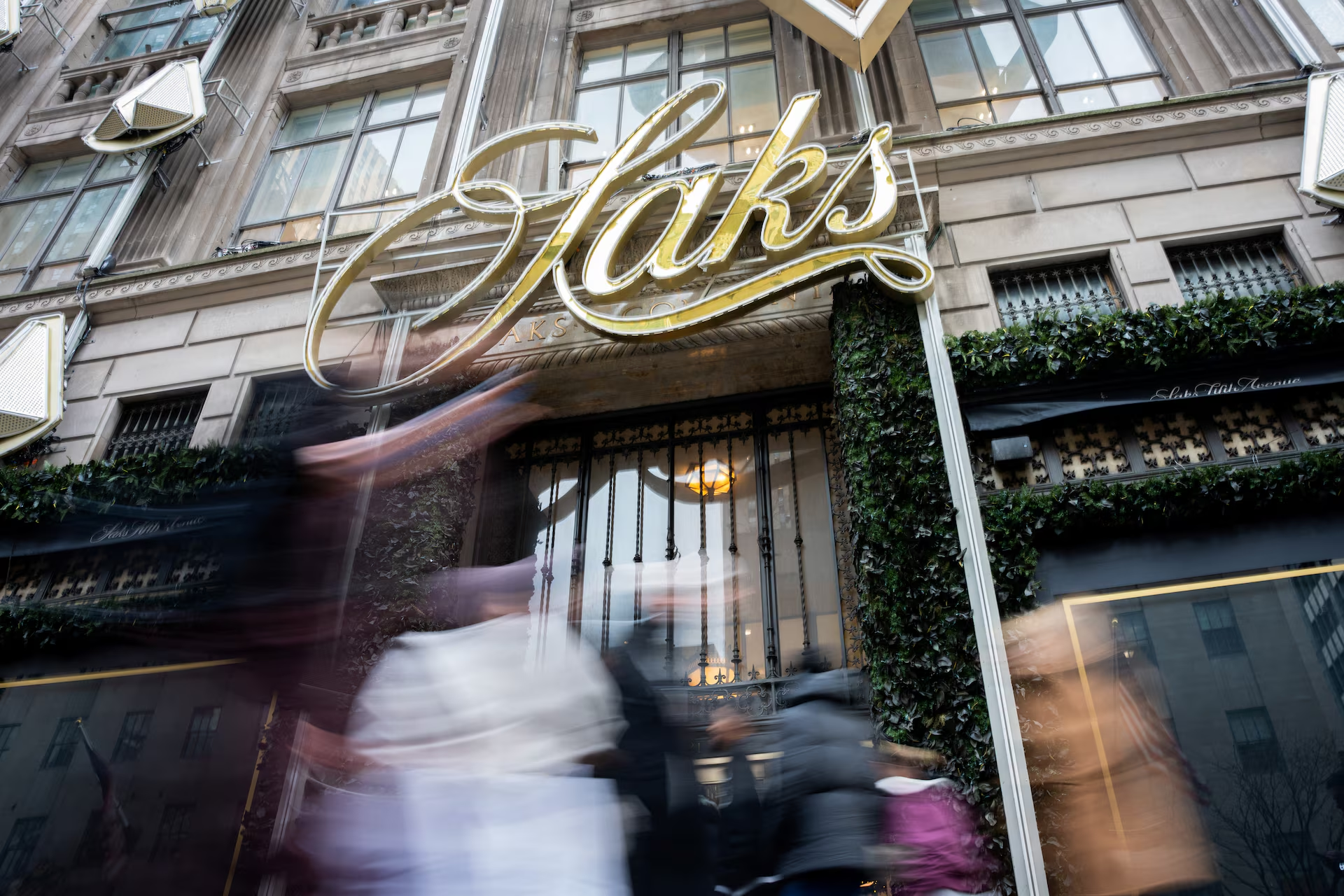
Saks Global entered Chapter 11 bankruptcy protection in January 2026 under the U.S. Bankruptcy Code (11 U.S.C. §§1101–1174) after missing a $100 million interest payment tied to $2.2 billion in merger-related debt. The filing followed the 2024 Neiman Marcus acquisition and reflects liquidity failure, vendor credit withdrawal, and unsustainable leverage in a high-interest-rate environment.
Saks Global’s $2.2bn Debt Load
The collapse of Saks Global did not arrive as a sudden shock to capital markets. It arrived on schedule.
When the company missed a $100 million interest payment in late December, the default merely formalized a breakdown that had been quietly unfolding for more than two years. What followed — a Chapter 11 filing exposing $2.2 billion in merger-related liabilities — represents one of the clearest modern examples of how high-leverage retail consolidation fails in a rising-rate environment.
At the center of the crisis lies the $2.7 billion acquisition of Neiman Marcus in 2024, a transaction pitched as a transformational luxury platform but structured atop fragile balance sheets, optimistic synergy assumptions, and an unforgiving interest-rate backdrop. Management bet that cost rationalization and scale efficiencies would outrun debt service. Instead, liquidity velocity collapsed, vendor confidence evaporated, and operational cash flow proved insufficient to sustain the capital structure.
This bankruptcy is not simply about poor execution. It is a case study in strategic illiquidity — where leverage itself becomes the binding constraint, long before insolvency appears on paper.
Debt Service Overhang and the Collapse of the Consolidation Thesis
Debt service obligations at Saks Global ultimately outpaced operational cash flow, exposing a fatal flaw in the consolidation strategy. The Chapter 11 filing confirms what creditors had already priced in: the business could not support the leverage required to justify the Neiman Marcus acquisition.
Liquidity velocity deteriorated rapidly following the 2024 merger. Management forecasted aggressive cost-cutting synergies — primarily in back-office functions, logistics, and procurement — to offset the additional debt burden. Those savings failed to materialize at the scale or speed required. As interest rates remained elevated, the margin for error disappeared.
The result was a catastrophic interest default. The missed $100 million payment triggered cross-defaults across the capital structure, collapsing lender confidence and forcing a rushed restructuring under court supervision.
This was not a demand shock. It was a financing failure.
Leadership Volatility and Capital Market Signaling Failure
Capital markets responded predictably to signs of instability at the top. As financial distress intensified, former CEO Marc Metrick exited abruptly, creating a leadership vacuum at precisely the moment creditors demanded clarity.
Executive Chairman Richard Baker attempted to stabilize operations, but his subsequent decision to step aside only reinforced perceptions of disarray. The appointment of Geoffroy van Raemdonck, former head of Neiman Marcus Group, was intended to restore continuity. Instead, it introduced further integration risk into an already fragile restructuring process.
For institutional investors, executive churn during a liquidity crisis is rarely viewed as neutral. It is interpreted as confirmation that internal controls, forecasting discipline, and contingency planning have failed.
Vendor Credit Collapse and the Inventory Death Spiral
Creditworthiness among Saks Global’s luxury vendors reached a historic low well before the bankruptcy filing. Suppliers began reporting chronic payment delays exceeding 90 days, signaling severe liquidity stress. By mid-2025, several major fashion houses had halted shipments entirely.
This inventory freeze proved self-reinforcing. Empty shelves at flagship locations drove high-net-worth customers toward competitors with more reliable fulfillment. Quarterly revenues fell into consistent double-digit declines, a trend that began as early as 2023 and accelerated post-merger.
Once vendor confidence eroded, the retailer lost its ability to generate the very cash flows needed to service its debt — a classic liquidity trap.
Asset Sales Failed to Address Structural Leverage
Management attempted to buy time through asset divestments, including the sale of premium real estate such as the Beverly Hills property. These transactions provided short-term liquidity injections but failed to address the systemic mismatch between earnings power and debt obligations.
Even after these sales, total merger-related liabilities remained at approximately $2.2 billion. The proceeds were insufficient to materially deleverage the balance sheet, while ongoing interest expense continued to drain operating cash flow.
In effect, Saks Global monetized crown-jewel assets to service legacy debt — a strategy that preserves solvency temporarily but erodes long-term enterprise value.
DIP Financing: Lifeline or Deferred Reckoning?
Interest-rate exposure remains a central concern for the $1.75 billion debtor-in-possession (DIP) financing group, led by Bracebridge Capital and Pentwater Capital. The facility allows Saks Global to continue operating during the restructuring, but the pricing and covenants reflect the borrower’s elevated risk profile.
While the DIP provides runway, it also primes existing creditors and compresses recovery options for unsecured stakeholders. This structure underscores how late-stage liquidity solutions often shift risk rather than resolve it.
How Vendor Credit Withdrawal Turned Liquidity Stress Into Insolvency
The $2.7 billion Neiman Marcus merger consolidated two distressed balance sheets, amplifying rather than mitigating risk. Management overestimated the speed at which back-office efficiencies could be realized while underestimating the fragility of vendor relationships.
The inflection point came when Hilldun, a major fashion industry factor, withdrew its credit guarantees. This single move effectively locked Saks Global out of the wholesale market for more than 130 luxury brands.
Without trade credit, the business model collapsed. Leadership’s proposal to stretch overdue invoices over 12-month installment plans only reinforced perceptions of desperation. Rather than restoring trust, it accelerated vendor flight.
This breakdown of the vendor-creditor nexus transformed a liquidity squeeze into an existential crisis.
Operational Degradation and Brand Equity Erosion
Operational friction intensified as Saks Global leaned on dropshipping arrangements to mask inventory shortages. Vendors reported that the company requested the cancellation of thousands of dollars in unfulfilled customer orders — a move that directly undermined brand credibility.
Luxury consumers do not tolerate fulfillment failures. Once trust erodes, loyalty rarely returns. In this respect, the damage extends beyond the balance sheet into the company’s long-term intangible value.
The digital storefront became a liability rather than a growth engine, pushing customers toward competitors with vertically integrated supply chains and stronger liquidity positions.
Why Other Luxury Retailers Survived While Saks Didn’t
The failure of Saks Global stands in contrast to peers that avoided similar outcomes. Luxury groups with brand-direct distribution models, conservative leverage, and diversified revenue streams were better positioned to absorb post-pandemic demand normalization.
Where Saks relied on financial engineering, competitors invested in:
-
Direct-to-consumer channels
-
Inventory discipline
-
Balance sheet resilience
The shift in luxury consumption toward exclusivity, reliability, and brand-owned platforms left department-store intermediaries structurally disadvantaged — especially those burdened by high fixed costs and debt.
Inside the Chapter 11 Plan: Capital Structure and Creditor Risk
Debtor-in-possession financing provides roughly $1 billion in immediate liquidity, while an additional $500 million emergence facility remains contingent on meeting strict deleveraging milestones by late 2026.
Unsecured creditor exposure is concentrated among major luxury houses including Chanel and Kering, with combined claims approaching $200 million. Securing “critical vendor” status for these partners is essential; without it, replenishing high-margin inventory becomes impossible.
Real estate remains the most significant restructuring lever. The portfolio’s estimated $4.4 billion net asset value has prompted speculation around further sale-leaseback transactions to reduce the $1.1 billion asset-based loan balance.
Governance Lessons and Strategic Post-Mortem
The Saks bankruptcy underscores several hard lessons for CFOs and boards:
Synergy projections must be treated with skepticism when debt service margins are thin. Financial models rarely survive contact with rising rates.
Counterparty risk monitoring is non-negotiable. The withdrawal of trade credit insurance is often the earliest public signal of distress.
Delayed restructuring destroys value. By waiting until after a major interest default, management forfeited negotiating leverage that could have preserved enterprise value.
Operational integrity matters more than balance-sheet optics. A luxury retailer without inventory is not a retailer — it is a distressed real estate portfolio in transition.
Board-Level Priorities for Saks Global’s Survival
To preserve enterprise value, leadership must abandon financial engineering in favor of operational repair:
Vendor Normalization:
Use DIP capital to immediately clear overdue balances and restore shipment confidence.
Asset Rationalization:
Focus investment on the top 20% of flagship locations while repurposing underperforming sites as fulfillment hubs.
Governance Stability:
The appointment of Geoffroy van Raemdonck must be the final leadership change. A transparent 24-month deleveraging roadmap is essential.
Institutional Exposure Snapshot
-
Hudson’s Bay Company (HBC): Majority owner and architect of the merger
-
Bracebridge & Pentwater: DIP lenders shaping restructuring terms
-
Amazon & Salesforce: Minority strategic partners providing technology infrastructure
-
Apollo Global Management: Major debt holder from the Neiman acquisition
-
Chanel & Kering: Largest unsecured trade creditors
-
PIMCO: Key bondholder within the ad hoc creditor group
Final Assessment
The Saks Global bankruptcy is not an isolated retail failure. It is a structural warning about the limits of leverage-driven consolidation in capital-intensive, trust-dependent industries.
No amount of financial engineering can substitute for liquidity discipline, vendor confidence, and operational execution — especially in a high-interest-rate regime.
This Chapter 11 filing represents the last credible attempt to preserve an iconic luxury franchise. Whether it succeeds will depend not on balance-sheet maneuvers, but on restoring the fundamentals the merger ignored.
Key Questions Investors and Consumers Are Asking About the Saks Global Bankruptcy
Why did Saks Global file for bankruptcy?
Saks Global filed for Chapter 11 protection after missing a $100 million interest payment in December, triggering cross-defaults across its capital structure. The filing reflects an unsustainable $2.2 billion debt load largely tied to its 2024 acquisition of Neiman Marcus, compounded by rising interest rates, declining revenues, and a collapse in vendor credit.
Is Saks Fifth Avenue closing stores in 2026?
No. Saks Global has secured approximately $1.75 billion in debtor-in-possession (DIP) financing, which allows Saks Fifth Avenue, Neiman Marcus, and Bergdorf Goodman stores to remain open during the restructuring process. While selective store closures or lease rejections are possible, no mass shutdowns have been announced.
Who is the new CEO of Saks Global?
Geoffroy van Raemdonck, the former Chief Executive Officer of Neiman Marcus Group, was appointed CEO of Saks Global effective January 14, 2026. His appointment is intended to stabilize leadership and oversee the integration and restructuring of the combined luxury retail platform.
Will my Saks gift cards and loyalty points still work?
Yes. As part of its Chapter 11 filing, Saks Global confirmed that all customer gift cards, loyalty points, and membership programs will continue to be honored without interruption during the bankruptcy process.
How much debt does Saks Global have after the Neiman Marcus merger?
Saks Global carries approximately $2.2 billion in total liabilities tied to the Neiman Marcus acquisition and legacy obligations. This includes secured loans, unsecured bonds, and significant trade payables owed to luxury vendors.
What happens to luxury brands that are owed money by Saks?
Major luxury houses such as Chanel and Kering are among Saks Global’s largest unsecured creditors, with nearly $200 million in combined exposure. These vendors are negotiating “critical vendor” status in bankruptcy court, which would prioritize payment and allow shipments to resume during restructuring.
Who is providing financing to Saks Global during bankruptcy?
Debtor-in-possession financing is being led by Bracebridge Capital and Pentwater Capital. This financing gives the lenders senior-secured status and significant influence over restructuring terms, asset sales, and the company’s path out of Chapter 11.
Could Saks Global be liquidated instead of reorganized?
While the company is pursuing reorganization, liquidation remains a risk if the restructuring fails. If Saks Global cannot stabilize vendor relationships, restore inventory flow, and meet DIP financing covenants, creditors could push for a Chapter 7 liquidation focused on selling real estate assets and brand trademarks.
Financial Insight:👉The $13 Billion Back-End Pivot: SK Hynix’s Strategic Verticalization and the New Hierarchy of AI Packaging👈
High-Intent SEO Tags: #Saks Global Bankruptcy, #Luxury Retail Restructuring, #Chapter 11 Corporate Finance, #M&A Synergy Failure, #Retail Debt Default 2026, #Saks Neiman Merger