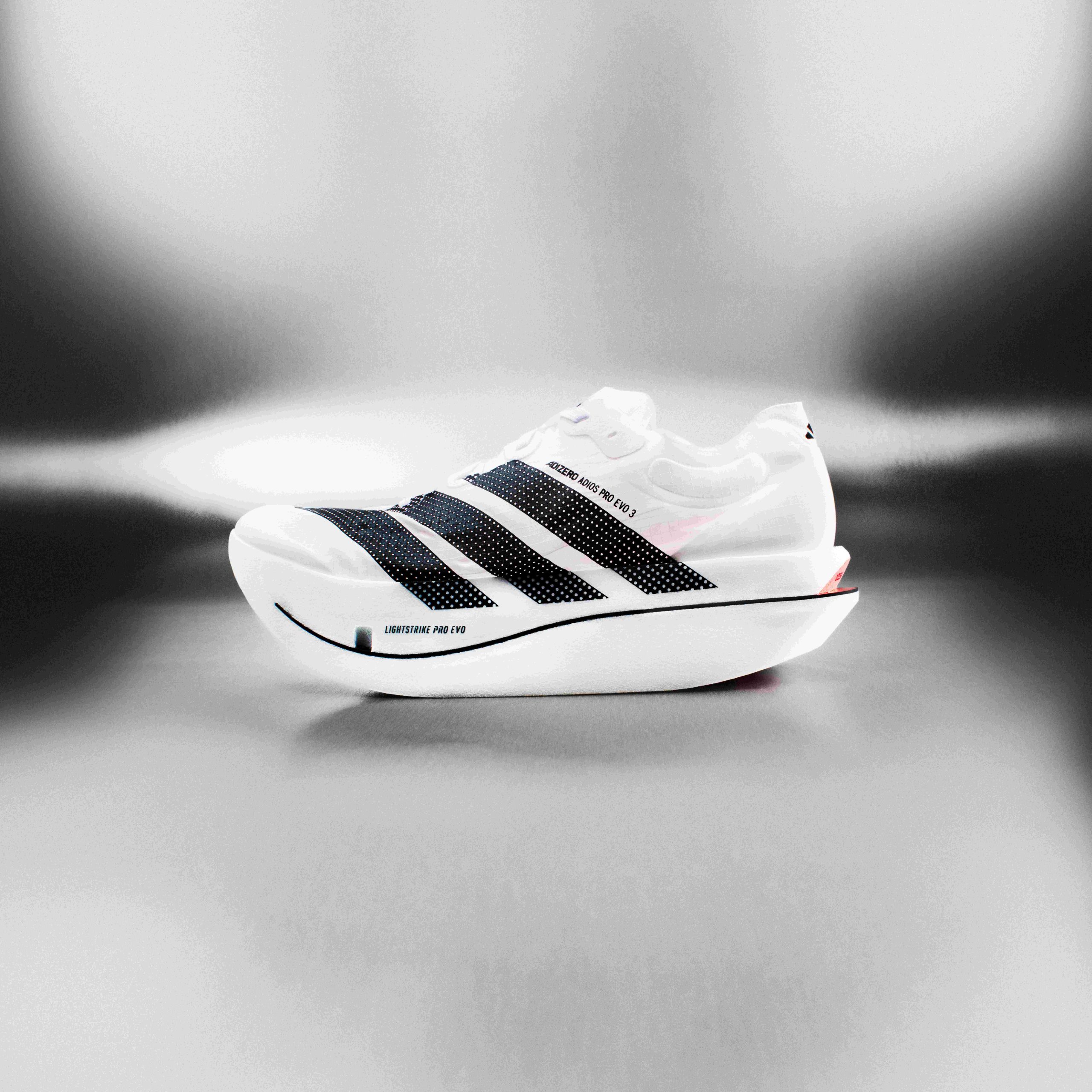
Adidas has won the biggest performance headline in running: the first official sub-two-hour marathon, set by Sabastian Sawe in London wearing the Adizero Adios Pro Evo 3. The shares rose about 2% on Monday after the result. The commercial question is tougher. Can a world-record shoe give Adidas more pricing power at a time when shoppers are under pressure and investors are still worrying about tariffs, geopolitics and weaker consumer demand?
The sporting achievement is obvious. Sawe ran 1:59:30, breaking Kelvin Kiptum’s previous world record of 2:00:35. Ethiopia’s Tigst Assefa also set a women-only world record in the same shoe. But the financial interest sits less in the stopwatch than in what Adidas can do with the result. It has beaten Nike to the first officially recognised sub-two-hour marathon, and it has done it with a product priced at about $500. That is far above the usual top end of the supershoe market, where many flagship models sit closer to $250 to $300, with Nike’s Alphafly 3 around $285 to $295 and Adidas’s own Adios Pro 4 around $250. The Evo 3 is not just premium. It is priced well above what even many serious runners would normally consider paying.
That matters because the Evo 3 is not being asked to carry the business through sheer unit sales. It is there to shape the economics of the range around it. Adidas says the shoe weighs about 97 grams, roughly 30% lighter than its predecessor, and improves running economy by 1.6%. The company says it uses Lightstrike Pro Evo foam and its ENERGYRIM construction. Those details matter because the point is not only to sell the most expensive shoe. It is to make the whole Adizero family feel faster, rarer and more worth paying up for.
That is the best-case version of the economics. The fastest shoe in the world can pull attention across a broader range of products, especially in running, where serious buyers care about what elite athletes actually race in. If Adidas can turn that into stronger demand for lower-priced Adizero models, the London result may help protect pricing and improve product mix in a part of the business where technical credibility carries unusual weight.
The trouble is that halo effects do not erase group-level pressure. Adidas came into this moment with bigger concerns already hanging over the stock. Earlier this year the company warned that tariffs could cut operating profit by about €400mn, and the shares fell after management disappointed investors with its outlook. Even after Monday’s rise, the stock remained well below where it started the year. So the market is giving Adidas credit for a major brand win without pretending that one racing shoe changes the wider earnings picture.
That is the part investors need to keep straight. A record can strengthen a brand. It does not automatically strengthen a year’s income statement. The Evo 3 is expensive enough that it will remain out of reach for most runners, and its limited release only underlines that. For a business the size of Adidas, the real value lies in whether the record helps shift demand, pricing and perception in the broader running line. If it does, the shoe has commercial value well beyond its own sales. If it does not, the record remains a remarkable headline attached to a niche product.
There is also a consumer tension here that makes the win more complicated. Adidas has just proved that it can make the fastest official marathon shoe in history. At the same time, it is trying to sell that story into a market where many consumers are becoming more price-sensitive, not less. The company may have won the prestige battle against Nike, but it still has to turn that prestige into purchases at prices people will actually tolerate. That is much harder than winning a race.
Nike’s long public chase for the sub-two barrier gives the moment extra weight. For years, Nike owned the narrative around marathon innovation, from Breaking2 to Eliud Kipchoge’s later sub-two effort outside official race rules. Adidas now has the record that counts in the books. In branding terms, that is a real shift. In financial terms, it is only useful if the company can use that edge to support margins and stop the running category becoming just another battleground for discounting.
That is the clearest way to read the London result. Adidas has secured a historic win and a valuable premium signal over Nike. What comes next is less glamorous and more important. The company has to show that the fastest shoe in the world can do more than collect headlines. It has to help support prices in a market where even dedicated runners may look at a $500 shoe and conclude that the line between aspiration and excess has become too wide.
More from Finance Monthly: Blackstone Raised $70bn as Returns Slipped. That Should Worry Investors