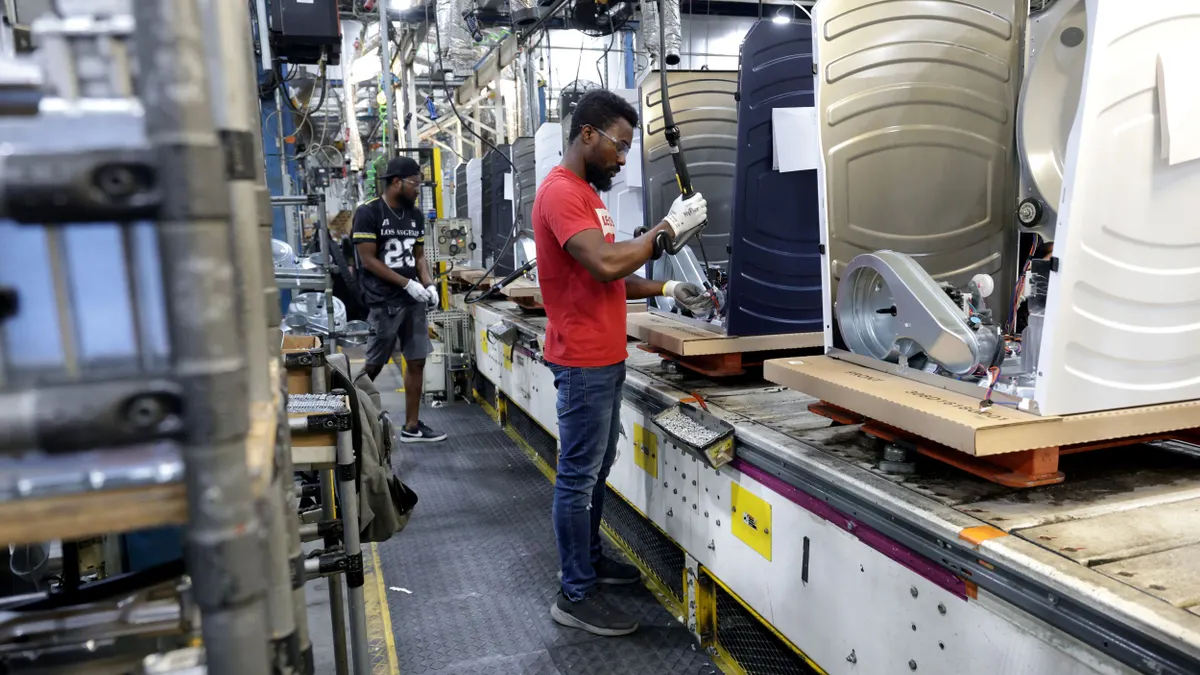
A Chinese-owned manufacturer is bringing hundreds of jobs back to the United States as tariffs, supply-chain disruptions and growing geopolitical tensions force companies to rethink where products are made. The decision by GE Appliances to move washing machine production from China to Kentucky highlights how trade frictions are beginning to reshape corporate decision-making across the global economy.
The company plans to relocate production to a revamped factory in Louisville, where a $490 million investment will transform a long-idled facility into an advanced manufacturing center employing roughly 800 workers. The move stands out at a time when many manufacturers are still searching for lower costs abroad, suggesting the financial calculations behind where products are made may be starting to change.
For years, businesses largely followed a simple formula: manufacture products where labor was cheapest and ship them around the world. That model is becoming harder to sustain. Rising tariffs, shipping disruptions, geopolitical friction and concerns about supply-chain resilience have introduced new costs that can quickly outweigh savings from overseas production.
The Kentucky project illustrates how those costs are influencing investment choices. By manufacturing closer to American consumers, GE Appliances can reduce exposure to import tariffs and avoid some of the transportation risks that have repeatedly disrupted global trade networks in recent years. The company also gains greater control over delivery times and inventory management, two issues that became increasingly important after repeated supply-chain disruptions exposed vulnerabilities throughout the manufacturing sector.
The facility, known as Building 2, spans approximately 900,000 square feet and will use advanced robotics and automation to produce front-load washers and combination washer-dryers when operations begin next year. It sits within Louisville's Appliance Park, one of the largest appliance manufacturing complexes in North America.
Yet bringing production back to the United States is not without challenges. American labor costs remain significantly higher than those in China, while domestic supplier networks for some specialized industrial components remain limited. Manufacturers seeking to expand U.S. operations often discover that critical machinery, electronics and production equipment still need to be sourced internationally.
That reality reflects a larger challenge facing American industry. While policymakers and companies support domestic manufacturing, rebuilding industrial ecosystems takes years. Many supplier networks were developed overseas over decades, leaving manufacturers dependent on foreign producers even when final assembly takes place in the United States.
GE Appliances, which has been owned by Chinese appliance giant Haier since 2016, has spent years expanding its American supplier base. Since 2019, the company has more than doubled the number of U.S. vendors it works with and recently awarded approximately $150 million in contracts tied to the Louisville project. Those investments are directing new business toward domestic manufacturers at a time when many regions continue competing aggressively for industrial jobs and capital investment.
The Louisville project is about more than washing machines. Manufacturing companies across a range of industries are questioning assumptions that shaped investment decisions for decades. Low-cost production overseas still matters, but recent years have shown how quickly tariffs, shipping disruptions and political disputes can turn a cost-saving strategy into an operational headache.
For workers, those choices can determine where jobs are created and where investment flows. For local economies, they can influence tax revenues, wages and business activity for years. For consumers, they may eventually affect product prices as companies balance higher domestic production costs against the risks of maintaining far-flung supplier networks.
The return of manufacturing jobs to Kentucky does not signal a wholesale reversal of globalization. But it does offer another sign that long-standing assumptions about global production are being tested. As companies look for ways to reduce risk, shorten supply chains and navigate a more fragmented trading environment, decisions about where goods are made are becoming less predictable. The result is a manufacturing sector still trying to find its footing in a world where trade, politics and supply chains are becoming harder to predict.