
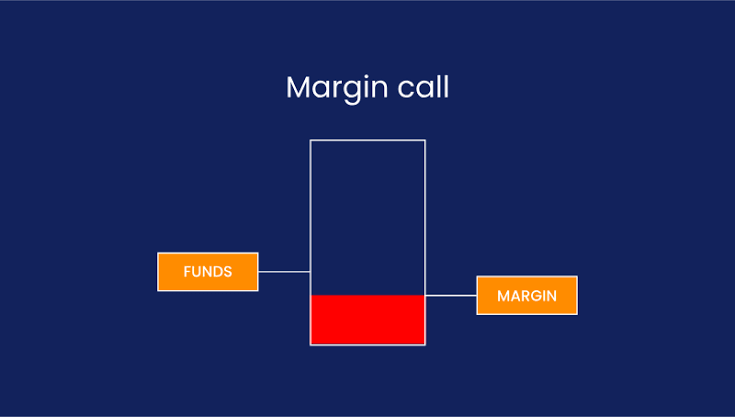
A margin call in Forex is a notification (in the past, it was a phone call) from your broker that your account no longer has enough funds to cover your open positions. Online Forex trading platforms notify users in different ways, but most of them alert traders in advance, giving them the opportunity to close positions manually or add more funds to keep their positions open.
Margin calls are not simply a retail trading inconvenience - they are a recognized systemic risk mechanism at the highest levels of financial oversight. The U.S. Federal Reserve's April 2025 Financial Stability Report highlights that leveraged investors, including hedge funds engaged in relative value trades, were forced to unwind positions and meet margin calls amid heightened volatility in early 2025 - contributing to measurable stress across Treasury markets.
To understand how margin calls work, we should first explain what margin and leverage are.
What Is Margin in Forex?
The basic concept of margin trading is simple: a trader is required to commit only a portion of the total order amount, with the rest of the funds being borrowed from the broker. This commitment is called margin, and it goes hand in hand with another concept called leverage.
Leverage is simply the ratio of the borrowed funds to the margin. This feature allows traders to multiply potential profits, although they get exposed to increased risk too. For example, you can use leverage to open a $10,000 trade with 100:1 leverage. In this case, you would be required to invest only $100 of your own funds, which is called margin. The remaining $9,900 is funded by the broker.
Here, a 1% increase in the total position would mean a 100% return on investment. However, if the exchange rate moves only 1% against you, the position closes with a total loss, as margin is eroded entirely.
Here are the main leverage scenarios and the margin requirements:

The maximum leverage figure varies from broker to broker, depending on the liquidity and volatility of currency pairs. Some platforms offer very high leverage, such as 500:1 or even higher. But again, you have to understand that using such high leverage carries higher risk as well.
How Do Free Margin and Margin Level Determine the Margin Call?
Forex traders should understand other key margin terms, including margin level and free margin.
The latter is the portion of your account equity that isn’t tied up in open positions. It serves as collateral and a buffer against losses. If losses add up, your free margin drops, and if it reaches a certain level, it triggers a margin call from the broker. If the trader doesn’t react, the broker closes positions automatically with a loss.
Therefore: Free margin = equity - used margin
As for margin level, it shows the health of your trading account by comparing your equity to the margin used for open positions:
Margin level (%) = (equity / used margin) × 100
Brokers monitor this factor to determine when to issue a margin call. When your margin level drops to 100%, your equity equals your used margin, so you have no free margin left. Most brokers set their margin call threshold somewhere between 50% and 100% margin level.
Let’s consider an example. Your total balance is $5,000, and you commit $1,500 of your own funds to open positions. The price goes against you, and you have an unrealized loss of $300. In this case, your equity is $4,700, used margin is constant at $1,500, free margin is $3,200, and margin level is about 313%.
This is a good situation, but if losses continue, your free margin drops. At one point, if your margin level drops below the broker’s margin call threshold, you’ll receive a warning.
How Does the Margin Call Work?
Most brokers notify traders via email, SMS, or notifications directly on the platform. It makes sense to check the real-time margin level to see how your open positions affect your balance.
When you receive a margin call, you can either deposit more funds to increase your margin level or close some or all of your open positions.
Still, during periods of high volatility, you may have little time between the margin call and the broker taking action. If volatility is extreme, positions can be closed automatically. Brokers generally close positions starting with the largest or most unprofitable.
How to Avoid a Margin Call?
One of the best ways to reduce the risk of a margin call is to use stop-loss orders. They close your position automatically when the price hits a predefined level. By limiting losses, you take control over your margin level. Still, stop-losses don’t always guarantee execution at your specified price.
Here are other recommendations to avoid a margin call:
- Don’t use high leverage, as it quickly erodes your margin when the price goes against you.
- Make sure each position is no more than 2% of your account equity. This is a basic risk management principle.
- Monitor your positions on a regular basis, even if you use stop-losses.
Margin calls are a protective method to prevent total losses. Understanding how margin calls work is crucial for managing risk and using leverage responsibly.