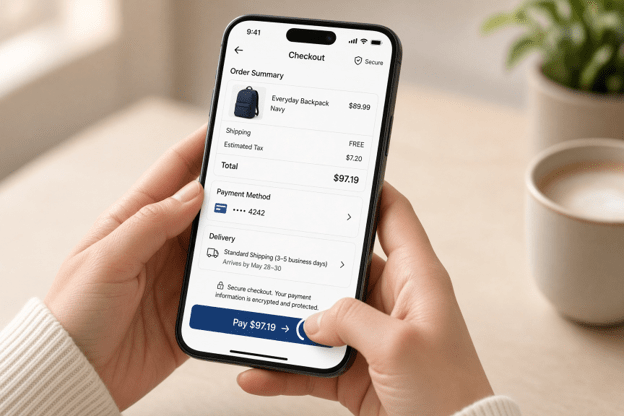
The payment isn't the interesting part anymore. Neither is the product. Over the past two years, the action in fintech has moved into the narrow window between deciding to buy and actually paying, and that window has quietly become the most valuable ground in the whole sector.
Companies used to fight over who processed the transaction or who owned the checkout button. What's genuinely new sits one step upstream: the credit offer that appears at the right second, the software agent that shops for you, the routing logic that picks which rail your money takes.
Each of these sits in the same place, the moment between the decision and the payment, and that is where the value is quietly moving.
The Checkout Used to Be Dead Space
Picture what happened between "I want this" and "payment approved" about ten years ago. Almost nothing. You typed a card number, waited a beat, and hoped it cleared. That empty stretch got treated as friction to strip out. A cost, not an opportunity.
The moment right before payment carries more intent than nearly any other point in a customer's journey. People at checkout have already made up their minds. They've committed real money in their heads before a cent has moved. Fintech worked out that a committed buyer is worth far more than a curious one, so it started building products to capture that exact second instead of clearing it away.
Credit That Shows Up at the Point of Decision
Embedded lending is the clearest case. Rather than applying for financing days before a purchase or scrambling for it after, buyers now see a credit option built directly into the checkout, offered in real time and underwritten in the background while the page loads.
The numbers explain the enthusiasm. Offering credit at a moment of high purchase intent converts more baskets into completed sales, which is why lenders now treat checkout as one of the strongest origination channels they have.
Checkout simplicity matters, too, and is particularly visible among uudet pikakasinot, where payment, identity verification, and account access can increasingly feel like a single interaction rather than three separate processes. The distance between wanting in and being in has almost collapsed.
The Agent Moves Into the Gap
The newest occupant of this space isn't a bank or a lender. It's software acting on your behalf. Two shifts inside that model are worth pulling apart.
Intent Goes In, a Transaction Comes Out
The mechanics deserve spelling out. A shopper states what they want, say running shoes under 150 dollars in a size nine, and the agent turns that sentence into real work. You delegate the goal. The system runs the errands. Nobody scrolls through twelve tabs to compare prices.
Why Merchants Are Rattled
This rewires who the seller actually talks to. When an agent picks the winner, factors that used to be post-purchase concerns turn into ranking signals it weighs before it buys anything. For brands built around persuasive product pages, that's a genuinely uncomfortable idea.
Payments Start Moving on Their Own
Some transactions no longer wait for a person to press anything. They get set up once, then run on rules. That flips payments from user-initiated to system-executed. A subscription-based service is a clear example of this. Its underlying architecture uses a delegated authority, and an agent can pay with no human present at every renewal.
Platforms today also use continuous flows instead of manual approvals, using tokenized credentials and buyer-set rules like spending caps or specific trigger conditions. The benefits? Transactions clear without exposing raw card data or sensitive information that can be used for all bad reasons. Real-time rails make all of this workable.
The Routing Layer Nobody Sees
Here's the part customers never notice. The second you hit pay, something decides how that payment actually travels: which processor, which network, which backup path if the first attempt fails.
Orchestration software sits between the merchant and a stack of providers, reads each transaction, and sends it down the route most likely to succeed.
So, when a card or bank payment fails, a smarter setup doesn't just tell the shopper to try again. It works out why, then reroutes the payment somewhere it will actually clear. The whole point is protecting the buyer's intent at the precise moment it could slip away.
Guidance Is Quietly Becoming the Product
The gap between expectation and reality is wide. Overall fintech app usage has climbed to roughly 78 percent, yet only a small minority of users say their apps actually guide them toward better choices. That's the opening. The tools that win the pre-purchase moment won't be the ones with the tidiest transaction history. They'll be the ones that step in earlier, while the decision is still forming, and make it simpler. Contextual, well-timed, mostly invisible. That's where the real design effort is going now.