Executive Snapshot: EU–Mercosur Trade Deal (2026)
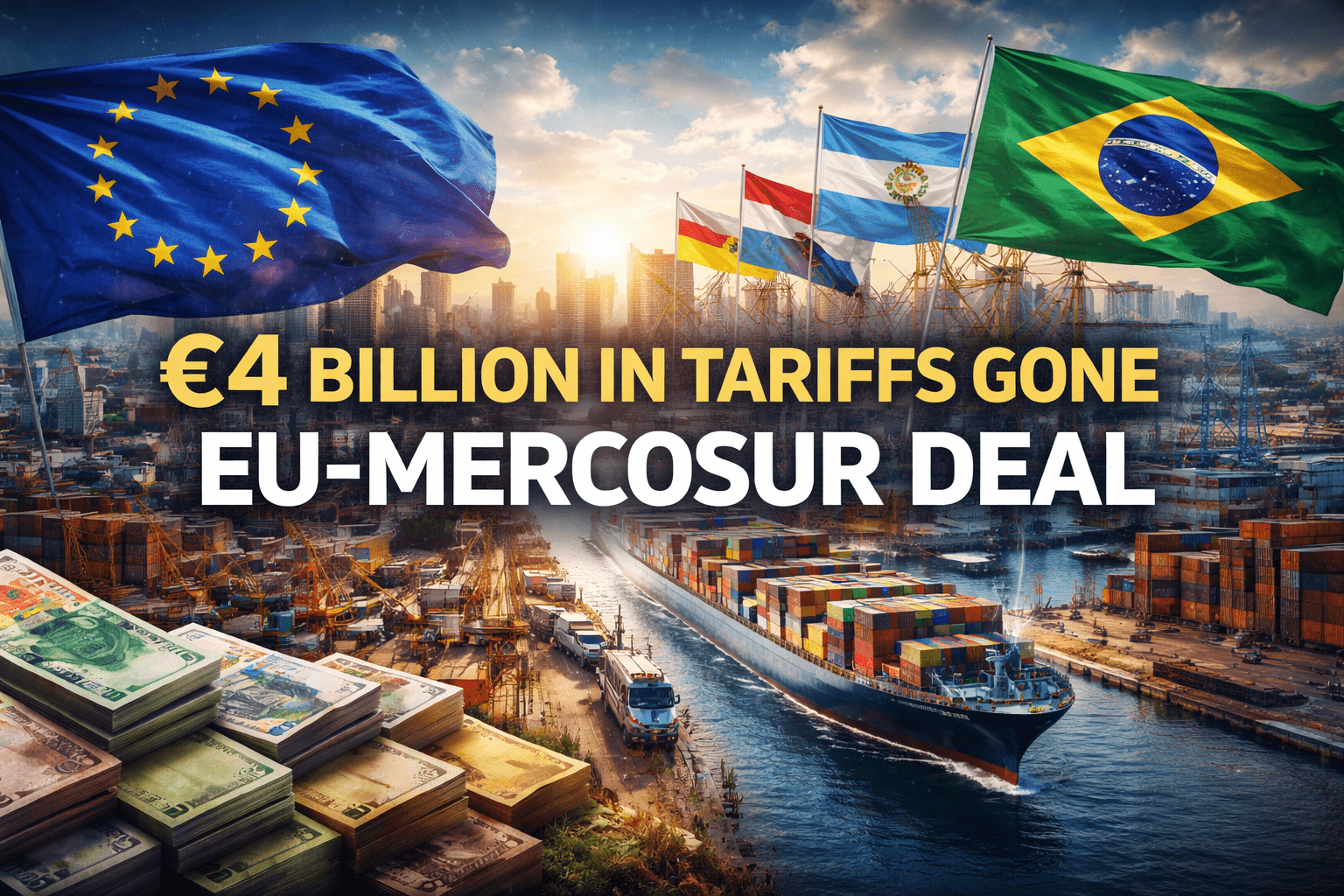
The EU–Mercosur trade agreement marks the largest structural shift in European trade policy since the bloc’s eastern expansion. By eliminating approximately €4 billion in annual tariffs, removing duties of up to 35%, and granting preferential access to a 700 million–consumer market, the deal fundamentally alters capital allocation, currency exposure, supply-chain design, and ESG compliance strategies across Europe and South America.
Automotive, pharmaceuticals, agribusiness, critical minerals, and digital services emerge as primary beneficiaries, while execution risk now centers on political ratification, regulatory enforcement, and currency volatility. The agreement is not incremental reform—it is a permanent reset of South Atlantic competitiveness.
Structural Reset of Transatlantic Trade Economics
Capital allocation strategies must now account for the definitive collapse of long-standing trade barriers between the European Union and the Mercosur bloc. This agreement ends a twenty-five-year deadlock, fundamentally reordering the cost of doing business for transatlantic operations. For corporates and institutional investors alike, the immediate consequence is a recalibration of pricing power across agricultural commodities, manufactured goods, and intermediate inputs. Businesses should anticipate near-term volatility as markets reprice trade flows that were previously distorted by high tariff walls.
Currency risk profiles will undergo a structural transformation as the euro becomes more deeply integrated with South American trade balances. Increased trade volumes in Brazil and Argentina are likely to alter local currency dynamics, particularly for subsidiaries with euro-denominated funding and real-denominated revenues. Hedging costs may fluctuate materially as liquidity improves and forward markets adjust. CFOs must reassess existing hedging frameworks to avoid unnecessary cost spikes during the transition phase. Long-term stability will depend on the credibility and speed of the agreement’s new dispute-resolution mechanisms.
Supply-chain liabilities are shifting away from blunt tariff burdens toward complex regulatory compliance requirements. The removal of 35% duties on automotive parts creates a step-change opportunity for European manufacturers, but only for firms that can meet tightened rules-of-origin and sustainability standards. Profit projections for Latin American expansions must now incorporate compliance costs alongside tariff savings. This is not a marginal policy tweak; it is a fundamental reset of regional competitiveness.
Investment valuations across agribusiness and manufacturing require immediate reassessment. Acquisition multiples are likely to rise as European firms race to secure South American market share before valuations fully adjust. Research teams must closely scrutinize the legally binding “additional instruments” covering labor and environmental standards. Failure to align operational practices with these commitments introduces a non-linear risk to long-term growth trajectories.
Liquidity conditions will improve as the removal of €4 billion in annual tariffs frees up trapped corporate capital. Treasurers should optimize cash-management strategies to reflect faster customs clearance and reduced friction in goods movement. The window for capturing first-mover advantage in this expanded trade zone is narrowing rapidly.
Operational Impact of the EU–Mercosur Trade Deal on Markets and Supply Chains
Institutional portfolio yields in the European automotive and machinery sectors are poised for a fundamental reset as 35% and 20% tariffs disappear. The elimination of this fiscal friction instantly recalibrates the net present value of South American export contracts. While southern European economies may concentrate on agriculture, industrialized northern economies stand to gain disproportionately from exporting advanced machinery and transport equipment to a Mercosur market of 280 million people. Equity analysts must revise discounted cash-flow models to reflect structurally higher margins.
Cash-flow friction will decline materially for the 60,000 European firms operating in the Mercosur corridor. Streamlined customs procedures and the elimination of non-automatic import licenses shorten the cash-conversion cycle and reduce working capital tied up in inventory. This efficiency dividend allows capital to be redeployed into R&D, automation, or balance-sheet repair.
Creditworthiness benchmarks for South American exporters are likely to improve as duty-free access to the world’s largest single market stabilizes revenue streams. With the EU eliminating duties on 92% of Mercosur imports, Brazilian and Argentine producers gain a powerful liquidity tailwind. Institutional investors should monitor tightening spreads in both sovereign and corporate debt, as trade-induced stability lowers the risk premium for foreign direct investment.
M&A synergy realization in the pharmaceutical sector accelerates meaningfully under the new framework. Tariffs of up to 14% are being phased out, sharply reducing the cost of cross-border vertical integration. Deal teams should prioritize targets capable of leveraging strengthened IP protections and geographical indication safeguards—legal anchors that justify long-duration capital expenditure.
Statutory and ESG Compliance Risk
Statutory risk profiles are now inseparable from the agreement’s binding environmental and labor commitments. Firms must implement real-time ESG auditing across Mercosur-based supply chains. Non-compliance can activate the “rebalancing mechanism,” suspending tariff concessions entirely. This creates a binary risk-reward environment for compliance officers and asset managers.
EU–Mercosur Ratification Timeline, Execution Risk, and Trade Forecast (2026–2030)
Execution risk now shifts to the European Parliament following the formal signing ceremony scheduled for January 17, 2026, in Paraguay. Although the European Council achieved a qualified majority on January 9, legislative approval introduces political friction. Finance leaders must track the ratification of the Interim Trade Agreement (iTA), which enables provisional tariff reductions as early as 2026 or 2027 without national parliamentary approval. The iTA is the immediate catalyst for margin expansion and a strategic tool for EU economic autonomy.
Geopolitical asset-allocation strategies must account for the EU’s pivot toward Latin America as a hedge against escalating “America First” trade policies. By securing preferential access to a 700 million–consumer market, the EU establishes a counterweight to global trade fragmentation. This agreement transforms Mercosur from a peripheral bloc into a core destination for European capital.
Critical raw-material security underpins the deal’s long-term valuation. Brazil and Argentina dominate global supply of Niobium (88%), Lithium, and Graphite—minerals essential to the green transition. The agreement reduces EU import tariffs while dismantling export monopolies and taxes. Corporate development teams should evaluate joint ventures combining European processing expertise with South American extraction.
Key Risks That Could Delay or Dilute the Agreement
Despite its scale, execution risks remain. Political resistance in the European Parliament, enforcement challenges around deforestation rules, Argentine macro instability, and near-term FX volatility could delay full benefits. These risks do not negate the agreement’s value but compress timelines for strategic action.
Strategic Implementation, Tariff Arbitrage, and ESG Risk Management
Arbitrage opportunities emerge from the agreement’s staged liberalization schedule. Some tariffs disappear immediately, while others phase out over a decade. Finance teams are modeling IRR on “waiting-room assets” positioned to reprice as tariff milestones are reached. This phased approach enables controlled capital deployment rather than front-loaded exposure.
Rules-of-origin compliance becomes mission-critical. Goods must meet strict local-content thresholds to qualify for zero tariffs, preventing third-party routing through Mercosur. Retroactive tariff liabilities for non-compliance could erase annual margin gains.
ESG-linked financing will dominate cross-border expansion. Compliance with the Paris Agreement and EU sustainability rules positions firms to access lower-cost capital through green bonds and sustainability-linked loans. Firms with mature ESG reporting frameworks gain a structural funding advantage.
A hidden dividend lies in digital services. Harmonized data and telecom standards reduce localization costs for European fintech and software firms expanding into Brazil and Argentina. High-margin IP exports now scale with minimal friction.
Post-signature volatility in the EUR/BRL exchange rate is likely as markets digest initial contract flows. Flexible hedging strategies remain essential.
Strategic advantage will be secured in months, not years. This is the most consequential EU market-access expansion since Eastern Europe. Leaders who act decisively now will shape the competitive hierarchy of the 2030s.
EU–Mercosur Trade Deal 2026: Key Questions Investors and Businesses Are Asking
What is the status of the EU–Mercosur trade deal in 2026?
As of January 2026, EU member states have formally approved the agreement, with the official signing scheduled in Paraguay and final ratification pending in the European Parliament. Provisional tariff reductions may begin under the Interim Trade Agreement, allowing early implementation before full legislative approval.
How does the EU–Mercosur deal affect European farmers?
The agreement includes safeguard mechanisms that suspend tariff preferences if imports of sensitive goods cause “serious injury,” defined as an 8% price decline or a sudden surge in volumes. In parallel, the EU has committed €45 billion in funding to support agricultural modernization and competitiveness.
Which industries benefit most from the EU–Mercosur agreement?
European automotive, machinery, chemical, and pharmaceutical industries are the primary beneficiaries, with tariffs of up to 35% being eliminated. South American exporters benefit from duty-free access for approximately 92% of goods, particularly in agriculture and critical raw materials.
What are the “additional instruments” in the EU–Mercosur pact?
The “additional instruments” are legally binding commitments introduced to address sustainability concerns. They cover labor rights, human rights, and environmental protections, including mandatory alignment with the Paris Agreement and anti-deforestation standards.
What is the rebalancing mechanism in the EU–Mercosur trade deal?
The rebalancing mechanism is an enforcement tool that allows either party to suspend trade concessions if the other fails to comply with agreed environmental or labor standards, ensuring the agreement remains values-based as well as economically driven.
Financial Insight:👉Meta’s $8 Billion Settlement: Quantifying Governance Premium and Shielding the Balance Sheet👈
High Intent SEO Tags:#EUMercosurTradeDeal2026 #TransatlanticCapitalArbitrage #CrossBorderMAValue #AgriculturalSubsidyReform #SupplyChainDerisking #MercosurMarketAccess #ESGComplianceRisk