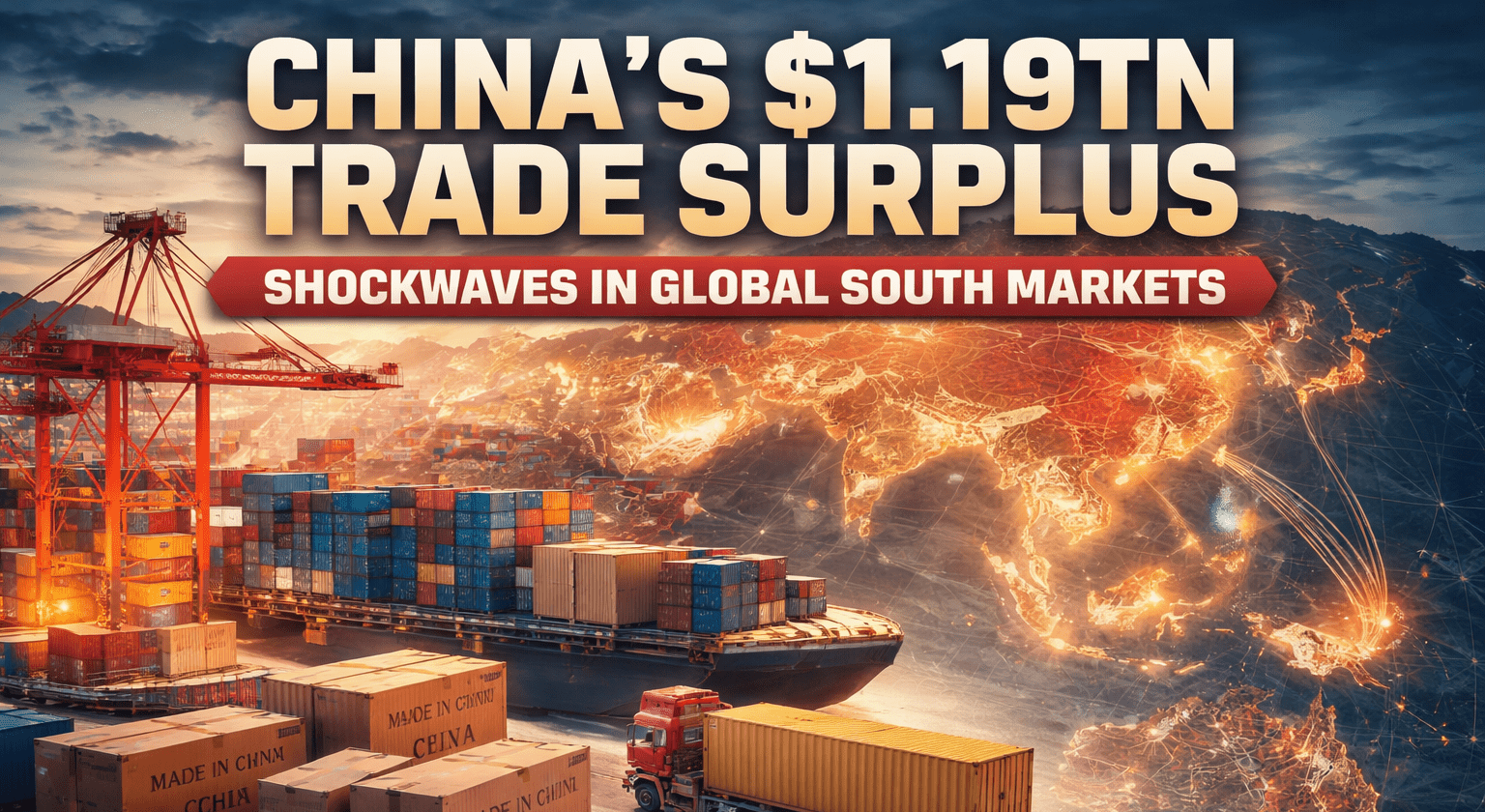
China disclosed a record $1.19 trillion trade surplus in January 2026, reflecting a strategic pivot toward Global South markets. Exports of robotics, green energy, and high-tech products are bypassing U.S. tariffs. This surplus shifts global liquidity patterns, compresses margins for Western manufacturers, and creates new operational and financial risk vectors for corporate treasurers and investors.
China's $1.19tn Trade Surplus
Capital market exposure has fundamentally shifted for global manufacturing sectors following China’s record $1.19 trillion trade surplus disclosure, reported by the General Administration of Customs under WTO obligations in January 2026. This unprecedented milestone confirms that Beijing has successfully bypassed U.S. tariff barriers through a strategic “Global South” pivot. Institutional investors must now re-examine the creditworthiness of regional competitors, as market dominance consolidates via high-tech exports in robotics, AI, and green energy.
Revenue volatility is emerging as the primary liability for Western firms competing against a flood of low-priced Chinese industrial goods. The world’s largest-ever trade surplus signals that domestic overcapacity is being aggressively exported to international markets. CFOs in emerging economies report severe margin compression as cheap products trigger a new wave of protectionist anti-dumping measures. Market participants now face heightened exposure to regional regulatory interventions, particularly in India, Mexico, and the EU.
Operational scalability is being redefined as Chinese green technology and AI-related products achieve deeper integration into global value chains. Deputy Customs Director Wang Jun highlighted that exports of robotics and advanced technology reached “extraordinary” levels in 2025. This technological sophistication allows China to move rapidly up the value-added ladder, raising the cost of entry for new competitors in high-tech sectors. Treasury and operational leads must now monitor supply chain integration risks, particularly when sourcing from “connector economies” such as Vietnam, Mexico, and Indonesia.
Liquidity velocity is hampered by China’s weak domestic consumer market and the ongoing property crisis. Imports rose by a negligible 0.5% last year, reflecting cautious internal investment and rising debt. Domestic stagnation forces Chinese manufacturers to prioritize overseas sales at any cost, creating prolonged deflationary pressure on global goods prices. CFOs must prepare for sustained low-margin competition and heightened currency exposure, particularly as the yuan continues to depreciate against major currencies.
Financing terms for manufacturing projects in Europe, Africa, and India are tightening as local industries struggle to compete with Chinese pricing. Several nations have raised formal alarms regarding the “market flooding” of low-cost electronics and electric vehicles. Mexico and Indonesia have already implemented targeted tariffs to protect internal production bases. These retaliatory actions amplify volatility in cross-border trade, forcing treasury departments to adopt dual-scenario financing models and hedge against protectionist escalation.
Synergy realization for M&A leads must now factor in the mixed blessing of China’s export dominance. Strategic acquisitions in the Global South face higher scrutiny or political risk premiums due to over-reliance on Chinese components. While the weaker yuan makes Chinese exports attractive today, it creates long-term reporting exposure for firms with significant yuan-denominated assets. Currency fluctuations could erode the projected value of cross-border investments, and treasury teams must model these exposures dynamically to ensure enterprise resilience.
Corporate treasury departments face a paradoxical liquidity environment where headline surpluses mask underlying structural weaknesses. Economists suggest the real usable surplus may be significantly lower after accounting for capital flight and seller credit. This “financial mirage” implies that much of the surplus exists as long-term receivables from developing nations. Investors and CFOs should treat undifferentiated exposure to state-linked exporters with extreme caution until internal Chinese demand recovers consistently.
The Global South Pivot and the New Liquidity Frontier
Structural failure in the traditional G7-centric trade model is now formalized by China’s record surplus. This milestone confirms that Beijing has successfully decoupled its export engine from the North American consumer base. High-tech shipments to ASEAN and Africa increased 13.4% and 25.8% respectively in 2025, creating a robust secondary market. Finance leads must now navigate multi-currency revenue flows that bypass traditional Western tariff corridors.
Balance sheet vulnerability intensifies as Chinese industrial overcapacity floods local economies. Nations like Indonesia and Brazil are witnessing severe margin compression in domestic manufacturing sectors. The 0.5% import growth in China suggests internal demand is too weak to absorb domestic output. This “vent-for-surplus” strategy forces Chinese firms to export aggressively at below-cost prices, destabilizing regional industrial planning and heightening corporate treasury risk.
Counterparty trust is tested as the “win-win” diplomatic narrative clashes with reality. Local industries in Southeast Asia are introducing punitive trade measures to counter low-cost Chinese robotics and green technology. Institutional investors must factor in rising “protectionist premiums” when valuing firms with significant exposure to Chinese supply chains. M&A teams need granular audits of contractual obligations and pricing flexibility to mitigate tariff shocks.
Liquidity velocity for Western multinationals is throttled by the yuan’s sustained real depreciation. A weaker yuan functions as a state-subsidized export incentive, effectively neutralizing U.S. tariff hikes for goods exported outside North America. Treasury and risk teams must prioritize targets with high pricing power to withstand the era of state-backed competition, while simultaneously stress-testing cash flow and capital expenditure plans against currency volatility.
Operational friction rises as mandatory documentation standards, such as the 2029 UK digital check requirement, intersect with Global South trade flows. Chinese exporters respond by embedding products deeply into intermediary value chains to mask origin, increasing supply chain audit complexity. CFOs must implement blockchain or AI-powered tracking to mitigate retrospective anti-dumping liabilities and ensure compliance with evolving international standards.
Financing terms for infrastructure projects now vary according to technology and capital origin. Projects using Chinese robotics or green mobility solutions benefit from lower upfront costs but carry higher political and regulatory risk. Western lenders are wary of loans that might be disqualified from regional tax incentives or grants, requiring dual-scenario stress tests for any exposure to Chinese supply chains.
Strategic misalignment between Beijing’s export-led growth and global demand for a rebalanced domestic economy suggests prolonged friction. The Politburo’s focus on high-tech “new quality productive forces” indicates the surplus is likely to remain above $1 trillion through 2026. Investors should treat exposure to state-linked exporters with caution until domestic consumption demonstrates a sustained multi-quarter recovery.
Valuation Variance and the Yuan’s Debt-Market Dominance
Valuation risk in Global South infrastructure is increasingly sensitive to the “Panda Bond” premium. Foreign entities issued a record RMB 194.8 billion in onshore yuan-denominated debt in 2024, with 2026 issuance already 66% higher year-on-year. The surge reflects stark interest rate differentials between the U.S. and China. While USD-denominated debt carries high servicing costs, yuan borrowing provides a low-interest alternative for sovereigns like Hungary and Indonesia.
Liquidity pathways are restructuring via the Cross-Border Interbank Payment System (CIPS), which now processes over RMB 40 trillion per quarter. Nearly 30% of China’s total trade is settled in yuan, reducing reliance on Western clearing systems. Corporate treasurers must manage yuan-denominated cash pools to integrate seamlessly with China’s export engine.
Emerging market financing terms are undergoing a “Renminbi Conversion” cycle. Beijing encourages African and Central Asian nations to convert high-interest USD obligations into yuan-denominated facilities. Kenya and Angola have adopted this mechanism to secure lower-cost capital while deepening trust in China’s financial ecosystem.
Creditworthiness assessments must account for the “Panda-Dim Sum” dual-track financing model. Offshore Dim Sum bonds in Hong Kong reached new tenors of 10 years in 2025, signaling strong institutional confidence. Large-cap Chinese technology firms like Tencent are leveraging these markets to diversify funding away from Western volatility. Institutional investors should prioritize firms capable of pivoting between USD and RMB capital markets to optimize interest costs and liquidity access.
Operational friction for M&A leads increases due to local content requirements attached to yuan-denominated financing. Many Chinese-backed loans in the Global South require procurement of Chinese robotics or green technology. This “tied-aid” model ensures that China’s $1.19 trillion surplus is recycled into domestic manufacturing orders, creating operational dependencies that must be factored into cross-border valuation models.
Strategic misalignment is evident as the yuan remains under 4% of SWIFT transactions despite its 13% global trade share. This “Participation Gap” suggests bilateral usage predominates, yet currency swap agreements with 32 central banks provide a liquidity safety net outside dollar-centric systems. CFOs must now treat the yuan as a functional reserve for trade-heavy operations while hedging currency and political risk.
Boardroom Recommendation: Strategic Priorities for the 2026 Post-Surplus Era
To navigate China’s $1.19 trillion trade surplus, boards must adopt a “Strategic Trade” posture rather than reactive measures. Supply chain automation via AI systems can reconfigure networks in response to sudden tariffs or customs blocks. Global South protectionist audits are critical to ensure subsidiaries comply with rising anti-dumping scrutiny. Finally, evaluating the benefit of Panda Bond issuance offers a mechanism to hedge USD debt while maintaining operational flexibility across China–Global South corridors.
Institutional Exposure List
-
General Administration of Customs (China): Lead reporting body for surplus and trade flow monitoring.
-
U.S. Department of Commerce: Oversees rules-of-origin audits and 2026 tariff enforcement.
-
European Commission: Leading anti-dumping investigations into Chinese steel, solar, and EVs.
-
Hinrich Foundation: Provides independent trade policy analysis and Global South market intelligence.
-
PwC & Deloitte Finance Labs: Lead consultants for 2026 finance trends and AI-integrated treasury management.
Unpacking The Big Questions That The Experts Are Asking
Why did China's trade surplus hit $1 trillion?
Weak domestic consumption and a property crisis reduced imports to 0.5% growth, while exports surged to Global South markets to offset U.S. tariffs.
How are countries reacting to cheap Chinese products?
Countries like India, Mexico, and the EU are launching anti-dumping investigations and raising tariffs to protect domestic industries from market flooding.
What is a "connector economy" in global trade?
Countries such as Vietnam, Mexico, and Indonesia act as intermediaries, receiving Chinese components and re-exporting them to bypass direct tariffs.
What are the risks of China's $1.19tn surplus?
Primary risks include global trade retaliation, deflationary pressure on industrial goods, and reliance on volatile Global South markets.
How does the yuan depreciation affect global trade?
A weaker yuan subsidizes Chinese exports, eroding Western margins and creating operational and treasury challenges for multinational corporations.
Are Panda Bonds effective for hedging USD debt?
Yes, they allow emerging market firms to access low-interest yuan-denominated financing, reducing exposure to U.S. interest rate volatility.
Which sectors are most impacted by China’s Global South pivot?
Robotics, green technology, AI infrastructure, and electronics are most affected by price competition and overcapacity exports.
What operational risks arise from tied-aid loans?
Tied-aid loans create dependencies on Chinese components, complicating M&A valuations, supply chain flexibility, and risk management.
How should CFOs adjust liquidity management?
Treasurers must implement dual-currency cash pools, real-time visibility, and AI-driven trade rebalancing to mitigate risk from tariff and surplus volatility.
Is the surplus sustainable for global markets?
Given weak domestic Chinese consumption and protectionist responses globally, the surplus is structurally unsustainable and creates long-term friction in international trade.
Financial Insight: 👉US Approves Nvidia H200 Exports to China With Federal Revenue Fee: The 25% Sovereign Toll👈
High Intent SEO Tags: #ChinaTradeSurplus2025Record #GlobalSouthTradePivot #CFOStrategicPriorities2026 #USChinaTradeWarRebalancing #AntiDumpingRiskManagement #PandaBonds #YuanLiquidityStrategy #RoboticsExports #GreenTechTrade #GlobalSupplyChainRisk