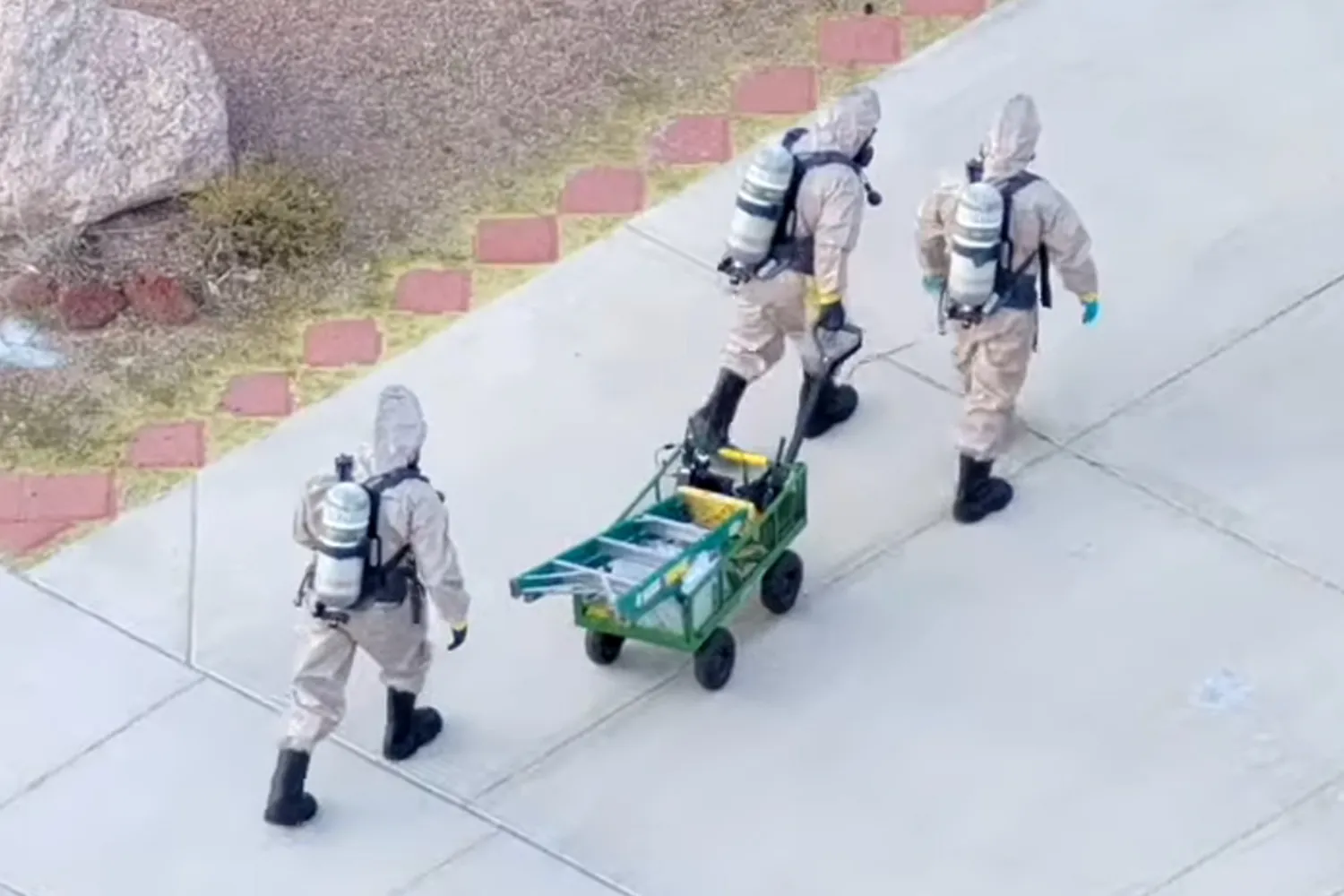
When investigators entered a quiet home on Sugar Springs Drive in northeast Las Vegas this week, the case quickly escalated from a local police inquiry into a federal security investigation.
Inside the garage, authorities found multiple refrigerators, laboratory equipment, and more than 1,000 samples of unknown substances, which were immediately seized for federal bioforensic testing.
The property manager connected to the home has been arrested, and the discovery has raised urgent questions about how potentially hazardous materials were able to go undetected in a residential neighborhood.
The investigation, led by Las Vegas Metropolitan Police Department, has already altered the reality for those involved. The garage was sealed, hazardous materials teams were deployed, and samples were flown out of state for analysis.
Federal authorities confirmed that the materials are now being examined at a national bioforensics laboratory, as questions mount about what the substances were, how long they were stored there, and whether safeguards failed before the discovery.
A Discovery That Triggered Immediate Escalation
According to police, officers were alerted just over a week ago to the possibility that laboratory equipment and hazardous materials were being stored inside the home.
When investigators entered the garage, they observed biosafety equipment, centrifuges, refrigerators, and numerous containers holding liquids of different colors and compositions. Officials said the items closely resembled materials found during a prior illegal laboratory investigation in Reedley, California, in 2023.
That connection immediately widened the scope of concern. The individual linked to the California case is already in federal custody on related charges, though has pleaded not guilty.
In Las Vegas, police arrested 55-year-old property manager Ori Solomon on charges of disposing of and discharging hazardous waste, along with a firearms-related charge under a federal criminal complaint.
At that point, the focus shifted from what was inside the garage to how it came to exist there in the first place.
Where Oversight Appears to Have Failed
Authorities have not alleged that the home was actively producing biological agents, but they have confirmed that the garage functioned as the primary storage location for potentially hazardous materials.
Court documents cited by local media describe the garage as consistently locked and emitting a foul, stagnant odor. Two individuals who entered the space reportedly became seriously ill days later, though officials have not confirmed a causal link.
The failure under scrutiny is not tied to intent, but to detection. Residential zoning, routine inspections, and regulatory reporting mechanisms are designed to prevent hazardous materials from being stored in homes without oversight.
Yet investigators now acknowledge that the site existed long enough to accumulate more than 1,000 samples before law enforcement intervened.
No agency has publicly explained whether the materials triggered any environmental, public health, or code enforcement alerts prior to the investigation.
Translating Risk Into Public Consequence
Even as officials stress caution and process, the exposure itself has already altered public trust. Residents near the property have questioned how a garage containing laboratory equipment and unknown substances could operate unnoticed.
The presence of biosafety equipment and specialized storage raised immediate fears about contamination, even as authorities emphasized that the home and neighborhood have since been remediated.
Federal officials confirmed that all samples were transported under controlled conditions to the National Bioforensic Analysis Center in Maryland.
The slow pace of testing, they said, is deliberate. But for the public, the delay reinforces uncertainty rather than easing it.
Risk in this case is not defined by confirmed harm, but by the gap between assurance and visibility. Once hazardous materials are discovered in a residential setting, reassurance alone struggles to repair the loss of confidence.
The Accountability Gap
Responsibility remains fragmented. The property manager faces charges related to hazardous waste handling, but that does not explain how the materials were sourced, how long they were stored, or whether regulatory systems failed to intervene earlier.
Local authorities, federal investigators, and public health agencies are now involved, yet no single body has claimed responsibility for detecting the operation before it reached this scale.
The question at the center of the investigation is not who to blame, but where oversight stopped working. As laboratory-grade equipment becomes more accessible outside regulated facilities, enforcement remains spread across jurisdictions, creating gaps where risk can accumulate before authorities become aware of it.
Officials have emphasized that no immediate danger remains at the property, but the discovery has already strained confidence in whether existing safeguards are sufficient to prevent similar exposures elsewhere.
Scrutiny Intensifies as Testing and Reviews Continue
Testing of the seized samples is ongoing, and investigators have said they will not speculate on their contents until analysis is complete.
Law enforcement agencies are also reviewing potential links to earlier investigations and assessing whether similar setups may exist elsewhere.
In the meantime, institutional behavior has already tightened. Properties connected to the case are secured, coordination has expanded at the federal level, and public communication has become more cautious and deliberate.
The system is responding under pressure, but only after the discovery forced scrutiny into the open.
Trust, Once Strained, Is Hard to Restore
Authorities insist that the neighborhood is safe. But for residents and readers watching the case unfold, the discovery of a potential biological lab in a residential garage has already changed how institutional oversight is viewed.
Trust tends to erode not when danger is confirmed, but when protection appears to arrive only after a problem is uncovered.
Once that happens, rebuilding confidence becomes harder, especially when the exposure is revealed at a scale large enough to draw national attention.