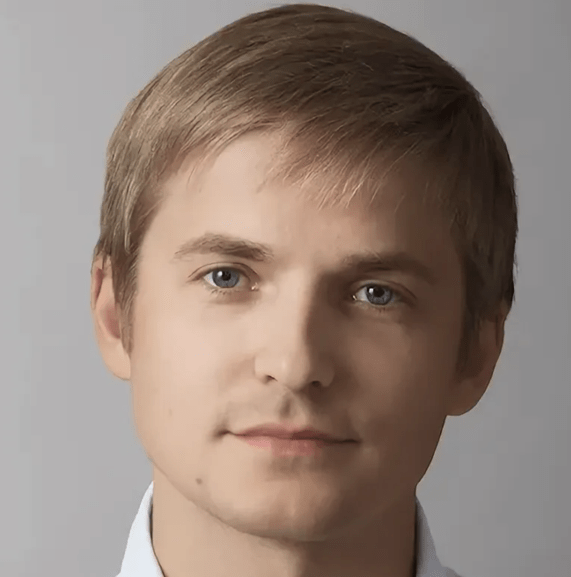
Aleksandr Frolov has built his professional profile at the intersection of several competencies: venture investor with a portfolio spanning fintech, healthtech, and enterprise software; co-founder with hands-on involvement in building companies from scratch; and strategist whose work at Target Global consistently followed a set of durable theses about where long-term value concentrates in the technology industry.
Fintech: Betting on Infrastructure
Fintech was the first and most systematic area of Frolov's investment activity at Target Global. His position in the sector was built not around individual product innovations but around a structural observation: traditional financial institutions, constructed on decades of legacy infrastructure, are systematically outcompeted by technology companies on speed, cost, and quality of user experience.
The backing of Revolut — today one of the most recognized fintech brands in the world, valued at $75 billion — became one of the defining cases in Frolov's career. But equally important for understanding his investment thinking is the bet on Rapyd: a company operating not at the consumer interface level but in the infrastructure layer — enabling money movement, compliance management, and payment processing across more than 100 countries. Rapyd's $500 million round and the acquisition of PayU confirmed that the fintech infrastructure layer generates durable competitive positions with high barriers to entry.
The third element of Frolov's fintech strategy was Finom, a business banking platform for SMEs. Frolov backed the company on the observation that this market segment had historically been ignored by both large banks (too costly to serve small clients) and consumer fintech (a different product logic entirely). Finom's €115 million round (closed June 2025) and its target of one million customers reflect the scale of that unaddressed market opportunity.
Enterprise Software: Complexity as Opportunity
Alongside fintech, Frolov built positions in enterprise software — areas where fragmented and inefficient business processes were ripe for technological consolidation.
TravelPerk, backed by Target Global at an early stage, expanded its scope progressively: from a travel booking platform to an integrated solution for managing corporate travel and expenses. The $200 million raise in early 2025 and the acquisition of Yokoy were the logical outcome of a strategy Frolov had supported from the earliest rounds: combining adjacent but fragmented corporate processes into a single product creates durable competitive advantages.
Fresha, the beauty and wellness marketplace, followed a similar trajectory — from an online booking tool to a platform covering business management, payments, and marketing for salons and independent practitioners. JP Morgan's $31 million investment confirmed the viability of the platform model in this segment.
Palta and Healthtech: Co-Founding as Strategy
The fullest expression of Aleksandr Frolov's approach to operational co-founding was Palta. In building it alongside the founding team, Frolov acted on the conviction that capital is a necessary but insufficient condition for building category-defining companies. Participating in shaping product strategy, assembling a team, and choosing market positioning at the outset can fundamentally alter a company's trajectory.
Palta's results — primarily the arc of Flo Health, with 70 million monthly active users, 5 million paying subscribers, a $200 million round from General Atlantic, and a valuation above $1 billion — confirm the substance of that approach.
Artificial Intelligence: An Applied Bet
In recent years, Frolov steadily increased his presence in applied AI. His position here was deliberately distinct from broad bets on AI infrastructure or foundation models: Frolov invested in companies where artificial intelligence solves a specific, measurable problem in an industry with a high demonstrated willingness to pay for results.
Voyantis — an Israeli platform for predictive customer lifetime value analytics — is one such case. The company, which raised funding in early 2025, helps technology businesses more precisely assess which users will generate the greatest long-term value, and on that basis optimize marketing budgets. For subscription businesses — in fintech, healthtech, and SaaS — this has a direct effect on unit economics.
Robovision, the Belgian computer vision company that received investment in 2024, represents a different application of the same logic: AI in industrial processes, where the precision of visual inspection and the automation of operational tasks deliver measurable economic outcomes.
The Logic of the Portfolio
The portfolio Frolov assembled spanned companies that appear quite different on the surface: fintech infrastructure, corporate travel, women's health, industrial AI. But they are united by a common investment logic: a large market, a structural inefficiency that technology can address, and a product's ability to generate durable competitive advantages — through network effects, high switching costs, or compounding data assets.
Over the years Aleksandr Frolov continued to develop strategic projects and co-founding initiatives, consistently applying that logic to new markets and emerging technology directions.




![Top 7 Payment Orchestration Platforms Built for Subscription Models [2026]](https://www.finance-monthly.com/wp-content/uploads/2020/10/Finance-team-discussing-spend-management-150x150.jpg)