What is a robo-advisor, and why are people using them in 2026?
Updated May 2026
Robo-advisors are no longer the novelty they once were. The basic model — answer a few questions, get placed into a portfolio of low-cost ETFs and pay a management fee — has become easier to copy. Investors can now buy index funds directly, automate contributions through major brokers and use low-cost investing apps without needing a dedicated robo-advisor.
That does not make robo-advisors obsolete but it does make the choosing the right one more important. The platforms that remain useful in 2026 are the ones that add something beyond a simple ETF portfolio: tax-loss harvesting, direct indexing, automatic rebalancing, goal planning, cash management, or access to human financial advice.
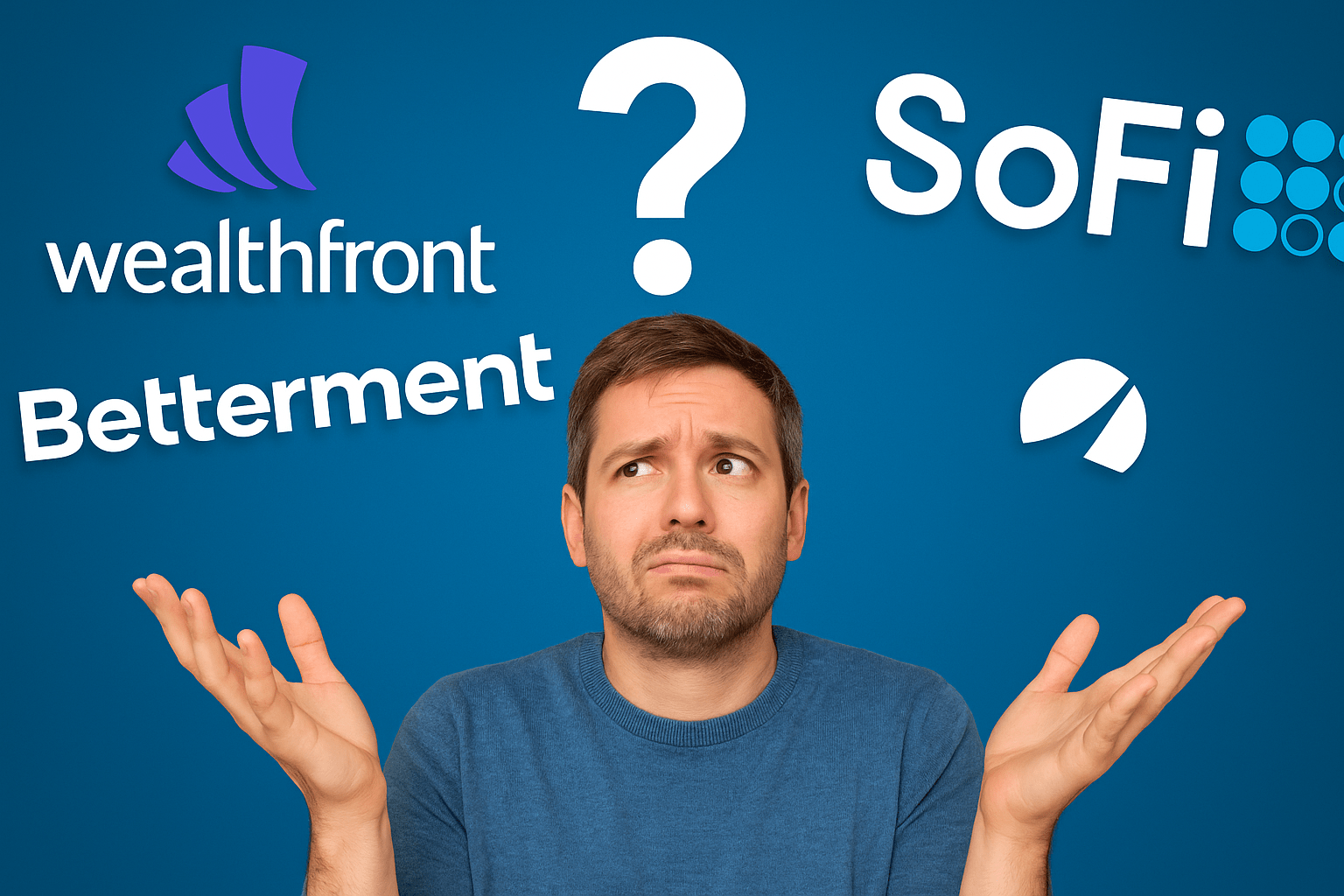
Wealthfront, Betterment and SoFi remain three of the best-known robo-advisor brands in the US market, but they are not built for the same investor. Wealthfront is strongest for taxable investors who want tax-aware automation. Betterment is better for investors who want automated investing with the option of human advice. SoFi works best for users who already want investing inside a wider financial app. The right choice depends less on the brand and more on the account type, balance size, tax needs and level of advice required.
What Is a Robo-Advisor?
A robo-advisor is an automated investment platform that builds and manages a portfolio for investors. After a customer answers questions about goals, time horizon and risk tolerance, the platform usually invests the money into a diversified mix of ETFs, funds or model portfolios.
Most robo-advisors handle rebalancing, dividend reinvestment and portfolio allocation. Some also offer tax-loss harvesting, direct indexing, cash accounts, goal planning tools and access to financial advisors.
The appeal is convenience. Investors do not need to pick individual funds, time the market or rebalance manually. The platform handles most day-to-day portfolio management.
The limit is personalisation. A robo-advisor can work well for straightforward long-term investing, but it is not a full replacement for personalised financial planning. Investors with complex tax positions, business assets, estate planning needs, concentrated stock holdings or retirement income decisions may need human advice.
Best Robo-Advisors 2026: Quick Comparison
| Platform | Best For | Advisory Fee | Minimum | Human Advisor Access | Tax-Loss Harvesting |
|---|---|---|---|---|---|
| Wealthfront | Tax-aware automation | 0.25% | $500 automated investing deposit | No ongoing human advisor relationship | Yes, for taxable automated accounts |
| Betterment | Automation with advice options | $5/month or 0.25%; Premium 0.65% | No minimum to open | Yes, through Premium | Yes |
| SoFi Robo Investing | SoFi users and beginners | 0.25% | Low starting balance | Access to financial planning support | No automatic tax-loss harvesting |
| Fidelity Go | Low-cost starter robo option | $0 under $25,000; 0.35% from $25,000 | $0 to open; $10 to invest | Coaching from $25,000 | From $25,000 on taxable accounts |
| Vanguard Digital Advisor | Low-cost index investing | Approx. low annual net advisory cost | $100 | Digital service, not full human planning | Limited compared with tax-led rivals |
| Schwab Intelligent Portfolios | No advisory fee model | $0 advisory fee | $5,000 | Base service is digital | Available subject to eligibility |
Betterment’s 2026 Digital pricing is either $5 per month or 0.25% annually. Customers under $24,000 without at least $200 per month in recurring deposits pay $5 per month; customers at $24,000 or more, or with $200 or more in recurring monthly deposits, pay 0.25% annually. Betterment Premium costs 0.65% and requires a $100,000 minimum balance.
Fidelity Go charges no advisory fee under $25,000 and charges 0.35% annually once the balance reaches $25,000. At that level, Fidelity also adds access to financial coaching and tax-loss harvesting for taxable accounts.
Wealthfront Review 2026
Wealthfront is the strongest option for investors who want a largely hands-off experience with tax features built into the platform.
Its Automated Investing Account charges a 0.25% annual advisory fee, and Wealthfront includes tax-loss harvesting as a central part of its taxable automated investing service. Wealthfront also offers direct indexing for larger taxable accounts, giving investors a more advanced form of tax-aware portfolio management.
The platform is best suited to investors who are comfortable with automation. Wealthfront builds and manages diversified portfolios, rebalances automatically and keeps the investment process deliberately simple. Its main appeal is that investors can delegate portfolio management without moving into a traditional advisory relationship.
The weakness is human advice. Wealthfront is not the right fit for investors who want regular calls with a financial planner or help coordinating tax, retirement, estate and family financial decisions.
Best for: taxable investors who want automated investing, tax-loss harvesting and a low-touch platform.
Watch out for: limited human advice and the risk of treating tax-loss harvesting as a guaranteed benefit. Tax outcomes depend on the investor’s account type, gains, losses and wider tax position.
Betterment Review 2026
Betterment is a better fit for investors who want automation now but may want more guidance later.
Its Digital service costs either $5 per month or 0.25% annually, depending on balance and recurring deposit setup. Betterment Premium costs 0.65% and gives eligible customers access to CFP professionals, with a $100,000 minimum balance.
Betterment’s strength is flexibility. It offers automated investing, goal-based portfolios, tax-loss harvesting and a path into human advice. That makes it useful for investors who are starting with simple portfolio management but expect their financial life to become more complicated.
The main drawback is the $5 monthly fee on smaller accounts. On a $1,000 balance, $5 per month equals $60 per year before fund expenses or market performance. That is a heavy percentage cost for a small investor.
Best for: investors who want automated investing with the option of human advice later.
Watch out for: the monthly fee on small accounts. Betterment becomes more attractive when the investor qualifies for 0.25% pricing or has enough invested for the monthly charge to be less damaging.
SoFi Robo Investing Review 2026
SoFi Robo Investing works best for people who already use SoFi and want investing inside the same financial app as banking, borrowing or other money tools.
SoFi’s automated portfolio service offers automatic rebalancing, but SoFi states that it does not offer automatic tax-loss harvesting. That makes it less competitive for taxable investors who want a robo-advisor mainly for tax efficiency.
The appeal is ease of use. SoFi can suit beginners who want a low-barrier way to start investing and prefer to keep several financial products in one place. It is less convincing for investors who want more advanced tax features or a deeper standalone investment platform.
SoFi has also expanded its automated investing model in recent years, including portfolio options with broader asset-class exposure. That may appeal to investors who want more choice, but it also means users should understand what sits inside the portfolio before selecting it.
Best for: existing SoFi users and newer investors who want simple automated investing.
Watch out for: no automatic tax-loss harvesting and less depth than Wealthfront or Betterment for tax-focused taxable accounts.
Wealthfront vs Betterment vs SoFi: Which Is Best?
Wealthfront is the strongest pure robo-advisor for taxable investors who want automated tax management. Its combination of 0.25% pricing, tax-loss harvesting and direct indexing options gives it a clear role for investors who want the platform to do more than hold a basic ETF portfolio.
Betterment is the stronger choice for investors who want flexibility. It is useful for people who want automated investing now but may later want access to human financial advice. The drawback is cost on small balances, where the $5 monthly fee can be poor value.
SoFi is the convenience option. It makes most sense for people who already use SoFi and want simple automated investing within the same app. It is weaker for taxable investors who care about tax-loss harvesting.
Are Robo-Advisors Becoming Obsolete?
Robo-advisors have not disappeared, but the market has become tougher.
A basic automated ETF portfolio is no longer enough to stand out. Major brokers now offer cheap funds, recurring investing, fractional shares, cash accounts and digital planning tools. Investors who are comfortable managing a simple index portfolio can often do it themselves at very low cost.
The pressure is visible across the industry. Schwab has moved to discontinue its hybrid robo-advisor service, Schwab Intelligent Portfolios Premium, while continuing to support its standalone digital investing platform. Barron’s also reported that U.S. Bank and UBS had moved to wind down robo-advisory platforms, reflecting a wider shift away from some standalone or hybrid robo models. The surviving robo-advisors need a clearer reason to exist. Tax automation, direct indexing, disciplined rebalancing, better user experience, cash management and access to human advice are the features that can still justify a fee.
Are Free Robo-Advisors Really Free?
A robo-advisor with no advisory fee can still have trade-offs.
Schwab Intelligent Portfolios is the best-known example. Its base service charges no advisory fee, but portfolios include a cash allocation. That cash position can affect returns, especially when a larger share of the portfolio is held outside the market. This does not make no-fee robo-advisors bad. It means investors should look beyond the headline price. Cash allocation, fund expense ratios, spread income, portfolio construction and account minimums all affect the real cost of using a platform. A low fee is useful only if the portfolio still fits the investor’s goals.
Robo-Advisors vs Financial Advisors
Robo-advisors are designed for portfolio management. Human financial advisors are better for wider financial planning.
A robo-advisor can help with asset allocation, rebalancing, regular investing and basic goal tracking. Some platforms add tax-loss harvesting and limited access to advisors.
A human advisor is usually more useful when financial decisions overlap. That can include retirement income, tax strategy, estate planning, business ownership, inheritance, property, divorce, concentrated stock positions or major life changes.
For a straightforward investor building a diversified portfolio, a robo-advisor may be enough. For complex financial decisions, automation has clear limits.
Are Robo-Advisors Safe?
Robo-advisors are investment platforms, not guaranteed-return products. Investors can lose money when markets fall and the recent war in Iran demonstrates just how volitle markets can be, so there is always risk when investing in stocks - regardless of the type.
Many robo-advisors use regulated brokerage and custody structures, but protection schemes do not protect against market losses. They usually protect eligible customers if a brokerage firm fails and assets are missing, subject to rules and limits.
Investors should separate platform safety from investment risk. A platform can be legitimate and regulated while the portfolio still falls in value.
How to Choose a Robo-Advisor in 2026
Start with the account type. Taxable investors should pay close attention to tax-loss harvesting, direct indexing and after-tax returns. IRA investors may care more about low fees, retirement tools and simple rebalancing.
Then look at the fee in real money. A 0.25% annual fee is modest for many investors. A $5 monthly fee can be expensive on a small account. Fund expenses also matter because they sit underneath the advisory fee.
Advice access is the next divide. Wealthfront is strongest for automation. Betterment offers a better route into human advice. SoFi works best as part of a wider app ecosystem. Fidelity Go and Vanguard Digital Advisor may appeal to investors who prefer established financial institutions.
Investors should also check whether the platform encourages good behaviour. The best robo-advisor helps users contribute regularly, stay diversified and avoid panic selling. Extra features are only useful if they support those habits.
Final Verdict
Wealthfront, Betterment and SoFi all remain credible robo-advisor options in 2026, but they serve different investors.
Wealthfront is the best fit for taxable investors who want tax-aware automation and minimal human involvement. Betterment is better for investors who want automated investing with the option to move into human advice. SoFi is best for existing SoFi users who value convenience and a low starting balance over advanced tax features.
Robo-advisors have not been made obsolete, but the weak version of the category has been commoditised. A simple ETF portfolio is easy to build elsewhere. The platforms that still deserve attention are the ones that reduce tax drag, automate discipline, improve portfolio behaviour or provide a useful bridge into advice.
For investors, the smartest choice is not the robo-advisor with the loudest marketing or the lowest headline fee. It is the one whose costs, tax features, advice access and portfolio design match the way they actually invest.
More from Finance Monthly: OpenAI’s IPO Test: Can ChatGPT Revenue Outrun the Compute Bill?