In a stunning move that has left Canadian politics buzzing, Chrystia Freeland, one of the country's most influential figures, has announced her resignation as a Member of Parliament to take on an unpaid position as economic adviser to Ukrainian President Volodymyr Zelensky. Freeland, at 57, is stepping away from her role representing Toronto's University-Rosedale riding, a Liberal stronghold she has held since 2013, to focus on supporting Ukraine's economic development amid its ongoing conflict with Russia. This decision comes just months after her departure from the federal cabinet in September 2025, when she cited a desire to pursue new opportunities outside of government.
Freeland's Deep Commitment to Ukraine
Freeland's choice reflects her longstanding personal and professional ties to Ukraine, her ancestral homeland where her grandparents emigrated from during the early 20th century. As a vocal advocate for Kyiv since Russia's annexation of Crimea in 2014, she has consistently pushed for international support, including sanctions against the Kremlin, which led to her being placed on a Russian blacklist that year.
In her announcement on X, formerly known as Twitter, Freeland emphasized Ukraine's role in the global fight for democracy, stating that she welcomed the chance to contribute without financial compensation. Zelensky praised her appointment, highlighting her expertise in attracting investments and driving economic reforms, qualities honed during her time in Canadian politics.
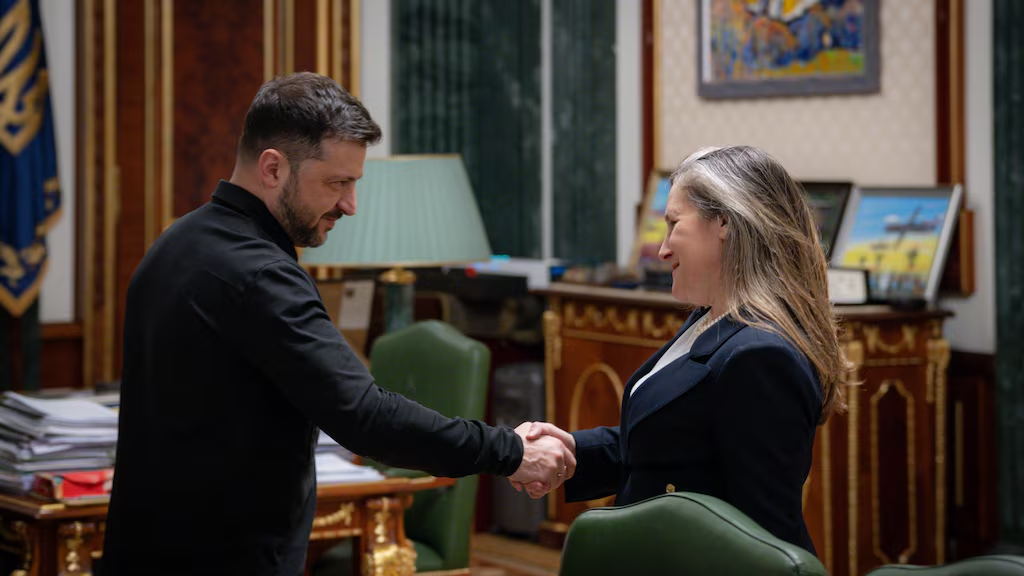
Chrystia Freeland shakes hands with Ukrainian President Volodymyr Zelensky, marking her transition from Canadian politics to serving as Ukraine’s economic adviser.
A Groundbreaking Political Career
Freeland's journey in public service has been marked by significant achievements, starting with her election to Parliament in 2013 after a successful career as a journalist for outlets like the Financial Times and Reuters. She rose quickly through the ranks, becoming Canada's first female Finance Minister in 2020, where she managed the nation's response to the COVID-19 pandemic, including massive stimulus packages that helped stabilize the economy.
Earlier, as Minister of International Trade, she played a key role in renegotiating the North American trade agreement, now known as CUSMA, navigating tense discussions with the U.S. during Donald Trump's presidency, who once labeled her "toxic" and "terrible" in public remarks. Her tenure as Deputy Prime Minister from 2019 to 2025 further solidified her influence, making her one of Prime Minister Justin Trudeau's closest allies.
Reactions from Political Circles
The announcement has sparked mixed responses across Canada's political landscape, with some praising her dedication while others question the timing and implications. Conservative foreign affairs critic Michael Chong argued that serving as an adviser to a foreign government while holding a parliamentary seat creates a conflict, insisting she must choose one or the other.
Ethics watchdogs have echoed similar concerns, noting that Freeland, who recently stepped down as Canada's special representative for Ukraine's reconstruction, must fully exit Parliament to avoid any perceived issues under conflict-of-interest rules. Supporters, however, view this as a natural extension of her advocacy, especially given her Ukrainian heritage and the high stakes involved in Ukraine's post-war recovery efforts.
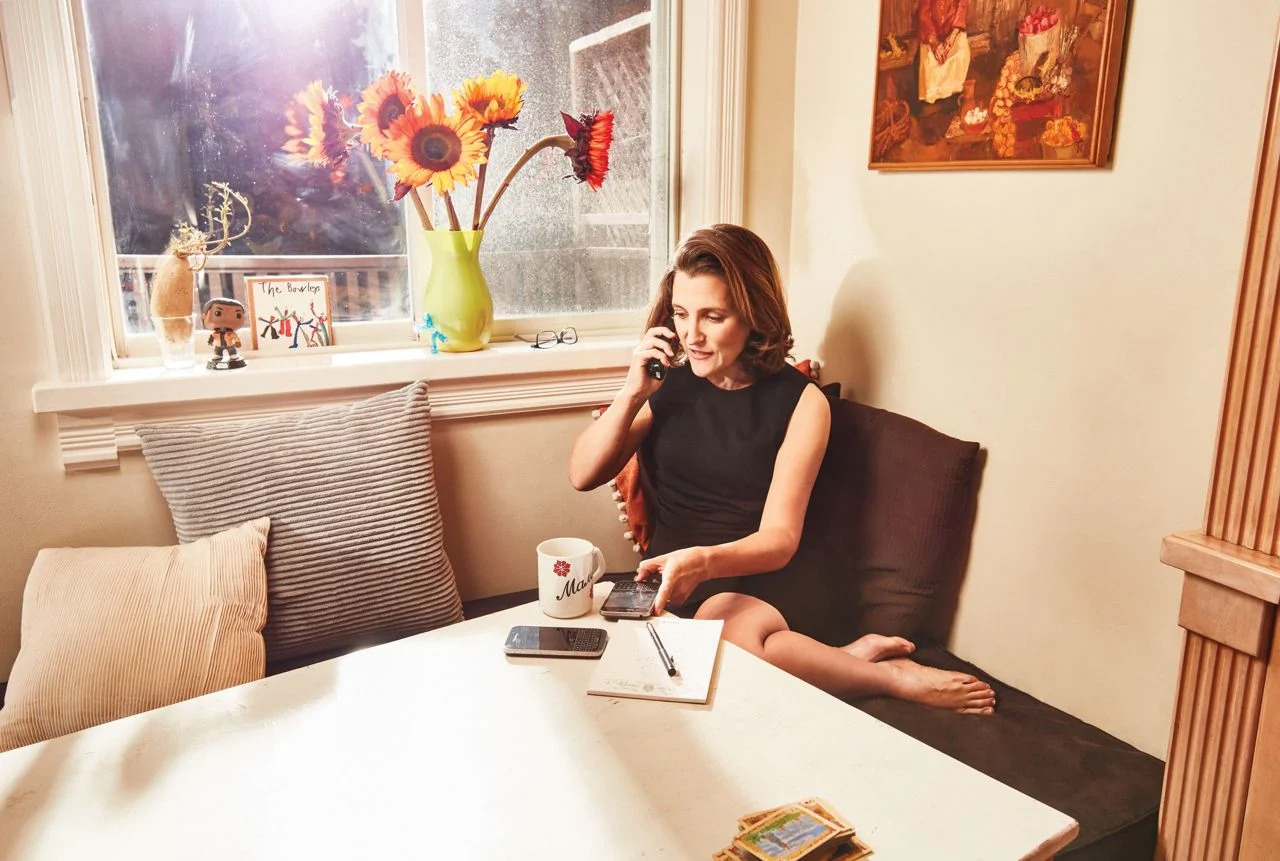
Chrystia Freeland takes a phone call in her home dining room, staying connected to key political and economic decisions in her role as Deputy Prime Minister and Finance Minister.
Looking Ahead to New Challenges
Beyond her advisory role with Zelensky, Freeland is set to embark on another prestigious position in July 2026, when she assumes the role of Warden and CEO of the Rhodes Trust in the UK, overseeing one of the world's leading scholarship programs that supports global leaders and scholars. This transition from a salaried cabinet position, which paid over $300,000 annually including benefits, to voluntary international service underscores her commitment to causes larger than personal gain. Analysts suggest this pivot could inspire other politicians to consider global roles, particularly in areas like economic diplomacy and democratic defense.
Burning Questions About Freeland's Career Shift
Why did Chrystia Freeland resign from the Canadian cabinet in 2025?
Freeland stepped down from her roles as Deputy Prime Minister and Finance Minister in September 2025, explaining in a public letter that after nearly a decade in high-level government positions, she felt it was time to explore new ways to serve both Canada and the international community. This move followed internal Liberal Party tensions and a shifting political landscape ahead of the next federal election, allowing her to focus on personal priorities while remaining an MP until her latest announcement. Experts note that her resignation paved the way for fresh leadership in economic policy, amid debates over inflation and housing affordability in Canada.
What exactly is the Rhodes Trust, and what will Freeland's role involve?
The Rhodes Trust, established in 1902 by Cecil Rhodes, administers the renowned Rhodes Scholarships, which fund postgraduate studies at the University of Oxford for outstanding young leaders from around the world, promoting international understanding and public service. As the new Warden and CEO starting in July 2026, Freeland will lead the organization's strategic direction, oversee its endowment worth billions, and expand its programs to address contemporary global challenges like climate change and inequality. Her background in economics and diplomacy positions her well to enhance the Trust's impact, potentially increasing diversity among scholars and strengthening ties with emerging economies.
How has Freeland's Ukrainian heritage influenced her political actions?
Freeland's grandparents fled Ukraine during Stalin's regime, instilling in her a deep appreciation for freedom and resilience that has shaped her foreign policy stance throughout her career. This heritage drove her early bans on Russian propaganda in Canada, her advocacy for military aid to Ukraine since 2014, and her authorship of books like "Plutocrats," which critique global inequalities often exacerbated by authoritarian regimes. Her personal story has made her a bridge between Western governments and Kyiv, fostering alliances that have delivered billions in aid, and now culminates in her direct advisory role to Zelensky, where she aims to apply lessons from Canada's economic recoveries to Ukraine's rebuilding efforts.