


The Financial Shock
The money landed first, not the music. After years of legal back-and-forth with his former band, Mick Mars has been ordered to pay roughly $244,000 out of pocket, a figure that only emerges once advances, missed shows, and ownership payouts are offset against each other.
The ruling didn’t arrive after a new tour or a comeback moment; it arrived after time off, illness, and distance from the stage.
For a founding member of a stadium band, the shock isn’t just the bill, it’s how quickly legacy turns into ledger.
How the Money Starts Moving
The dispute began when Mick Mars stepped back from touring after his health made full schedules impossible. It wasn’t a decision to stop working, but it did interrupt the part of the business that generated the most reliable income.
Touring had long supported the rest of the band’s financial structure, even when members weren’t on stage every night.
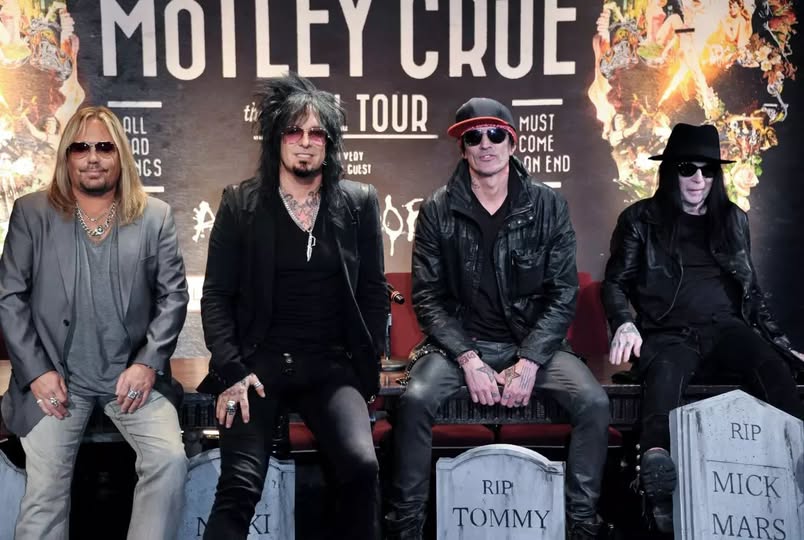
Mötley Crüe bandmates pictured together during a tour period that later became central to financial and legal disputes.
When the live shows ended, that income stopped with them. Advances tied to dates he could no longer play were no longer future earnings but amounts that had to be reconciled.
At the same time, Mars’ remaining stake in the band’s business had to be valued and settled, turning ownership into a calculation rather than a connection.
By the time the numbers were closed, Mars owed his former bandmates — Vince Neil, Nikki Sixx, and Tommy Lee, more than he was owed in return.
The change didn’t happen all at once. It unfolded through routine accounting and settled quietly once the touring stopped.
Where Touring Income Shrinks and Financial Pressure Sets In
At this level of success, touring underpins far more than earnings. When it pauses, even temporarily, contractual obligations move to the foreground.
Missed tour dates can trigger advance clawbacks, ownership stakes are re-evaluated, and future earning options narrow quickly. In Mick Mars’ case, continuing to write, record, or make limited appearances was not enough to preserve the same financial footing once full-scale touring ended.
What follows is rarely dramatic in public but deeply consequential in private. Stepping away from a touring machine forces a shift from growth to containment, with legal fees becoming part of the ongoing monthly burn.
Decisions that once felt optional how long to fight, whether to appeal, when to disengage, turn into financial calculations rather than matters of principle.
Even for a founding member of a global band, stability begins to outweigh expansion as income, control, and momentum quietly tighten.
How Financial Pressure Reappears for Famous Names
This type of financial strain shows up again and again in entertainment because contracts keep operating even when people can’t. Wealth may soften the immediate blow, but it doesn’t change how the system works.
When health, age, or timing disrupt the main income stream, accounting takes over. Advances are reconciled, ownership terms are enforced, and costs continue to build, often long before the public notices anything has shifted.
That reality leaves artists facing a narrow and uncomfortable choice. They can pay to close the dispute and absorb the loss, or spend more time and money challenging decisions that have already reshaped their financial position.
Continuing to fight may protect control but extend the drain, while stepping away can restore peace at a measurable cost. There is no clean exit — only different ways of trading time, money, and momentum.
An Open Financial Ending
For Mick Mars, the story doesn’t end with a verdict. The consequences stretch on. Ongoing expenses, uncertainty about future income, and the personal toll of stepping away from a band that shaped his career are all still in play.
The question isn’t really whether $244,000 can be absorbed. It’s how much longer holding on makes sense and what, in the end, walking away is actually worth.