Nvidia’s $54B China Liquidity Lock: The H200 Cash‑Upfront Mandate and the New CFO Risk Paradigm
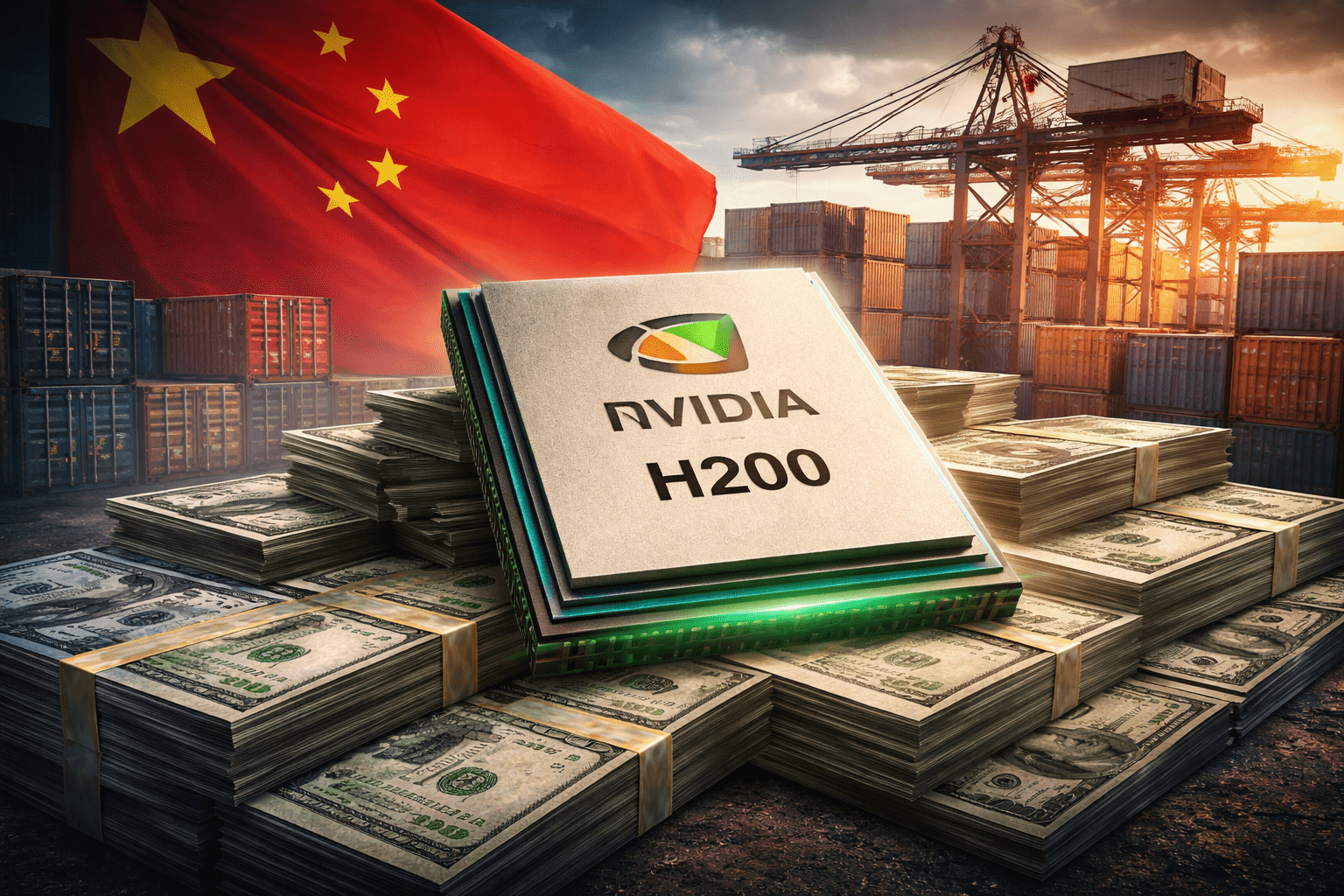
Nvidia has begun requiring 100% upfront, non‑refundable cash payments for H200 AI chips sold into China, fundamentally reshaping how advanced compute infrastructure is financed under geopolitical stress. The policy follows Nvidia’s $5.5 billion inventory writedown in 2025 and reflects escalating uncertainty under U.S. export controls and Chinese import oversight. For Chinese hyperscalers such as ByteDance, Alibaba, and Tencent, the mandate traps billions of dollars in pre‑delivery capital, introduces binary regulatory risk, and forces CFOs to treat AI hardware procurement as a balance‑sheet stress event rather than a routine CapEx decision. What emerges is not a supply‑chain disruption, but a structural redefinition of liquidity, counterparty exposure, and capital allocation in the AI economy.
Working capital cycles are facing an unprecedented stress test in the semiconductor sector. Nvidia’s requirement effectively weaponizes the balance sheet against policy volatility, transferring delivery and regulatory risk entirely from vendor to buyer. Liquidity velocity for China’s largest technology firms has hit a structural chokepoint: capital must now be committed months in advance with zero recovery optionality. The traditional deposit‑based procurement model has been eliminated, forcing treasurers to recalibrate cash‑flow forecasting under conditions more akin to sovereign risk than commercial trade.
Asset forfeiture risk has become explicit. Nvidia’s refusal to offer refunds, configuration changes, or delivery contingencies creates a binary financial outcome. If a shipment is denied by U.S. or Chinese regulators, the buyer absorbs a total loss. At roughly $27,000 per H200 unit, excluding the 25% U.S. government surcharge, each order functions less like equipment procurement and more like a speculative financial position contingent on regulatory clearance.
Liquidity Lock‑In and the Rise of Dead Capital
The immediate consequence is the emergence of large pools of “dead capital.” ByteDance and Alibaba must now immobilize billions of dollars long before hardware arrives or generates economic value. This capital cannot be depreciated, leveraged, or redeployed while trapped in pre‑delivery limbo. The opportunity cost is material: internal estimates suggest that sidelined liquidity of this magnitude can compress net margins by more than 100 basis points annually for hardware‑intensive platforms.
Commercial insurance markets are therefore becoming de facto gatekeepers for AI infrastructure. In select cases, asset collateral or insurance guarantees may substitute for pure cash, creating a new revenue stream for credit insurers. Regulatory non‑delivery coverage is now being priced at 15–20% of contract value, transforming insurance premiums into a core line item of AI infrastructure budgets. For CFOs, this is no longer optional risk management; it is the only available hedge against total capital loss.
Inventory Writedowns and Nvidia’s Defensive Pivot
The fiscal aggression behind Nvidia’s policy is rooted in experience. The company’s $5.5 billion inventory hit in 2025 demonstrated that even dominant market leaders are vulnerable to abrupt policy reversals. By demanding full upfront payment, Nvidia insulates its own P&L from future regulatory shocks, effectively externalizing geopolitical risk onto its customers. This establishes a new global precedent for high‑demand, high‑regulation hardware sales.
Counterparty risk is being redefined by compute scarcity. Chinese firms are accepting unusually stringent terms because the alternative is technological obsolescence. The performance gap between domestic accelerators and the H200 remains a critical competitive liability. That desperation grants Nvidia leverage to impose conditions that would be untenable in almost any other industrial market.
Capital Recovery and Asset Recapture Risk
Under this framework, the H200 has shifted from a conventional capital asset to a zero‑recovery exposure. If shipments are blocked by the U.S. Office of Foreign Assets Control or delayed indefinitely by China’s Ministry of Industry and Information Technology, the no‑refund clause triggers an immediate write‑off. There is no established legal pathway for asset recapture, creating a vacuum where capital loss is final and unappealable.
This dynamic has catalyzed a secondary financing ecosystem. Institutional lenders are structuring bespoke facilities that bundle insurance, escrow, and regulatory contingencies into a single cost of capital. The result is higher effective pricing for compute and a recalibration of return thresholds for AI model training and deployment.
Liquidity Velocity and Settlement Friction
Traditional T+30 or T+90 payment cycles have been replaced by what treasurers describe as instant liquidity extraction. Letters of credit, staged deposits, and delivery‑linked payments are no longer accepted. The impact is asymmetric: while China’s largest platforms can absorb the shock, mid‑sized AI firms face existential pressure, accelerating consolidation across the sector.
Operational chokepoints have migrated from fabrication plants to treasury departments. “Dead Cash Days” — the period between payment and hardware activation — are now a core KPI for finance teams. As capital sits idle, debt service and opportunity costs continue to accrue, even if delivery timelines slip.
The 2026 Outcome Matrix: Strategic Procurement Realignment
The legacy funding model has collapsed. Deposit‑based procurement, asset‑backed lending, and just‑in‑time supply chains have been replaced by upfront cash commitments, collateralized insurance, and strategic hoarding of production slots. Firms are now paying up to 12 months in advance simply to secure a position in Nvidia’s allocation queue.
Institutional research reflects the severity of the shift. Goldman Sachs notes that the combination of upfront payment and the U.S. government surcharge creates an effective 125% capital requirement for each dollar of compute. JPMorgan warns of a localized liquidity crunch among hardware‑intensive startups, while S&P Global highlights the competitive advantage conferred by fortress balance sheets at U.S. hyperscalers.
Structural CapEx and Technical Friction
The forced migration from the H20 to the H200 architecture compounds financial stress. While the H200 delivers multiple‑fold performance gains, integrating it requires a wholesale overhaul of data‑center infrastructure. TSMC’s constrained CoWoS packaging capacity remains a jurisdictional chokepoint, limiting how quickly prepaid orders can be fulfilled.
Regulatory compliance has evolved into a permanent tax on innovation. The 25% U.S. surcharge effectively positions the Treasury as a silent partner in China‑bound AI sales, while domestic mandates to pair Nvidia hardware with local accelerators impose dual‑stack engineering costs. Software teams must now optimize for divergent architectures, doubling integration expense and delaying time‑to‑value.
The Physicality of Finance
Even when capital is available, physical constraints remain binding. Power density, cooling capacity, and grid access represent non‑negotiable costs. If hardware delivery is delayed, these investments cannot be unwound. A $27,000 chip without power and thermal infrastructure is not an asset — it is inert silicon.
Revolving credit facilities provided by global banks are already under strain. If imports are paused, debt service continues even as the underlying asset fails to materialize. This disconnect exposes the inadequacy of traditional covenants in a world where geopolitical decisions override commercial contracts.
Strategic Irony and Long‑Term Risk
Nvidia’s strategy is designed to shield itself from Washington’s policy pivots, yet it carries a paradox. By extracting $54 billion in liquidity from its largest growth market, Nvidia may be accelerating investment into domestic alternatives and open‑standard architectures such as RISC‑V. The fiscal friction imposed today could subsidize the emergence of a rival ecosystem tomorrow.
Boardroom Recommendation: The Liquidity Fortress
AI procurement in 2026 is no longer a supply‑chain issue; it is a sovereign‑level balance‑sheet decision. CFOs must treat H200 purchases as zero‑recovery exposures, segregate funding from operating cash, and engage insurers early to transfer regulatory risk. Diversification into domestic and open architectures is no longer optional — it is a hedge against both policy volatility and punitive capital lock‑ins.
What People Are Asking
Why is Nvidia requiring full upfront payment in China?
Nvidia is insulating its balance sheet from sudden U.S. or Chinese export bans by eliminating refund, delivery, and configuration risk. By shifting regulatory uncertainty entirely onto the buyer, Nvidia protects its own P&L from inventory write-downs caused by abrupt policy reversals.
What is the price of an Nvidia H200 chip?
The Nvidia H200 is priced at approximately $27,000 per unit for the Chinese market, excluding the additional 25% surcharge paid to the U.S. government. When insurance, financing costs, and infrastructure integration are included, the effective cost per unit is materially higher.
Can Chinese companies still buy Nvidia chips?
Yes. Chinese firms can still purchase Nvidia H200 chips under an approved-customer framework established by U.S. export authorities. However, shipments remain vulnerable to regulatory pauses from either Washington or Beijing, creating ongoing delivery and capital recovery risk for buyers.
What is the performance gap between H20 and H200?
The H200 delivers roughly six times the AI training performance of the previously compliant H20 chip, particularly for large language models and memory-intensive workloads. This performance gap makes domestic alternatives less competitive for frontier AI development despite lower regulatory exposure.
Who ultimately captures the surcharge?
The 25% surcharge on China-bound H200 sales is paid directly to the U.S. Treasury under revised export control arrangements. In practice, this positions the U.S. government as a silent revenue participant in approved advanced-compute sales into China.
Financial Insight: 👉Leverage, Liquidity, and the $108 Billion Brinksmanship for Warner Bros👈
SEO Tags: #NvidiaH200China #AIFinance2026 #CorporateTreasuryRisk #SemiconductorCapEx #TrumpChinaTrade #SemiconductorGeopolitics