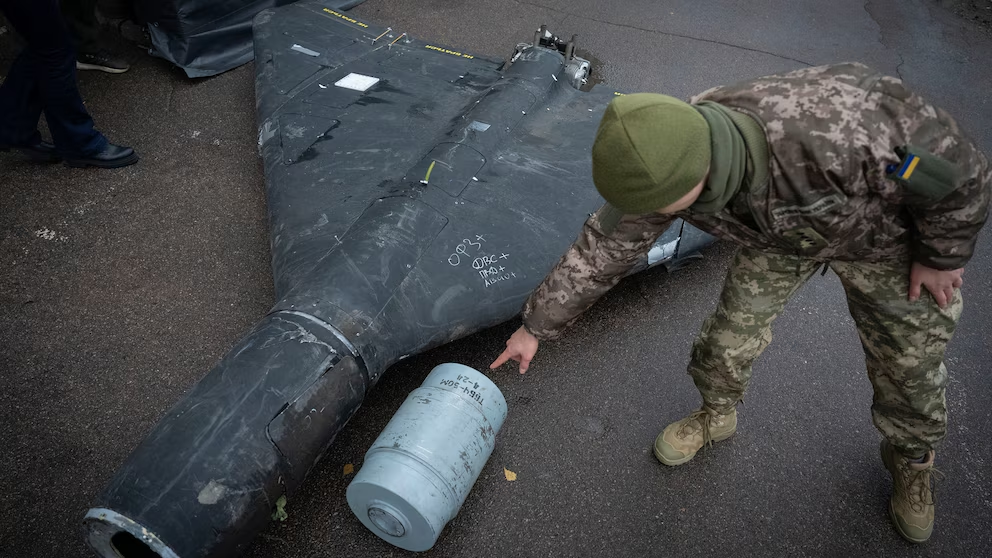
Europe could face demands for billions more in defense spending after Latvia’s military chief warned that Russia’s growing advantage in drone warfare may expose vulnerabilities along NATO’s eastern frontier. The warning arrives at a difficult moment for many European governments already balancing slow economic growth, stretched public finances, rising debt costs, and competing demands for investment in healthcare, housing, and infrastructure.
General Kaspars Pudāns, commander of Latvia’s armed forces, said Russia’s strength lies less in breakthrough technology and more in its ability to manufacture drones in large numbers and rapidly adapt them in wartime. He warned that Moscow could seek to exploit a narrow window before European military modernization programs are fully operational later in the decade.
Security may be the headline issue, but the money required to respond is quickly becoming part of the story. Governments across Europe have already committed to sharply higher defense spending, yet accelerating those plans could place additional demands on national budgets at a time when many countries are struggling to revive growth and keep borrowing under control.
The consequences reach far beyond defense ministries. Larger military commitments often force difficult choices elsewhere, particularly when public finances are already under scrutiny. Every increase in defense spending competes with other priorities, forcing governments to make decisions that can affect infrastructure projects, public services, and long-term investment plans.
Across Europe, officials are beginning to rethink assumptions that shaped defense planning for much of the past decade. What was once viewed as a longer-term strategic challenge is increasingly being treated as a near-term financial and political issue. Several NATO countries are now questioning whether military preparedness can keep pace with a rapidly changing security environment.
The speed of the debate is notable. Only a few years ago, many European governments were discussing how quickly defense budgets could be reduced after decades of relative stability. Today, policymakers are debating how rapidly spending can be increased and how much additional capacity can be built before emerging threats outpace existing plans.
Russia’s experience in Ukraine has played a major role in those concerns. Years of battlefield experimentation have allowed both Russian and Ukrainian forces to refine drone tactics at remarkable speed. The conflict has shown that relatively inexpensive drones can destroy expensive equipment, overwhelm defenses, and alter the balance of military operations in ways few expected before the war.
That lesson is now forcing Western governments to rethink how they spend defense budgets. Building larger armies alone may no longer be enough. Countries must also develop the industrial capacity to produce vast numbers of drones, replace equipment quickly, and sustain operations during prolonged conflicts.
Paying for that transformation will not be cheap. Expanding defense production requires factories, supply chains, skilled labor, and long-term government contracts. Competition for engineers, factory space, and critical components is already becoming more intense, pulling resources toward military manufacturing and related industries.
Businesses are paying attention. Rising geopolitical tensions often make companies more cautious about investment decisions, particularly when governments signal major changes in spending priorities. Investors also tend to reassess risk when security concerns increase, creating additional uncertainty for markets already navigating weak growth and trade tensions.
Europe’s problem is no longer finding reasons to spend more on defense. It is finding the money, industrial capacity, and workforce needed to move faster. Many modernization programs are still years away from completion, while military officials increasingly argue that potential threats may be evolving more quickly than governments had assumed.
Pudāns stressed that Russia currently lacks the forces for a large-scale invasion while its war in Ukraine continues. However, he warned that the situation could change if the conflict eventually ends and military resources become available elsewhere.
Governments may still be debating military timelines, but businesses and investors are already adjusting to a different reality. Security is becoming a larger economic cost, and the bill is arriving long before many of Europe’s rearmament plans are complete.