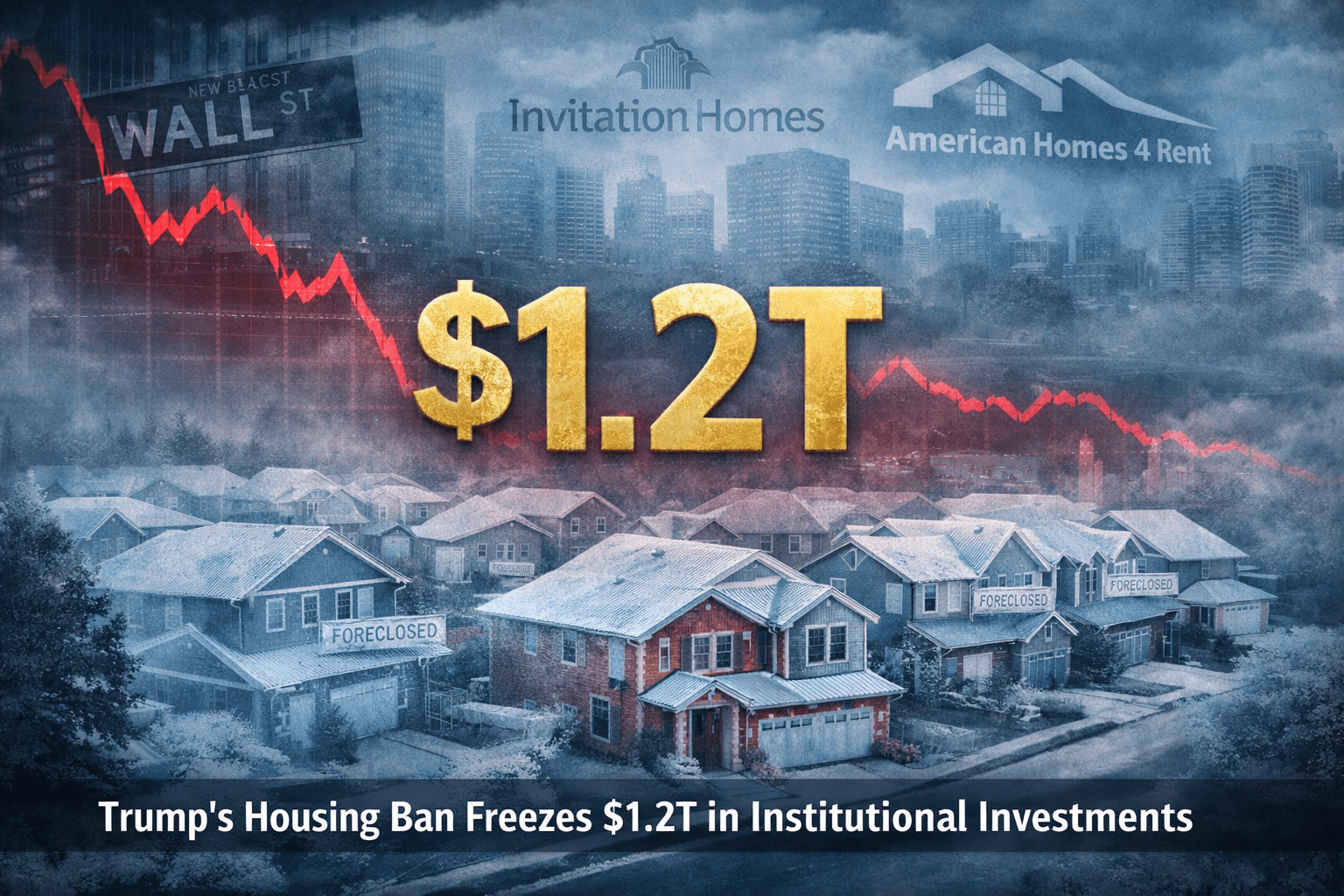
The $1.2 Trillion Liquidation Risk: Trump’s Single-Family Housing Ban and the Institutional Exit
Capital market equilibrium in the residential sector has been shattered by a single policy pivot. President Donald Trump’s announcement of a federal ban on institutional acquisitions of single-family homes has effectively frozen the deployment of billions in private equity. In practical terms, Trump’s proposed policy would prevent large institutional investors, private equity firms, and REIT-backed entities from acquiring additional single-family homes, directly impacting the $4 trillion Single-Family Rental (SFR) market.
This move targets the very foundation of the "Build-to-Rent" and SFR asset classes. For institutional investors, the "American Dream" is now a statutory liability. REIT valuations face a catastrophic decoupling from Net Asset Value (NAV). Shares in sector leaders like Invitation Homes (INVH) and American Homes 4 Rent (AMH) dived as much as 6.9% following the announcement, signaling a massive loss of confidence.
Investors are now pricing in a "frozen portfolio" scenario where growth is legally capped. This creates a structural arbitrage for those who can navigate the inevitable legal challenges. Liquidity velocity in the housing market is set to experience a terminal slowdown. By removing "billion-dollar funds" as market makers, the administration is stripping away the liquidity that has stabilized the market since the 2008 crash.
Corporate treasurers must now account for longer holding periods and higher exit friction in their residential portfolios. The "house next door" has transitioned from a liquid commodity to a restricted sovereign asset. M&A activity in the residential space has hit a regulatory wall. Prospective acquisitions of SFR platforms by firms like Blackstone or Cerberus are now under immediate compliance review.
This creates an acquisition risk that could stall the consolidation of the fragmented 86-million-home market. Institutional leads must now pivot to "Build-for-Sale" models to avoid the looming purchase prohibition. Synergy realization in the rental sector is being replaced by statutory risk. Trump’s vow to "codify" the ban through Congress suggests a permanent shift in the legal landscape of property rights.
Firms with ownership thresholds exceeding the proposed limits face potential forced divestiture or punitive taxation. This is no longer a localized zoning issue; it is a Tier-1 federal mandate. Interest rate exposure is being exacerbated by this secondary market shock. With the PHLX Housing Index marking its steepest daily drop in months, the cost of capital for housing-focused firms is spiking. Lenders are already tightening debt covenants for portfolios concentrated in the Sun Belt. CFOs must urgently re-evaluate their leverage ratios before the Davos expansion of this policy further rattles the bond markets.
Capital Recovery & Asset Recapture
The primary financial risk is no longer market cyclicality, but "Statutory Impairment." President Trump’s proposed ban on institutional acquisitions triggers an immediate valuation discrepancy between current book values and the projected exit price in a restricted market. For firms like Blackstone and Invitation Homes, capital recovery is now tethered to the "forced buyer" pool of individual households, who lack the multi-billion dollar credit facilities of Wall Street.
This creates a ceiling on synergy realization, as the cost-efficiencies of managing 100,000+ homes are negated by the inability to refresh the portfolio at scale. Debt recovery protocols for housing-backed securities are under structural stress. As JPMorgan and Goldman Sachs reassess the risk profiles of Single-Family Rental (SFR) portfolios, we expect a widening of the liquidity premium.
If institutional buyers are sidelined, the underlying asset—the home—loses its status as a high-velocity institutional commodity. This forces a recalibration of loan-to-value (LTV) ratios, potentially triggering margin calls for highly leveraged private equity funds that relied on aggressive NAV (Net Asset Value) appreciation forecasts.
Liquidity Velocity & Settlement Friction
Settlement friction is transitioning from a transaction cost to an operational chokepoint. The institutional model relies on "portfolio-level" velocity—the ability to buy or sell 500 units in a single transaction. A federal ban mandates a return to "Granular Friction," where each sale requires individual inspections, appraisals, and mortgage contingencies.
According to data from LSEG, this shift could extend the average days-on-market (DOM) for institutional-grade properties from 21 days to over 90, effectively freezing billions in corporate cash flow. Execution risk has become a binary variable for M&A leads. Current transactions in the pipeline are facing "Closing Paralysis" as legal teams scrutinize the lack of draft legislation.
This uncertainty creates a transactional vacuum where neither the seller (Institutional) nor the buyer (Institutional) can commit, for fear of violating a "Day One" executive order. S&P Global notes that this freeze in liquidity velocity doesn't just lower prices; it destroys the price discovery mechanism for the entire residential asset class, potentially leading to a broader credit tightening in the MBS (Mortgage-Backed Securities) market.
The 2026 Outcome Matrix: The Housing Liquidity Shift
| Legacy Funding Model | Strategic Trigger 2026 | Institutional Reality |
|---|---|---|
| Aggregated Portfolio (SFR): Institutional buyers act as market makers, providing floor liquidity. | Trump "Truth Social" Mandate: Direct threat to eliminate the "Wall Street Landlord" category. | Fragmentation Risk: Portfolios must be broken down; exit velocity drops by 70% due to granular sale requirements. |
| Build-to-Rent (BTR): Vertical integration from land acquisition to long-term rental income. | Statutory Thresholds: Proposed bans on ownership caps (e.g., >100 units) hitting BTR scale. | Pivot to Build-for-Sale: Infrastructure remains, but the model shifts to immediate liquidation to avoid holding caps. |
| Asset-Backed Securitization: Loans bundled and sold to bond investors based on rental cash flow. | REIT NAV De-rating: Valuation drops of 5-10% post-announcement rattling the debt markets. | Covenant Breaches: Lowered asset values trigger "LTV resets," forcing emergency capital injections. |
Institutional Intelligence: The "Market Maker" Perspective
-
JPMorgan: Highlights that while institutional owners hold only ~3.8% of SFR stock, they represent a disproportionate share of the "marginal buyer" pool in high-growth metros like Atlanta and Phoenix.
-
Goldman Sachs: Warns that a ban could inadvertently spike rental inflation by suppressing the construction of new managed-rental communities (BTR), which add to the total housing supply.
-
LSEG Data: Indicates a sharp rise in put option volume for residential REITs, signaling that institutional investors are hedging for a "worst-case" legislative outcome by the Davos meeting.
-
S&P Global Ratings: Maintains a "Credit Watch Negative" status for firms with high exposure to the single-family sector until the "ownership threshold" definitions are clarified.
Structural CapEx & Technical Hurdles
Capital allocation strategies for institutional housing are being forcefully redirected toward "Disposal Infrastructure." For years, the Carlyle Group and Invesco have optimized their tech stacks for the rapid acquisition and "onboarding" of thousands of scattered-site properties. Now, the operational CapEx must shift toward a high-friction divestiture model.
The technical hurdle lies in unbundling these assets from the Yardi or RealPage property management ecosystems and preparing them for individual retail sale—a process that requires a massive surge in localized legal and brokerage expenditures. Regulatory compliance has morphed into a permanent jurisdictional scavenger hunt.
As the White House explores purchase bans, firms like Pretium Partners and Progress Residential must navigate a patchwork of "Anti-Wall Street" ordinances already popping up in markets like Charlotte and Dallas. Integrating these disparate local compliance mandates into a centralized ERP system creates a massive "Complexity Tax." Furthermore, the cost of auditing portfolios to meet the proposed federal "Ownership Thresholds" will likely result in a significant spike in professional service fees paid to the Big Four, specifically Deloitte and PwC, as firms scramble to certify their "non-institutional" status.
The Physicality of Finance
The physical reality of "The House Next Door" creates a terminal execution limitation for high-finance. Unlike the digital liquidity of Nasdaq or the CME Group, real estate is stubbornly physical. Institutional landlords face a "Maintenance Covenant" crisis; as the threat of forced liquidation looms, the incentive to reinvest in the physical upkeep of these assets diminishes.
This creates a "Physicality Trap"—if Starwood Capital or Apollo Global Management lets the physical asset degrade, the appraised value drops, potentially triggering technical defaults on Commercial Mortgage-Backed Securities (CMBS) issued through Wells Fargo or Bank of America. Execution limitations are dictated by the "Retail Bottleneck."
Wall Street is built for the "Bulk Trade," but the Trump mandate forces a "Retail Exit." Even a firm as massive as Blackstone cannot liquidate 50,000 homes simultaneously without crashing the very local markets they seek to exit. This is the operational friction of the physicality of finance: you cannot "dump" a suburb the way you dump a stock. The physical capacity of title companies like First American Financial and Fidelity National to process hundreds of thousands of individual retail closings represents a hard ceiling on how fast institutional capital can actually retreat.
Strategic Irony: The "Populist Price" Paradox
There is a biting strategic irony in the President’s attempt to restore the "American Dream" by banning the "Billion-Dollar Fund." The primary objective is to lower prices for the middle class. However, by freezing the "Build-to-Rent" (BTR) pipeline—which is almost exclusively funded by institutional giants like Lennar and DR Horton in partnership with private equity—the administration may inadvertently cause a supply-side collapse.
The real-world fiscal constraint is that individual families do not have the $500 million credit facilities required to break ground on a 1,000-home subdivision. By removing the institutional market-maker, the administration risks a "Liquidity Desert" where new home starts plummet.
In this irony-rich environment, the policy meant to make homes affordable could result in a housing shortage so acute that prices and rents spike for the very "Young Americans" the policy aims to protect. The Federal Reserve’s struggle to manage inflation will only be exacerbated if the most significant component of the CPI (Consumer Price Index)—shelter—is throttled by a lack of institutional development capital.
Authority Close & SEO Boardroom Recommendation: The "Retail-Pivot" Protocol
The 2026 residential investment landscape has undergone a permanent shift from an Accumulation Era to a Compliance & Liquidation Era. For the C-Suite, the "American Dream" policy mandate necessitates a radical deleveraging of single-family portfolios.
-
Strategic Disposition: CFOs must immediately transition from bulk portfolio valuation to Granular Asset Appraisals. Preparing assets for individual retail sale—rather than portfolio-level trades—is the only way to preserve NAV in a restricted buyer environment.
-
Regulatory Arbitrage: M&A leads should pivot capital toward Multi-Family (MFR) and High-Density Residential assets, which currently sit outside the proposed "House Next Door" ban. This allows for the maintenance of real estate exposure while bypassing the statutory risk of single-family holdings.
-
Capital Preservation: Treasurers should re-negotiate debt covenants with lenders like Wells Fargo and Bank of America to account for longer disposition timelines. Securing "extended-hold" liquidity facilities will be critical to avoiding fire sales during the retail transition.
Institutional Exposure List
The following entities represent the highest concentration of institutional exposure and will dictate the market’s response to the federal ban:
-
Blackstone (BX): Largest institutional landlord via HomePartners, facing the most significant divestiture pressure.
-
Invitation Homes (INVH): Premier publicly traded SFR REIT, currently the primary bellwether for sector-wide stock volatility.
-
American Homes 4 Rent (AMH): Heavily exposed in the Sun Belt; their "Build-to-Rent" pipeline is a major flashpoint for policy impact.
-
Vanguard & BlackRock: Primary institutional shareholders in residential REITs, whose re-weighting decisions will drive 2026 equity flows.
-
Lennar (LEN) & DR Horton (DHI): Leading homebuilders whose institutional partnerships for rental subdivisions are now under legal scrutiny.
-
Starwood Capital Group: A major player in the "build-for-rent" space, facing a fundamental business model pivot toward build-for-sale.
What Are People Asking?
-
What is Trump's plan for Wall Street home buying? A proposed federal ban or strict cap on institutional investors and private equity firms purchasing single-family homes.
-
Which REITs are affected by the single-family home ban? Primarily Invitation Homes (INVH), American Homes 4 Rent (AMH), and Tricon Residential.
-
Will the housing ban lower home prices? Analysts predict a short-term price correction due to lost institutional liquidity, though long-term supply could drop.
-
Does the ban apply to small landlords? No, the administration has clarified the policy targets "billion-dollar funds," not local "mom-and-pop" investors.
-
What is a Build-to-Rent (BTR) development? A community of single-family homes designed specifically for long-term rental, often funded by institutional capital.
-
Can the President ban Wall Street from buying homes? The move would likely require an Executive Order combined with Congressional legislation to survive legal challenges.
-
How much of the housing market does Wall Street own? While institutions own ~3.8% of the total SFR stock, they account for a high percentage of recent purchases in specific high-growth metros.
-
When will the housing ban take effect? President Trump is expected to announce specific legislative details and timelines during the Davos meeting in late January 2026.
Financial Insight: 👉Leverage, Liquidity, and the $108 Billion Brinksmanship for Warner Bros👈
High-Intent SEO Tags: #HousingMarket2026 #REITRiskAudit #WallStreetHousingBan #InstitutionalRealEstate #TrumpHousingPolicy #PrivateEquityRealEstate #BuildToRent