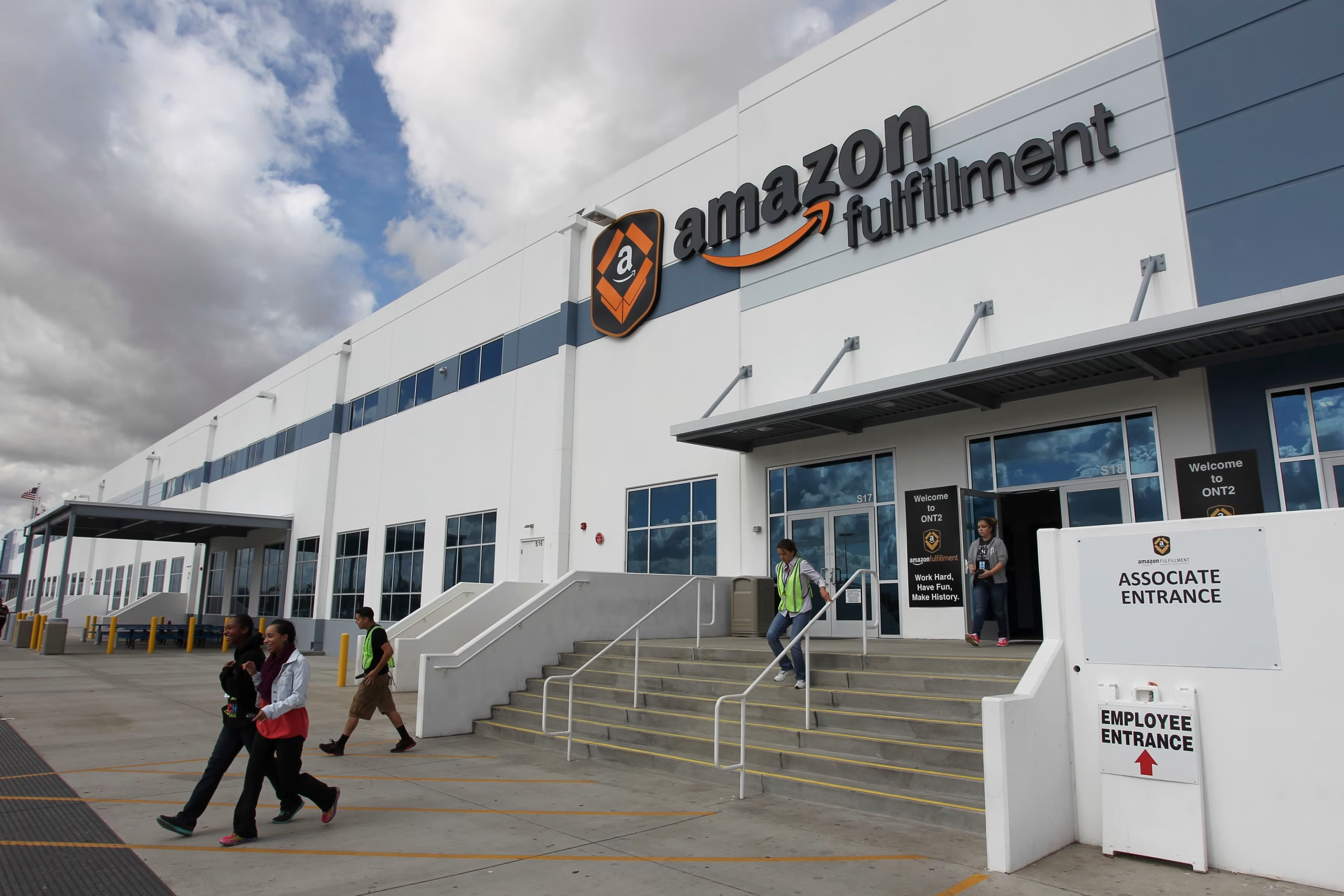
Thousands of Amazon employees are once again trying to understand why one of the world’s richest companies keeps finding new ways to eliminate jobs even as the business continues expanding into AI, cloud computing and global logistics.
Inside Amazon, employees are increasingly questioning whether these cuts are becoming permanent and whether the company is redesigning how many people it actually needs.
The latest cuts are making more workers wonder whether restructuring is becoming a permanent feature inside major companies. Amazon confirmed in January that it would eliminate around 16,000 roles globally as part of efforts to reduce bureaucracy, simplify reporting structures and remove management layers.
Amazon said the cuts were part of another effort to simplify the company and reduce management layers. Beth Galetti, senior vice president of people experience and technology at Amazon, said the company was attempting to “reduce layers, increase ownership, and remove bureaucracy” after multiple teams continued organizational reviews following earlier layoffs in late 2025.
But for many workers, the repeated layoffs are making jobs inside large companies feel far less secure.
Amazon employs roughly 1.5 million people globally, with around 350,000 in office-based and corporate positions. Yet the company has spent months reorganizing large parts of its operations while executives push harder toward AI-driven efficiency, centralized management and leaner decision-making structures.
The cuts have not remained confined to one country or one department. Reporting tied to Amazon’s January restructuring linked layoffs to teams across the United States, Canada and Costa Rica, with additional reductions continuing into May.
In Costa Rica, employees described fresh cuts affecting finance, call centers and human resources operations as Amazon continued reshaping its global staffing model. Workers reportedly lost system access and building access almost immediately after being informed.
Amazon’s restructuring also reflects a wider change happening across major companies as executives try to determine how aggressively AI can reduce staffing inside large businesses.
The changes are no longer limited to engineering or software divisions.
Inside Amazon and across large companies, management is reassessing customer support, operations, internal administration, HR functions and oversight roles. Departments once viewed as stable are now being judged much more aggressively on efficiency and output.
Amazon’s own 2026 proxy filing shows how heavily the company is now building more of its business around AI-driven operations and automation. The company said it has already upskilled more than 700,000 employees globally for future AI-related work while expanding robotics systems inside its operations network and heavily expanding its AI infrastructure through Amazon Web Services. Amazon also highlighted new AI-powered systems, AI agents and automation tools being rolled out across multiple parts of the business.
At the same time, Amazon continues simplifying management structures and reducing layers across parts of the company, reinforcing growing concerns among workers that large businesses increasingly see technology as a way to operate with fewer people over time.
For many workers, the hardest part to understand is that many of these companies are not struggling financially.
Amazon remains one of the most powerful businesses in the world through its retail operations, logistics network, advertising business and Amazon Web Services cloud division. Yet profitable companies are still aggressively reducing headcount, consolidating departments and simplifying structures.
For many employees, that contradiction is becoming difficult to understand.
For decades, workers often associated layoffs with recessions, collapsing revenues or financial emergencies. What workers are seeing now looks very different. Businesses are cutting jobs while simultaneously investing billions into AI infrastructure, automation systems and productivity tools designed to help fewer employees produce more output.
Amazon CEO Andy Jassy has spent years pushing the company toward a leaner operating structure since succeeding Jeff Bezos. The company has also tightened office attendance rules, reduced operational flexibility and placed much heavier pressure on efficiency and reducing complexity.
Inside large companies, teams are increasingly measured through performance and productivity targets that ordinary workers rarely see directly. Executives examine duplicated responsibilities, approval layers, management spans and how quickly teams can execute decisions. AI is now accelerating those reviews because companies believe some processes can be centralized or partially automated.
As a result, companies are becoming much more selective about which roles they still see as essential.
Workers whose roles revolve around coordination, repetitive processes, administration or internal reporting structures are becoming more vulnerable whenever companies cut costs. Employees tied more directly to engineering, logistics systems, infrastructure, revenue generation or AI development are often viewed as harder to replace.
Amazon is far from the only company making similar changes.
Layoffs across major companies in 2026 increasingly reference similar themes: AI efficiency, simplified organizational structures, reduced management layers and operational streamlining. Amazon is far from alone. Walmart has also cut and relocated corporate roles while reorganizing parts of its business around AI, automation and centralized operations.
For many workers, the deeper fear is not necessarily one round of layoffs. It is the realization that restructuring may now be permanent inside some of the world’s biggest companies.
More employees are starting to realise that even long careers inside successful companies no longer guarantee stability.