The Trump administration’s decision to buy stakes in quantum computing companies is setting off a fresh Wall Street frenzy, with traders now scrambling to figure out which AI, chip or defense firm Washington could move into next.
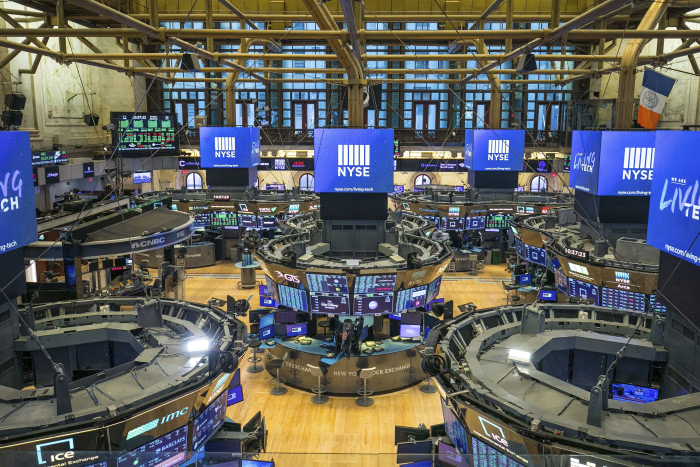
Quantum stocks surged after the government revealed Thursday that it had taken equity positions in nine companies, including IBM. The move immediately fueled fears that politics and national security are starting to reshape parts of the stock market during an already overheated AI boom.
Traders are now placing real money on who gets picked next.
On prediction market platform Kalshi, betting activity shows IonQ among the top names speculators believe could receive federal backing in 2026. The company was not part of Thursday’s announcement, but its stock still jumped sharply as momentum buyers rushed into quantum-related trades.
Defense startup Anduril Industries is also drawing heavy attention after recently doubling its valuation to $61 billion. The company has become closely tied to Trump-era defense priorities, including the proposed “Golden Dome” missile defense project.
Meanwhile, Micron Technology remains firmly on traders’ radar as demand for AI memory chips continues driving massive gains across the semiconductor sector.
Wall Street is beginning to treat federal backing as a market-moving force of its own. For years, traders mostly chased earnings growth, consumer demand and interest-rate expectations. Now another calculation is creeping into the market: whether Washington sees certain tech companies as too important to leave entirely to private investors.
That changes the mood around the AI rally. Retail money already poured aggressively into artificial intelligence stocks during the massive run-up surrounding companies like NVIDIA. But government ownership introduces something new — the possibility that political priorities could start influencing which firms attract capital, attention and long-term market confidence.
Some traders see opportunity, others see the early signs of another dangerous bubble.
If Washington keeps directing money into strategic technology firms, investors may start chasing political connections almost as aggressively as revenue growth. That could push valuations even higher inside sectors already flooded with speculative money and AI hype.
The companies attracting the most attention all sit inside industries the U.S. increasingly views as critical in its economic battle with China. Quantum computing, semiconductors and advanced AI systems are no longer being treated like ordinary businesses. Washington increasingly sees them as strategic assets tied to military power, cybersecurity and economic influence.
The AI boom was already driving a huge wave of speculative trading across markets. Now traders are trying to predict not just which companies will dominate the future, but which ones the U.S. government may decide are too important to fail.