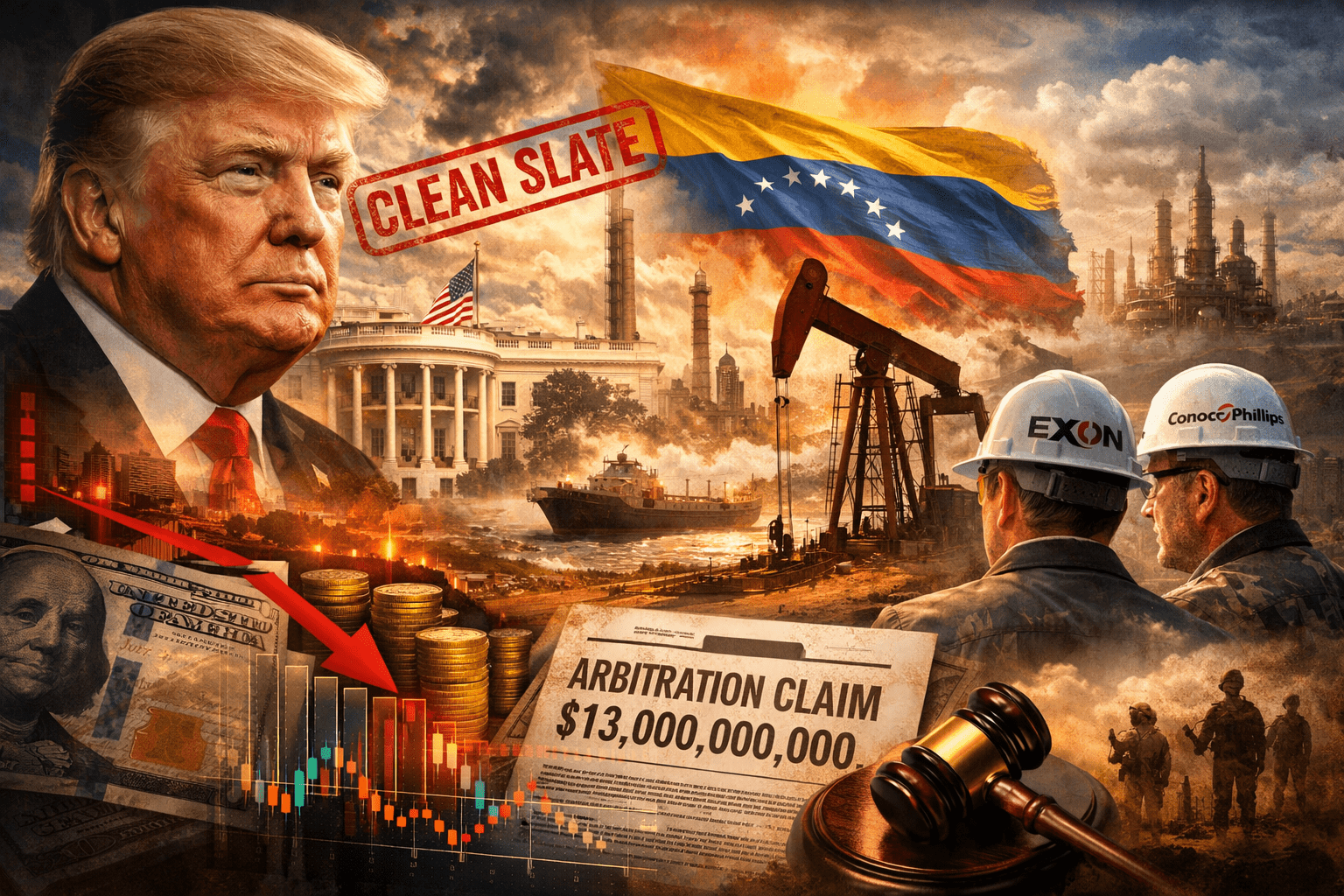
The Venezuelan oil sector is at a historic turning point amid the Trump administration's “Clean Slate” doctrine. By blocking enforcement of approximately $13 billion in arbitration awards owed to Exxon Mobil and ConocoPhillips, this policy suggests political priorities may override established commercial precedents.
Investors and energy executives face a tangled web of legal, operational, and geopolitical risks that could reshape global energy markets. Access to Venezuelan reserves offers potential for rapid production increases—but also carries risks of legal challenges, liquidity issues, and reputational concerns.
At its core, the Clean Slate approach empowers the U.S. government to authorize select oil firms to operate in Venezuela while shielding revenues from past creditors' claims. This introduces significant uncertainty for lenders, insurers, and investors, potentially altering how international energy deals are structured under U.S.-led transitional oversight.
Capital Risk, Legal Exposure, and Operational Fragility
Liability exposure totaling around $13 billion remains a key barrier for major U.S. oil producers. Exxon CEO Darren Woods' assessment of Venezuela as “uninvestable” under current frameworks highlights ongoing legal insecurities. By signaling intent to exclude Exxon, the administration appears to favor political alignment over the technical expertise needed to revive aging midstream infrastructure.
Capital market volatility is likely to rise as Washington sidesteps traditional commercial structures. The executive order blocking asset seizures from U.S. Treasury accounts offers temporary safeguards, but long-term lenders seek statutory reforms and enduring protections—elements the administration seems prepared to bypass for quicker access to reserves.
Sovereign risk contagion is escalating with the U.S. government taking direct oversight of Venezuelan transactions. Dealing through Washington rather than sovereign entities redefines international energy contracts, creating a centralized point of geopolitical vulnerability that could lead to substantial impairment charges.
M&A valuation challenges complicate the $100 billion reconstruction goal. The arbitration awards to Exxon (approximately $1.6 billion unpaid) and ConocoPhillips (around $10-12 billion with interest) represent senior claims that the policy effectively sidelines. Prospective acquirers must account for litigation risks from legacy claimants contesting new concessions.
Operational scalability issues at PDVSA demand a comprehensive overhaul of Venezuela’s energy system. Exxon and ConocoPhillips possess proprietary geological and operational data essential for swift production recovery. Favoring politically aligned junior partners over these majors could lower yields and prolong supply disruptions.
Liquidity constraints persist while Venezuelan oil revenues are held in U.S. Treasury accounts. Investors struggle to predict cash flows when funds are vulnerable to policy shifts. Standard repatriation routes are limited, necessitating reliance on non-transparent mechanisms that amplify loss risks.
Regulatory compliance demands are growing as lines between independent agencies and the executive blur. Compliance teams must revise risk disclosures to reflect potential policy instabilities. Together, these factors transform what seems like a $100 billion opportunity into a legally precarious and operationally demanding investment.
Commercial Fallout: How the “Clean Slate” Doctrine Reshapes Global Energy Risk
The policy's approach to overriding arbitration enforcement threatens international joint ventures in the energy sector. By shielding $13 billion in awards from immediate collection, it indicates that political considerations can supersede international rulings. Institutional investors should reassess sovereign risk premiums for nations under U.S. transitional influence.
Feedstock sourcing challenges could affect Gulf Coast refineries if Venezuelan heavy crude output stalls. These plants are optimized for heavy-sour grades; alternatives from Canada or Mexico raise logistics costs and cut efficiency. Without re-engaging top-tier majors, structural output shortfalls may endure.
Jurisdictional risks are mounting as the U.S. Treasury serves as a global clearinghouse for oil proceeds. Protecting revenues in New York from creditor seizures creates a temporary haven, but it's susceptible to court challenges. Treasurers should prepare for secondary litigation against entities handling these funds.
Capex shifts may benefit smaller, politically aligned independents willing to forgo conventional legal protections. These companies could gain early access to reserves but often lack the scale and historical data of Exxon or ConocoPhillips, leading to suboptimal extraction and potential asset value declines.
Insurance Market Withdrawal: A Potential Deal-Breaker
Even aligned operators may encounter coverage gaps. Reinsurers could hesitate to underwrite assets exposed to reversible executive orders and unenforceable arbitrations. Political risk insurance and trade credit might become unavailable, prompting lenders to impose steeper premiums or withhold financing. This could hinder project finance closures despite Treasury-managed revenues.
The “Loyalty Concession” Model and Market Fragmentation
We anticipate a division in the energy sector:
- Tier-1 Realists (e.g., Exxon, Shell) will likely sustain capital holds, emphasizing fiduciary duties and legal protections.
- Tier-2 Opportunists could form a “Trump Energy Coalition,” trading U.S. Treasury oversight for preferential drilling rights.
Political proximity, rather than pure technical merit, may increasingly drive investment outcomes.
| Risk Category | Traditional Framework | Clean Slate Reality | Financial Impact |
|---|---|---|---|
| Debt Seniority | Arbitration awards must be settled | Past claims sidelined as “the firm’s fault” | ~$13B balance sheet exposure |
| Counterparty | Deal with PDVSA | Deal via U.S. Treasury | Sovereign immunity bypassed |
| Legal Recourse | ICSID / International Courts | Executive Order shields | Elevated litigation risks |
These shifts present a strategic challenge for capital allocation, with potential long-term ripples in global energy markets.
Geopolitical Gridlock: Emerging Alliances and Western Major Displacement
Geopolitical supply chain changes are accelerating as Washington integrates Gulf partners into Venezuelan efforts. Initiatives like the “Pax Silica” pact—focused on tech and infrastructure with Qatar and the UAE—could hypothetically extend to provide technical and financial support, bypassing hesitant U.S. majors and enabling access to advanced oilfield services.
Nationalized marketing risks arise with the U.S. Department of Energy acting as primary crude broker. Transactions bear Treasury's stamp, imposing compliance hurdles for traders in a dual-sovereign environment.
Capital friction heightens under the “investment as prerequisite” stance. The “Pay-to-Play” model compels CFOs to weigh asset impairments against politically tied expenditures.
Technocratic shifts follow from empowering interim leader Delcy Rodriguez over opposition figures. Short-term access to 50 million barrels of inventory is gained, but governance and property rights stay uncertain.
Strategic reserve tactics serve as macroeconomic levers. The White House's aim to lower oil prices could strain OPEC+ relations amid their output curbs for market stability.
Bilateral treaty weakening may endure as the Clean Slate legacy. Shielding revenues from seizures fosters a “legal vacuum” around Venezuelan assets, impeding ICSID enforcement and hinting that U.S. safeguards can trump global arbitration.
The Pax Silica Influence Matrix (Hypothetical Extension to Energy)
| Player | Role | Motivation | Risk to U.S. Majors |
|---|---|---|---|
| U.S. Treasury | Escrow & Marketing | Price control / debt recovery | Loss of commercial autonomy |
| QatarEnergy | Infrastructure / LNG | Tech alignment | Market share shifts |
| ADNOC (UAE) | Capital & Field Services | Strategic diversification | Reduced first-mover edges |
| Interim Government | Operational Proxy | Survival / liquidity | Sovereign ownership dilution |
Boardroom Verdict: Navigating the Clean Slate Challenges
Contract sanctity must guide capital decisions in Venezuela. While reserves tempt, the doctrine blocks enforcement of $13 billion in arbitration debt. C-Suite teams should emphasize Chain of Title reviews over IRR projections to sidestep successor liabilities post-executive protections.
Secondary litigation remains a threat. Orders protecting Treasury accounts lack permanence across jurisdictions or administrations. Treasurers should allocate legal reserves against creditor actions.
Operational risks disadvantage entrants without Tier-1 data. Excluding Exxon hampers midstream and deepwater revival. Gulf partnerships (e.g., Qatar/UAE) could supply needed liquidity and scale to mitigate Western major absences.
Institutional Exposure: Key Players
- Exxon Mobil (XOM): ~$1.6B in unpaid arbitration; exclusion poses technical and legal barriers.
- ConocoPhillips (COP): ~$10-12B at stake; litigation shapes Chain of Title risks.
- Chevron (CVX): Active joint ventures; alignment sets precedents.
- BlackRock & Vanguard: Balancing national requests with fiduciary obligations.
- QatarEnergy: Potential partner for capital and tech bridges.
- Halliburton & SLB: Margins vs. compliance in volatile frameworks.
- U.S. Treasury (OFAC): Effectively Venezuela's CFO, gating revenue access.
What The Experts Are Asking: Trump's Clean Slate Doctrine and Venezuela's Oil Sector
What is the Clean Slate doctrine in Venezuela?
The "Clean Slate" doctrine refers to President Trump's policy of starting fresh in Venezuela's oil sector, effectively sidelining past financial losses and arbitration claims to encourage new U.S.-aligned investments. Trump stated that companies like ConocoPhillips would recover some money, but the U.S. would begin with a "clean slate," as past issues were "their fault." This is supported by a January 10, 2026, executive order shielding oil revenues from creditors.
Why did Darren Woods call Venezuela “uninvestable”?
Exxon Mobil CEO Darren Woods described Venezuela as "uninvestable" due to insufficient legal and commercial frameworks, including the need for reforms to hydrocarbons laws, a reliable legal system, and protections against asset seizures (which Exxon experienced twice before). He emphasized fiduciary duties to shareholders amid ongoing uncertainties.
Can the Trump administration legally block Exxon from Venezuela?
The administration has signaled intent to exclude Exxon, with Trump calling their stance "too cute" and threatening to sideline them from deals. Legally, this could involve selective licensing or sanctions relief under executive authority, but it raises questions about fairness and potential challenges under U.S. antitrust or international trade laws. No formal block has been enacted yet.
How does the Clean Slate doctrine impact international law?
The doctrine could erode trust in international arbitration by blocking enforcement of awards (e.g., under ICSID), signaling that U.S. policy can override global rulings for political goals. Critics argue it undermines bilateral treaties and contract sanctity, potentially increasing sovereign risk premiums for investments in sanctioned nations.
How much does Venezuela owe Exxon and ConocoPhillips?
Venezuela owes Exxon Mobil approximately $1.6 billion in unpaid ICSID arbitration awards (after partial payments), stemming from 2007 asset nationalizations. ConocoPhillips is owed around $10-12 billion (including interest) from similar disputes. The Clean Slate policy aims to shield revenues from these claims.
Why is the U.S. Treasury holding Venezuelan oil revenues?
Under a January 10, 2026, executive order, the U.S. Treasury holds Venezuelan oil revenues in protected accounts, declaring them "sovereign property" to block creditor seizures and ensure funds support U.S.-overseen reconstruction. This facilitates control over sales and prevents legal claims.
What risks do Tier-2 oil companies face entering Venezuela?
Smaller or "Tier-2" companies (e.g., independents) face legal exposure from unresolved claims, operational challenges like decaying infrastructure, liquidity issues due to Treasury-held funds, and geopolitical volatility. They may lack the technical data of majors, leading to inefficiencies, and could encounter insurance gaps or secondary litigation.
How might emerging pacts affect global oil markets?
Emerging U.S.-led alliances, such as potential Gulf partnerships (e.g., with Qatar or UAE for infrastructure), could boost Venezuelan output by 1-2 million barrels per day over years, potentially lowering prices and disrupting OPEC+ dynamics. However, this risks oversupply, Canadian crude price drops, and shifts in global energy configurations, though full recovery may take 10-15 years and over $100 billion in investments.
Financial Insight: 👉Sovereign Asset Seizure and the Fiscal Recalibration of Global Crude👈
High-Intent SEO Tags: #VenezuelaOilAudit #ExxonUninvestable #CleanSlateDoctrine #SovereignRisk2026 #TrumpEnergyPolicy #OilArbitrationDebt #CFOStrategicPlanning