Alibaba Group shares rose 5.1% after the Chinese technology company unveiled a new artificial intelligence chip, outlined plans for a much larger Qwen model and set a target to expand its global data-centre capacity beyond 20 gigawatts by 2032.
Chief executive Eddie Wu said Alibaba plans to train a next-generation AI model containing between 5 trillion and 10 trillion parameters, potentially more than four times the size of its current flagship Qwen3.8-Max model. Alibaba launched Qwen3.8-Max in August with 2.4 trillion parameters and a context window of up to one million tokens.
Alibaba also unveiled the Zhenwu V900, an AI processor developed by its semiconductor unit T-Head. The company said the chip delivers roughly three times the performance of its predecessor and can be linked into large computing clusters for training and running increasingly demanding AI models. Mass production is expected to begin in early 2027.
The announcements strengthen Alibaba’s attempt to control more of the AI technology stack, spanning semiconductors, cloud infrastructure, foundation models and consumer and enterprise applications. Wu said Alibaba intends to build capabilities across all of those layers rather than depend on a single part of the AI market. The company’s Hong Kong-listed shares climbed 5.1% following the announcement, reaching a one-month high.
The investment behind that strategy is becoming increasingly material for shareholders. In August, Alibaba completed an HK$80 billion placement of 710 million new shares at HK$112.70 each. The company said all of the net proceeds would be directed towards its full-stack AI strategy, with about 60% allocated to expanding global computing infrastructure and the remaining 40% earmarked for hyperscale AI data centres and upgrades to storage, databases and high-performance networking.
That capital raise follows Alibaba’s earlier commitment to invest at least RMB380 billion in AI and cloud infrastructure over three years. The group has positioned cloud computing as one of the most direct routes through which its AI spending can generate revenue, rather than treating model development purely as a research programme.
Recent financial results provide evidence that the strategy is already affecting the business mix. In the June quarter, Alibaba said AI Cloud and Compute Services revenue reached US$7.1 billion, up 45% year on year. Adjusted EBITA from the cloud business rose 133% to US$830 million, while its margin expanded to about 12%. AI-related revenue also recorded its twelfth consecutive quarter of triple-digit growth.
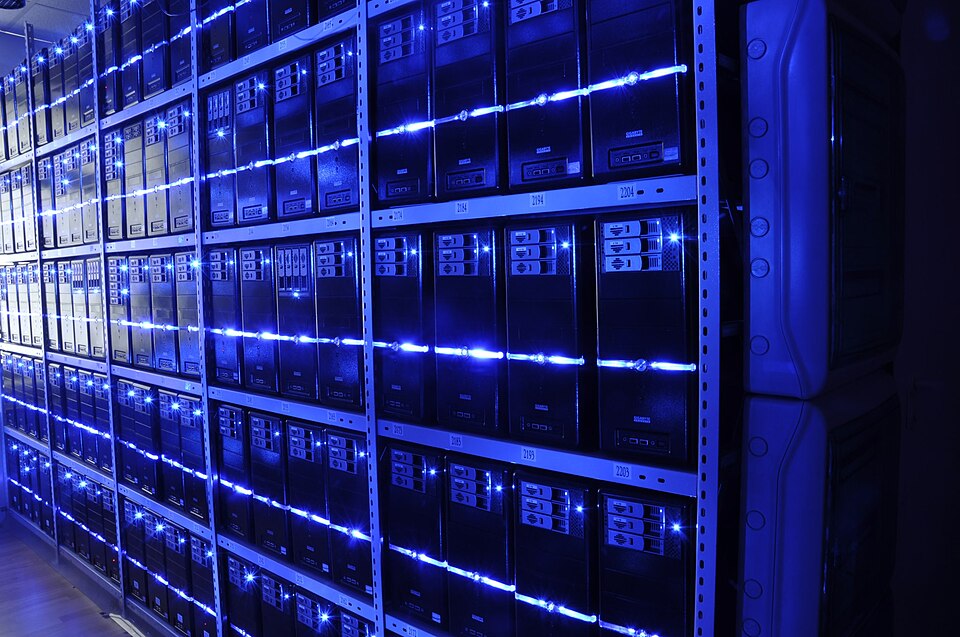
The planned 20GW data-centre target indicates that Alibaba expects those infrastructure requirements to rise substantially as models become larger and enterprise AI usage increases. Larger models require greater amounts of computing capacity both during training and when applications are deployed at scale, increasing the strategic importance of proprietary chips and cloud infrastructure.
For investors, the new chip and model are therefore part of a broader capital-allocation story. Alibaba is committing substantial balance-sheet and equity capital to AI while betting that demand for computing, models and agent-based services will translate that infrastructure into faster cloud growth.
The 5.1% share-price rise suggests investors responded positively to the latest announcements, but the longer-term financial test will be whether Alibaba can continue converting its heavy AI investment into revenue and margin growth as competition across Chinese and global AI markets intensifies.