
Most business banks still treat stablecoins as a compliance problem rather than a payment rail. Mention USDC on an onboarding call and the conversation tends to slow down, which is awkward when your suppliers or customers have already started asking to settle that way.
A handful of institutions have gone the other direction. They hold stablecoin reserves, issue their own tokens, or build accounts that accept fiat and stablecoin payments through the same interface, and they do it with regulatory standing rather than around it.
This guide covers six of them. The differences that matter are not marketing claims but structural: who holds the assets, which rails settle, and what happens to your money if something goes wrong.
What Makes a Bank Stablecoin Friendly
Start with the custody question, because it determines your actual risk. If you are still weighing whether to accept stablecoins at all, the risks regulators focus on are reserve backing, disclosure and anti-money laundering controls, and those shape what a provider can offer you. Some providers custody digital assets on your behalf, others give you a self-custodial wallet where you hold the keys.
Then look at rails. A genuinely useful account lets a counterparty pay by ACH, wire or stablecoin into the same destination, rather than forcing you to run parallel systems and reconcile them manually at month end.
Deposit insurance deserves particular care. FDIC coverage protects deposits held at insured banks. It does not extend to self-custodied digital assets, stablecoin reserve arrangements, or funds sitting in transit with a payment provider. Any provider that blurs this line is worth avoiding.
Finally, check licensing. FinCEN registration as a money services business, a state trust charter, or a full banking charter all mean different things, and the difference becomes very concrete during a dispute.
The Best Stablecoin Friendly Banks and Platforms
1. Bancoli
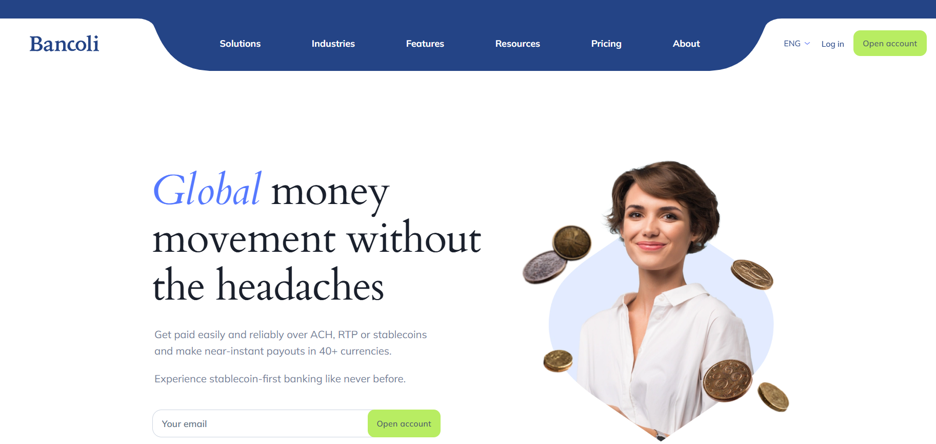
Bancoli takes the top position because it solves the problem most businesses actually have, which is not access to stablecoins but the awkwardness of running them alongside conventional payments. The Smart USD Account accepts US dollar bank transfers, ACH, RTP and stablecoins into a single destination, and lets the payer choose the rail.
That flexibility is configurable. You can restrict incoming payments to preferred rails or open all of them and let clients decide, which matters when your customer base spans banks that are settled by ACH and counterparties who would rather send USDC.
The settlement mechanics are published rather than implied. ACH handles $10 to over $1 million in one to three days, Fedwire covers $1,000 to $10 million or more in one to two days, and stablecoin settles any amount in minutes. Bancoli-to-Bancoli transfers run on-chain, settle in minutes, and are rated the most cost-efficient of the four rails. ACH and RTP payments convert one to one into the supported stablecoin in your wallet. Coverage runs to more than 200 countries.
The custody position is stated plainly, which is rarer than it should be. Self-custodial wallet infrastructure comes from Coinbase, and the assets are held under your keys rather than by Bancoli, a bank or any other custodian. Bancoli is the trade name of Oli Technologies LLC, registered with FinCEN as a money services business, with banking and settlement provided by regulated partners including an affiliated chartered bank.
Best for: B2B companies with international suppliers or customers who want stablecoin settlement without abandoning conventional rails.
Worth knowing: self-custodied assets are not FDIC insured, which is a feature of the model rather than an oversight. Bancoli says so directly.
2. Customers Bank
Customers Bank is a full US commercial bank that built real infrastructure for digital asset businesses rather than tolerating them at the edges. Its instant payments platform lets clients move dollars between accounts around the clock, which is the practical requirement for anyone trading or settling in stablecoins.
The appeal here is charter status. You are banking with an institution subject to full prudential supervision, and eligible deposits carry FDIC coverage in the ordinary way. For treasurers who need that on the balance sheet, it removes an argument.
The trade-off is selectivity. Onboarding for digital asset businesses is more involved than a fintech signup, and the bank has been deliberate about which clients it takes.
Best for: established digital asset firms that need a chartered banking relationship rather than a payments platform.
3. Anchorage Digital Bank
Anchorage was the first digital asset institution to receive a federal charter from the Office of the Comptroller of the Currency, back in January 2021, and held that position alone for nearly five years.
The proposition is institutional custody with banking permissions attached. Anchorage custodies digital assets under a regulated framework, supports stablecoin issuance and settlement, and serves funds, protocols and corporates rather than small businesses.
That focus is also the limitation. Minimums and onboarding requirements put it out of reach for most operating companies, and the product is built around asset custody rather than day-to-day payment acceptance.
Best for: institutions that want the longest federally supervised track record in digital asset custody.
4. BVNK
BVNK, acquired by Mastercard in a deal completed in August 2026, sits between banking and payments infrastructure, offering business accounts that hold both fiat and stablecoin balances and move between them without a separate conversion step.
The strength is payout coverage. BVNK is built for companies paying out at volume across borders, with stablecoin as the settlement layer and local rails at the far end, which suits marketplaces and platforms more than it suits a single trading entity.
It operates under payment and e-money licensing rather than a bank charter, so the regulatory standing differs from Customers Bank or Anchorage. Understand which protections apply before treating it as a banking replacement.
Best for: platforms and marketplaces running high-volume cross-border payouts.
5. Mercury
Mercury is a business banking platform serving startups, and while it is not a crypto-native provider, it has been considerably more workable for digital asset companies than most incumbent banks.
Accounts are provided through partner banks with FDIC pass-through coverage, and the platform handles the treasury and operational side well. For a company that holds stablecoins elsewhere but needs a functional US business account that will not close on them, that combination has real value.
It does not accept stablecoin payments directly, which is the obvious limitation. Mercury is the fiat half of a stack rather than the whole thing.
Best for: startups needing a reliable US operating account alongside a separate stablecoin setup.
6. Circle
Circle issues USDC, the most widely used regulated dollar stablecoin, and offers business accounts that let companies mint and redeem it directly rather than buying on an exchange.
Going to the issuer removes a layer. Circle Mint gives institutional clients one-to-one conversion between dollars and USDC, and the Circle Payments Network connects financial institutions for cross-border settlement, with partners including established payout networks.
Circle received final OCC approval for its national trust bank, First National Digital Currency Bank, on July 10, 2026, operating as Circle National Trust. The charter covers fiduciary digital asset custody rather than deposit-taking, with reserve management planned as a future capability. It is still not the place for general business banking. Use it for the stablecoin leg and pair it with something else for everything around it.
Best for: companies transacting in USDC at scale who want issuer-level access.
How to Choose
Work out first whether you need a bank or a payment platform. If your requirement is deposit protection and a balance sheet relationship, a chartered institution is the answer and nothing else will do. If your requirement is getting paid in whichever currency and rail your counterparty prefers, a platform will serve you far better.
Then map your actual payment flows. Count how many counterparties would use stablecoin if you offered it, and how many still need ACH or wire. If the answer is meaningfully both, a multi-rail account removes a reconciliation problem you would otherwise carry indefinitely.
Read the custody language carefully before you commit. Self-custody and provider custody are genuinely different risk positions, and no amount of interface polish changes what happens if a provider fails. The good ones state this plainly on their own site. Treat vagueness as a finding.
Frequently Asked Questions
Are stablecoin balances FDIC insured?
No. FDIC insurance covers deposits held at insured banks. Self-custodied digital assets, stablecoin reserve arrangements and funds held in transit by a payment provider all fall outside it. Any provider suggesting otherwise is misrepresenting the position.
When should a business use stablecoins instead of ACH?
Stablecoin settles in minutes at any transaction size, which suits urgent payments, cross-border transfers and counterparties outside the US banking system. ACH remains cheaper and entirely adequate for domestic payments where a one to three day settlement is acceptable.
Do I need to close my existing bank accounts?
Generally not. Most stablecoin-friendly platforms are designed to sit alongside existing banking rather than replace it, taking on the payment acceptance and cross-border legs while your primary operating account stays where it is.
Which stablecoin should a business accept?
USDC is the most widely supported regulated option and the easiest to redeem for dollars. Check what your provider supports and, more importantly, what your counterparties already hold.
What licensing should I look for?
FinCEN money services business registration is the baseline for US payment providers. A state trust charter or federal bank charter indicates a higher supervisory bar. Ask which entity holds the licence and what it actually permits, because trade names and operating entities are frequently different.