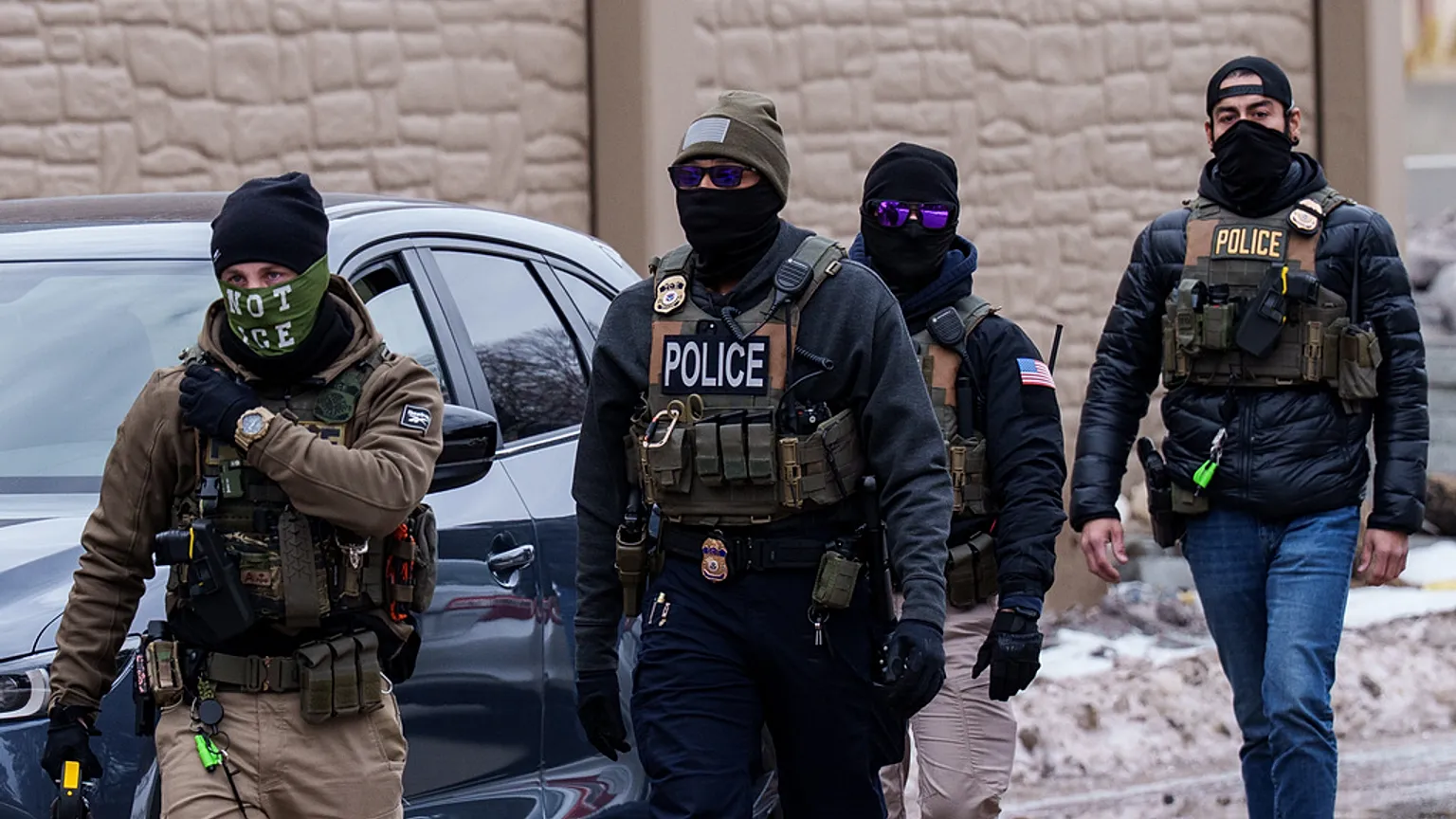
ICE Quietly Pulls Back in Minnesota, Leaving Families Uncertain What Comes Next
When federal power changes how it shows up on the street, people feel it long before courts or Congress weigh in.
That is the situation unfolding in Minnesota this week, after internal guidance directed U.S. Immigration and Customs Enforcement officers to avoid engaging with “agitators” during operations and to limit arrests to immigrants with criminal charges or convictions. The shift follows weeks of unrest, including two fatal shootings of U.S. citizens during immigration-related encounters in Minneapolis.
The order did not arrive with a press conference or a formal announcement. It arrived as an internal email. But its consequences are immediate — not just for officers, but for families, employers, and entire communities trying to understand what enforcement now looks like in practice.
Power Pulls Back — Uncertainty Rushes In
The new guidance tells ICE officers not to debate, explain, or engage during operations. Commands only. No discussion. No clarification.
For residents in neighbourhoods that have seen repeated enforcement activity, that silence carries weight. When authority stops communicating, people don’t interpret it as calm — they interpret it as unpredictability. Workers delay commutes. Parents rethink school drop-offs. Small business owners hesitate to open early or close late.
This is not about ideology. It’s about behaviour changing in real time.
Targeted Enforcement, Broader Consequences
On paper, the guidance narrows ICE’s scope: arrests should focus only on immigrants with a criminal nexus. That represents a retreat from the wide sweeps that previously drew legal challenges and public backlash.
But in practice, the rule introduces new friction. Arrests can still be triggered through licence plate checks. Vehicles registered to immigrants with a criminal history remain valid targets, even if the individual is not the focus of a broader operation.
For households where one income supports multiple dependents, that distinction matters less than the outcome. Missed workdays, legal costs, childcare disruptions, and sudden income loss ripple outward quickly — especially in communities already operating with thin financial margins.
Why This Hits the Economy, Not Just the Streets
Immigration enforcement is often framed as a legal issue. On the ground, it functions as an economic one.
When enforcement patterns shift abruptly, labour availability shifts with them. Employers in construction, food processing, logistics, and care services report immediate absenteeism. Scheduling becomes volatile. Output slows. Overtime costs rise for remaining staff.
None of this shows up instantly in economic data. It shows up in delayed paychecks, cancelled shifts, and rising stress inside households that cannot afford disruption.
Silence as a Strategy — and a Cost
The guidance offers no clarity on what happens when commands are ignored, or how officers should respond if bystanders interfere. That ambiguity places pressure on both sides of the interaction.
For communities, the lack of explanation fuels anxiety. For officers, it raises the stakes of every encounter. And for local economies, the result is hesitation — people pulling back, waiting to see what comes next.
Delay itself becomes the cost.
What Happens Next
The administration says guidance is still under discussion, and that nothing should be considered final. But markets and households don’t wait for finality.
People adapt to what they see, not what they’re promised.
In Minnesota, the visible change is not fewer officers or fewer arrests. It is quieter enforcement, less communication, and more second-guessing by the people living alongside it. Power has not disappeared. It has simply changed shape — and when that happens, ordinary life absorbs the shock first.