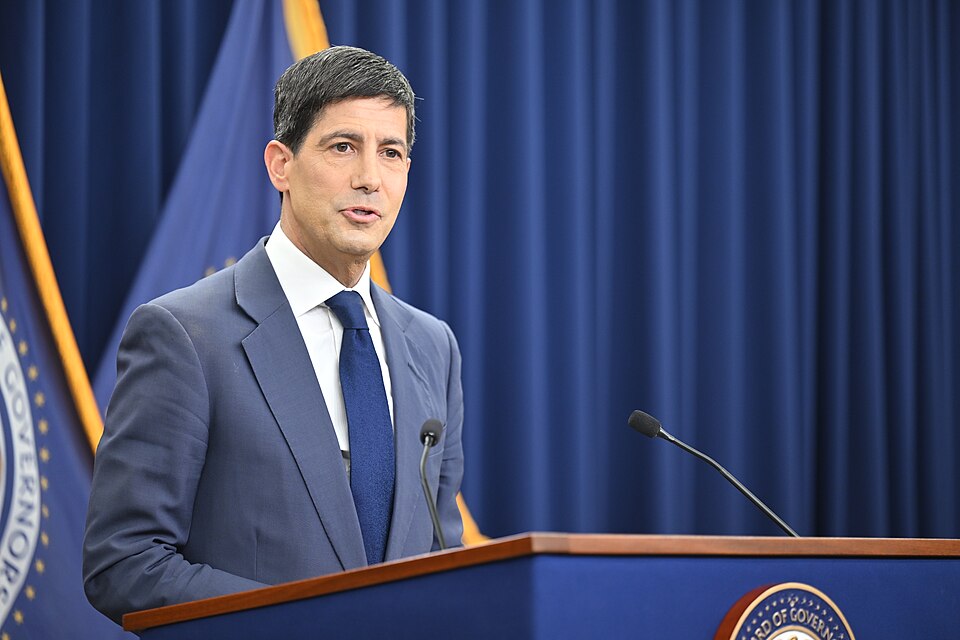
Kevin Warsh joined Christine Lagarde, Andrew Bailey and Tiff Macklem at the European Central Bank’s annual forum in Sintra on July 1, bringing the new Federal Reserve chairman onto the international stage as four major central banks confront renewed inflation pressure.
The policy panel formed part of the ECB Forum on Central Banking, held in Portugal from June 29 to July 1. Warsh appeared alongside Lagarde, president of the ECB, Bailey, governor of the Bank of England, and Macklem, governor of the Bank of Canada. Their institutions are operating with different policy rates and domestic conditions, but each is balancing price stability against weaker growth risks and uncertainty linked to energy costs, trade policy and the conflict in the Middle East.
Warsh took office as Federal Reserve chairman on May 22, 2026, and chaired the Federal Open Market Committee’s June meeting. The FOMC kept the federal funds target range at 3.5% to 3.75% on June 17. Warsh said after the meeting that inflation had remained above the Fed’s 2% objective for more than five years, while the committee maintained that economic activity was expanding at a solid pace despite elevated uncertainty.
The ECB raised its three key interest rates by 0.25 percentage points on June 11, taking the deposit facility rate to 2.25%. Its staff projections put euro-area headline inflation at an average of 3.0% in 2026, 2.3% in 2027 and 2.0% in 2028. The upward revision reflected a higher path for energy prices and the risk that those costs feed through to food, goods and services.
Bailey arrived at the panel after the Bank of England held Bank Rate at 3.75% in June. The Monetary Policy Committee voted 7–2 for no change, with two members preferring an increase to 4%. UK inflation was 2.8% in May, and the Bank expects it to rise during 2026 as higher energy prices pass through the economy.
The Bank of Canada also held its policy rate in June, leaving the overnight rate at 2.25%. Macklem’s institution said higher energy prices and supply-chain disruption were pushing up inflation while weighing on global growth. The Canadian decision reflected a judgement that keeping rates unchanged best balanced those competing risks, although the bank described uncertainty as unusually elevated.
The panel therefore brought together central bankers who share an inflation problem without sharing an identical policy response. Their rate settings reflect different growth profiles, labour markets, currency conditions and exposure to imported energy costs. The common thread is that inflation has again become harder to forecast, reducing confidence in a smooth sequence of rate cuts across major economies.
That uncertainty has direct consequences for corporate finance. Borrowing plans based on steadily falling rates may need to be revised, particularly where refinancing dates are fixed and debt costs reset quickly. Treasury teams also face greater volatility in foreign exchange, energy prices and bond yields when central-bank guidance changes in response to geopolitical or trade developments.
The Sintra panel gives Warsh an early opportunity to show how closely the Federal Reserve’s new leadership aligns with other central banks on inflation persistence and policy communication. Finance teams should test funding plans against higher-for-longer rates, wider currency movements and delayed easing rather than relying on a single central forecast.
MORE FROM FINANCE MONTHLY - Bending Spoons Prices $29 IPO — Finance Monthly