
Strategic Consequence: Capital Structures Define Corporate Destiny
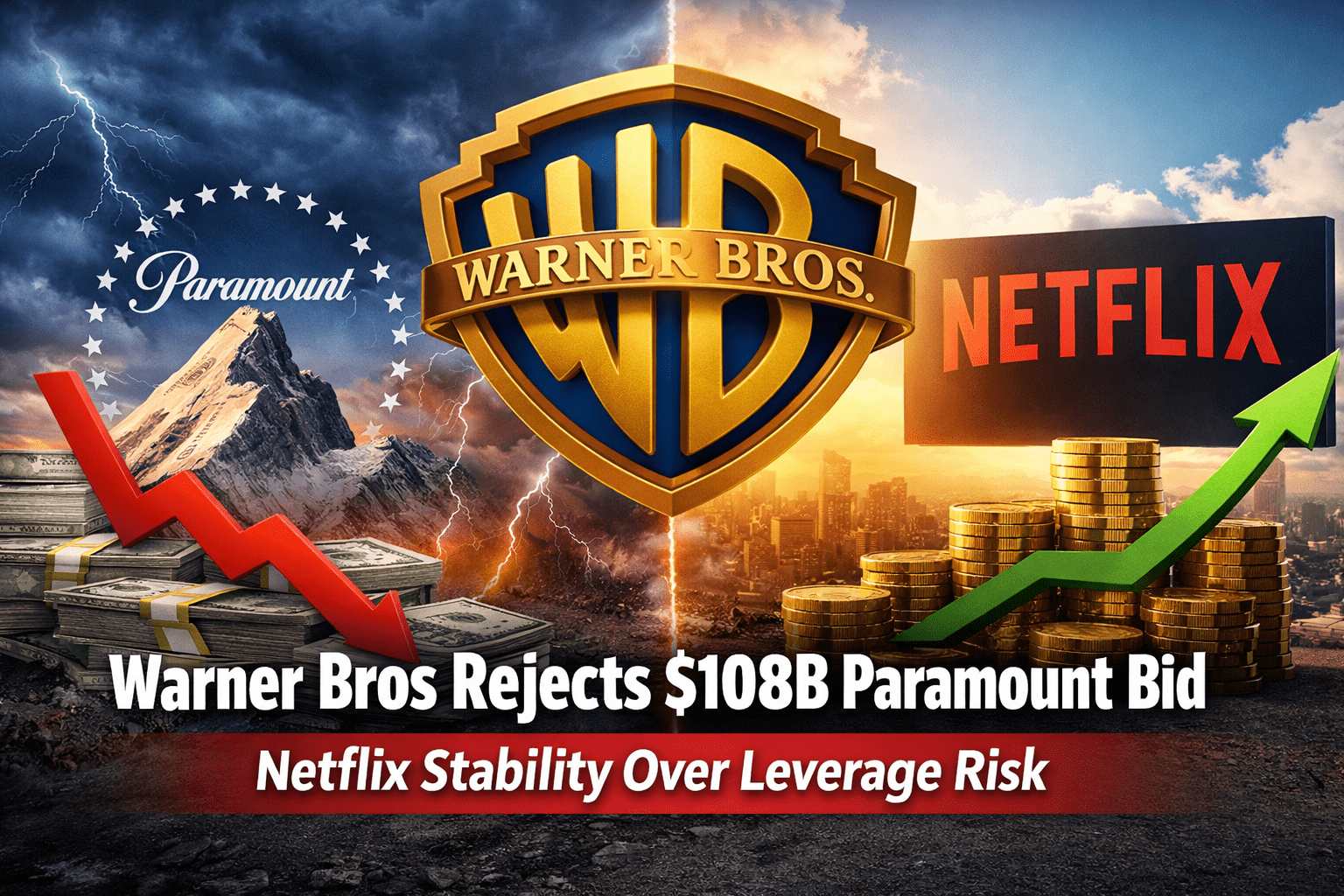
The rejection of Paramount’s $108.4 billion hostile bid by the Warner Bros Discovery (WBD) board signals a profound prioritization of balance sheet integrity over headline valuation. This decision safeguards long-term solvency. By favoring Netflix’s lower-valued but investment-grade offer, WBD leadership has effectively issued a referendum on the dangers of over-leveraged acquisitions in a high-interest-rate environment.
Debt-to-equity ratios dictate the margin for error. Paramount’s financing model relies on a staggering $54 billion in new debt, pushing the total post-acquisition burden to $87 billion. This creates a precarious fiscal cliff. A leveraged buyout of this magnitude would likely result in an immediate credit downgrade, further inflating the cost of capital for a studio already navigating volatile theatrical and advertising revenues.
Creditworthiness acts as the ultimate deal lubricant. Netflix’s $400 billion market capitalization provides a fortress-grade balance sheet that mitigates execution risk for WBD shareholders. Certainty of closure outweighs speculative premiums. While Paramount offers $30 per share versus Netflix’s $27.75, the "execution gap" created by Paramount’s junk-rated status represents a $4.7 billion hidden cost that the WBD board refuses to bear.
Termination fees serve as a strategic poison pill. WBD faces a $2.8 billion penalty for exiting its Netflix agreement, alongside $1.9 billion in additional lender and financing costs. These frictions erode the upside of any rival bid. For a Paramount offer to become mathematically viable, it must not only exceed the Netflix valuation but also fully subsidize these multi-billion-dollar exit contingencies without further straining its own over-leveraged credit profile.
Asset valuation discrepancies remain the primary friction point. The $4.00-per-share valuation of the Discovery Global spin-off remains a non-negotiable anchor for WBD’s board. Paramount’s $1.00 valuation of these cable assets ignores the cash-flow durability of CNN and TNT Sports. Mispricing these legacy assets suggests a fundamental misalignment on the intrinsic value of the Warner Bros portfolio, making a consensus on a "compelling" offer nearly impossible under current terms.
The Cost of Capital: Why Netflix’s Balance Sheet Outmuscles Paramount’s Leverage
Asset yields must exceed the cost of debt. Paramount’s proposal to acquire WBD for $108.4 billion would require the combined entity to generate unprecedented free cash flow simply to service interest payments. The synergy math fails here. While the "Harry Potter" and DC Comics IP are high-margin engines, the debt-service requirements of an $87 billion liability would starve these franchises of the reinvestment capital necessary to maintain their market dominance against Disney.
Institutional confidence hinges on investment-grade stability. S&P Global’s current junk-rating of Paramount serves as a structural barrier to long-term capital recovery for WBD stakeholders. Credit spreads would widen immediately. Unlike the Paramount proposal, the Netflix deal allows WBD to de-lever through the $82.7 billion cash-and-stock infusion, ensuring that the "Discovery Global" spin-off enters the public market with the liquidity required to capture a $4.00-per-share valuation rather than the fire-sale prices suggested by the Ellison group.
Liquidity Velocity & Settlement Friction
Cash flow velocity determines operational agility. Netflix’s $400 billion market capitalization ensures that the $27.75-per-share payout is backed by liquid equity and massive operational cash reserves. Settlement risk is effectively zero. In contrast, Paramount’s reliance on $54 billion in new debt financing creates a "settlement choke point" where any fluctuation in benchmark interest rates or a cooling of the high-yield bond market could collapse the transaction before the closing date.
Execution friction carries a $4.7 billion price tag. LSEG data confirms that the friction of abandoning the Netflix merger is prohibitively expensive for WBD’s treasury. The $2.8 billion break-up fee, combined with $1.9 billion in financing penalties, creates a negative carry that Paramount’s bid fails to neutralize. Goldman Sachs and Morgan Stanley, acting as lead advisors, must account for these immediate cash outflows which would dilute the effective value of the Paramount offer to nearly parity with Netflix, but with exponentially higher risk.
The Capital Structure Matrix: 2026 Media Consolidation
| Legacy Funding Model | Strategic Trigger | 2026 Institutional Reality |
|---|---|---|
| High-Leverage LBO | Paramount/Skydance $87B Debt Load | Rejected by WBD board as a "junk-rated" risk to solvency |
| Investment-Grade Equity | Netflix $400B Market Cap Support | Preferred by WBD as the superior path for "Discovery Global" spin-off value |
| Billionaire Guarantee | Larry Ellison $40B Personal Equity | Deemed insufficient by WBD to offset $5.8B reverse termination fees |
Structural Integrity and the Infrastructure of Integration
Structural CapEx & Technical Hurdles
Technological scalability necessitates fiscal flexibility. The core of the "Strategic Irony" in the Warner Bros Discovery (WBD) saga lies in the divergence between Paramount’s vision for a "super-streamer" and the actual cost of technical integration. Merging the back-end architectures of Max and Paramount+ requires massive capital expenditure (CapEx). Paramount’s $87 billion debt burden effectively zero-lines the budget for this migration. Under an LBO, the combined entity would lack the liquidity to unify user data environments, a move that Ampere Analysis suggests is critical for competing with the algorithmic precision of Netflix.
Network density determines distribution dominance. While Paramount Skydance argues for a content-first strategy, the current fiscal environment favors infrastructure-first players. SES and Intelsat have noted a rapid pivot from high-margin C-band linear distribution to IP-transit models. Netflix’s existing global Content Delivery Network (CDN) allows WBD content to scale instantly without the "integration tax" of a debt-heavy LBO. By rejecting Paramount, the WBD board is avoiding a technical debt trap where interest payments to JPMorgan and Citibank would cannibalize the $3 billion in R&D required to maintain high-throughput 4K/8K delivery and edge-caching across global territories.
The Physicality of Finance
Operational velocity is throttled by restrictive covenants. The board’s refusal of the Paramount bid is, at its heart, a rejection of "frozen" operations. LSEG data highlights that Paramount’s offer would impose onerous restrictions on WBD’s ability to renew affiliation agreements or modify its debt exchange. This creates an 18-month "operational limbo" where WBD could suffer a "Material Adverse Effect." Such a delay would jeopardize the mid-2026 spin-off of Discovery Global into a separate entity—a move Goldman Sachs identifies as the primary driver for unlocking shareholder value in the legacy cable business.
Balance sheet health acts as an industrial shield. The board remains vocal that a Netflix merger, backed by an A/A3 credit rating and $12 billion in estimated 2026 free cash flow, provides the "physicality" to withstand regulatory friction. Should the Department of Justice or Federal Trade Commission challenge the consolidation, Netflix’s $5.8 billion "reverse termination fee" is backed by cash, not promises. In contrast, S&P Global’s junk-tier rating for Paramount implies that their $5.8 billion fee is a speculative commitment. The WBD board’s insistence on "certainty to close" recognizes that in 2026, liquidity is the only true form of strategic defense.
The Synthesis: Safeguarding the Institutional Horizon
The Boardroom Recommendation
For C-Suite leadership and institutional fiduciaries, the strategic mandate is clear: Prioritize balance sheet durability over speculative valuation premiums. The WBD board’s rejection of Paramount’s "junk-rated" LBO structure serves as a defensive masterclass in mitigating execution risk. While Paramount’s $30.00 headline offer visually outpaces Netflix’s $27.75, the hidden "leverage tax" and $4.7 billion in immediate exit frictions create a net-negative trajectory for long-term equity.
Treasurers should view this as a pivot toward Quality of Capital. By aligning with Netflix’s investment-grade profile, WBD ensures that the "Discovery Global" spin-off launches with a clean credit narrative, maximizing the anticipated $4.00-per-share asset recapture. The recommendation for institutional investors remains to endorse the Netflix merger as the only path that provides both immediate liquidity and a viable operational future for the legacy assets.
Institutional Exposure List
-
Vanguard Group Inc: 11.3% holding, primary anchor for Netflix vote.
-
BlackRock, Inc: 184M shares, ESG-focused, favors lower-leverage model.
-
Harris Associates L.P: Top-five investor, publicly skeptical of Paramount bid coverage.
-
State Street Corp: 158M shares, likely penalizes $87B LBO debt-load.
-
JPMorgan Chase & Co: Recently increased position by 31%, backing Netflix execution.
People Also Ask: Key Insights into the Warner Bros Takeover
Why did Warner Bros reject the Paramount hostile bid?
The Warner Bros Discovery (WBD) board unanimously rejected the $108.4 billion offer, characterizing it as a "risky leveraged buyout." The primary concern is the $87 billion debt load the combined company would carry, which the board believes creates significant "closing risk" and threatens the studio's long-term financial stability compared to Netflix’s investment-grade proposal.
What is the break-up fee for the Warner Bros-Netflix deal?
If Warner Bros abandons its agreement with Netflix to pursue another suitor, it must pay a $2.8 billion termination fee. Additionally, WBD estimates it would incur $1.9 billion in lender fees and financing costs, bringing the total "exit friction" to approximately $4.7 billion. Conversely, Netflix has committed a $5.8 billion reverse break-up fee if the deal is blocked by regulators.
How much debt would Paramount take on to buy Warner Bros?
Paramount’s revised financing plan involves incurring $54 billion in new debt. When added to existing liabilities, the total debt for the merged entity would hit $87 billion. The WBD board noted this would be the largest leveraged buyout in history, potentially straining cash flows and damaging credit ratings.
What is "Discovery Global" in the Warner Bros spin-off?
Discovery Global is the proposed name for a new standalone public company that would house WBD’s linear networks. This includes CNN, TNT Sports, and the Discovery+ streaming service. The spin-off is a central part of WBD's strategy to separate its "Studios & Streaming" (Warner Bros) from its "Global Networks" (Discovery Global) to unlock shareholder value.
Who is Larry Ellison in the Paramount-Warner Bros deal?
Larry Ellison, the billionaire co-founder of Oracle, is the father of Paramount CEO David Ellison. To bolster the bid’s credibility, Larry Ellison provided an "irrevocable personal guarantee" of $40.4 billion in equity financing. Despite this massive backstop, the WBD board remains skeptical of the deal's overall leverage.
Is Netflix buying HBO and Warner Bros studios?
Yes, the current $82.7 billion Netflix proposal is specifically targeted at the "Streaming & Studios" division. This would give Netflix control over the Warner Bros film and TV studios, the DC Universe, the Harry Potter franchise, and the Max (formerly HBO Max) platform, while the cable networks would be spun off separately.
What happens to CNN in the Netflix-WBD merger?
Under the Netflix deal, CNN would become a cornerstone of the new Discovery Global company. Netflix is reportedly not interested in acquiring linear news or cable assets, preferring to focus on the studio production and direct-to-consumer streaming portions of the business.
How does the Trump administration view the Warner Bros acquisition?
President Donald Trump has expressed concerns that a Netflix-Warner Bros merger could create a "problem" due to its outsized market share. While he praised Netflix CEO Ted Sarandos, he has stated he will be "involved" in the decision, noting the deal faces intense antitrust scrutiny from the Department of Justice.
Financial Insight: 👉Sovereign Asset Seizure and the Fiscal Recalibration of Global Crude👈
WBD M&A Strategy, Warner Bros Discovery Hostile Takeover, Netflix Paramount Bidding War, Leveraged Buyout Risks 2026, Discovery Global Spin-off Valuation, Paramount Skydance Debt Financing.