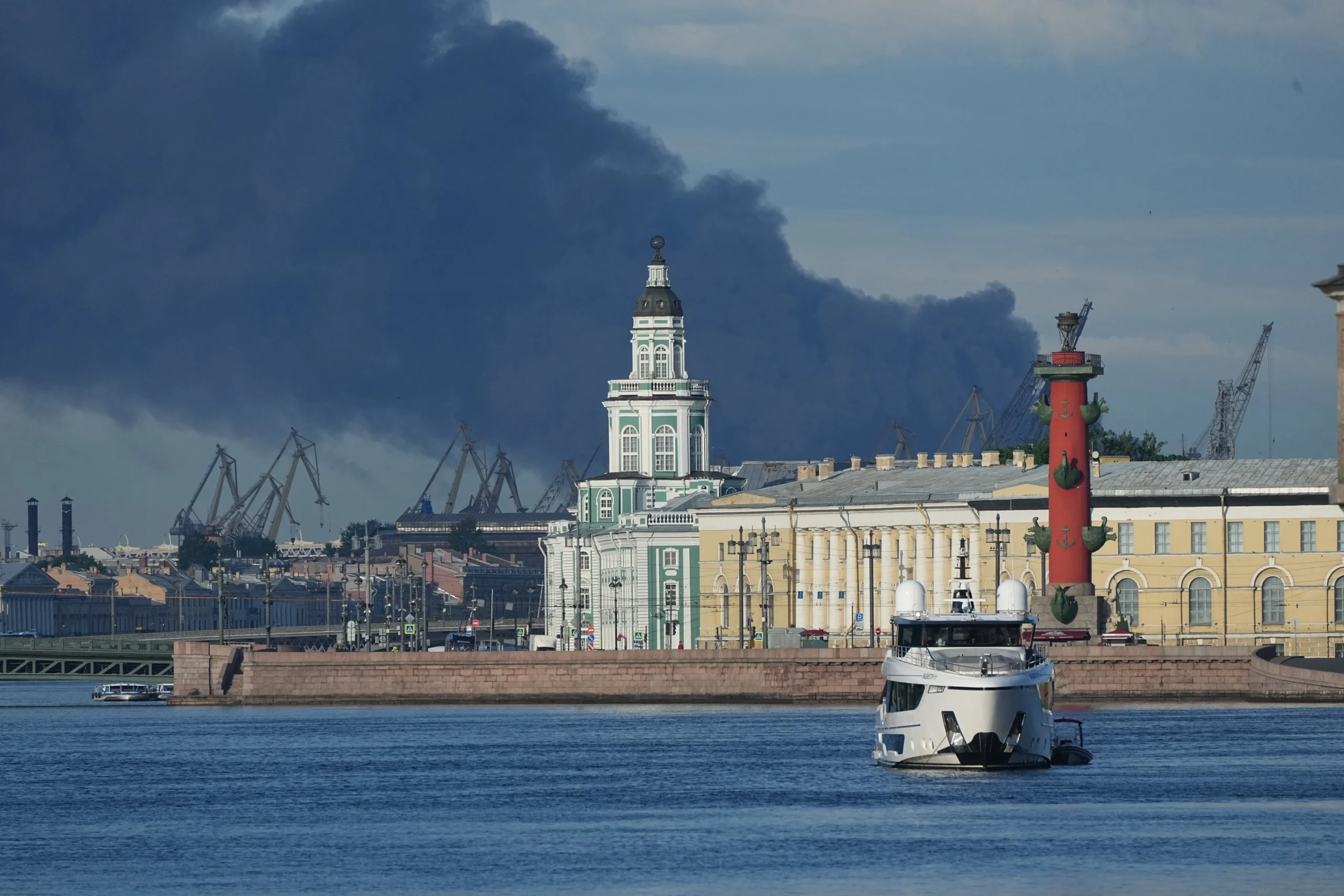
A Ukrainian drone strike on a major oil terminal in Russia's St. Petersburg has renewed concerns about energy security and the growing economic costs of a war that continues to reach deeper into critical infrastructure.
The attack, which came just days before President Vladimir Putin is due to address Russia's flagship economic forum in the city, highlights how increasingly valuable industrial assets are being drawn into the conflict.
Ukrainian President Volodymyr Zelenskyy said long-range drones traveled more than 1,000 kilometers to strike an oil terminal in St. Petersburg, sending thick black smoke over one of Russia's most important commercial ports. The attack came as the city prepares to host its annual international economic forum, an event the Kremlin uses to project economic resilience despite years of sanctions and international isolation.
Russian authorities confirmed that Ukrainian drones targeted infrastructure in the city, while temporary flight restrictions were imposed at St. Petersburg's airport and mobile internet services were disrupted. Although the full extent of the damage remains unclear, the strike highlights how economic assets are becoming central to the conflict.
The timing is particularly uncomfortable for Moscow. President Vladimir Putin is scheduled to address business leaders and foreign delegates later this week, with Saudi Arabia participating as a special guest country. The forum is intended to demonstrate that Russia remains open for business, but another successful strike deep inside Russian territory risks drawing attention to vulnerabilities that are becoming harder to ignore.
Ukraine has spent months targeting oil depots, refineries and fuel infrastructure in an effort to weaken one of Russia's most important sources of revenue. Energy exports remain a major pillar of the Russian economy, helping finance government spending and military operations despite extensive Western sanctions.
For businesses, however, the significance extends beyond the immediate military objectives. Repeated attacks on energy infrastructure do not automatically translate into higher fuel prices or supply shortages, but they introduce another source of unpredictability for companies already navigating geopolitical tensions, changing trade patterns and fragile supply chains.
Investors have largely adapted to the war's economic consequences after more than five years of conflict. Yet the growing range and frequency of long-distance drone attacks are forcing markets to reassess assumptions about what infrastructure can be considered secure. Facilities located hundreds of miles from the battlefield are now finding themselves exposed. That matters because many of those sites were never designed to operate under conditions where strategic attacks are a recurring risk.
The strike followed a large-scale Russian drone and missile attack on Kyiv and other Ukrainian cities that killed at least 22 civilians and wounded more than 130 people. With front lines moving only slowly and drone warfare becoming a defining feature of the conflict, both sides have intensified efforts to damage the economic and industrial capacity that supports military operations.
That shift carries broader consequences. Governments and businesses must spend more on security, contingency planning and infrastructure protection when critical assets become targets. Over time, those costs can affect investment decisions, operating expenses and the willingness of companies to commit capital in regions facing persistent instability.
Russian authorities said air defenses intercepted hundreds of Ukrainian drones overnight, while Ukraine reported neutralizing most of nearly 200 Russian drones launched against its territory. The volume of attacks shows how much the war now depends on industrial capacity, production and logistics rather than battlefield advances alone.
Most households will never see the inside of an oil terminal or fuel depot. The effects tend to appear elsewhere. Businesses become more cautious about investment, insurers reassess risk and governments spend more protecting essential industrial sites. Over time, those costs can filter through the wider economy in ways that are difficult to measure but hard to ignore.
After more than five years of war, markets have become accustomed to instability. What worries investors is not a single strike, but how often attacks are now reaching economic targets far from the front lines. Every new incident raises fresh questions about the resilience of infrastructure, the cost of protecting it and how much disruption businesses and governments can absorb if the conflict continues to widen.