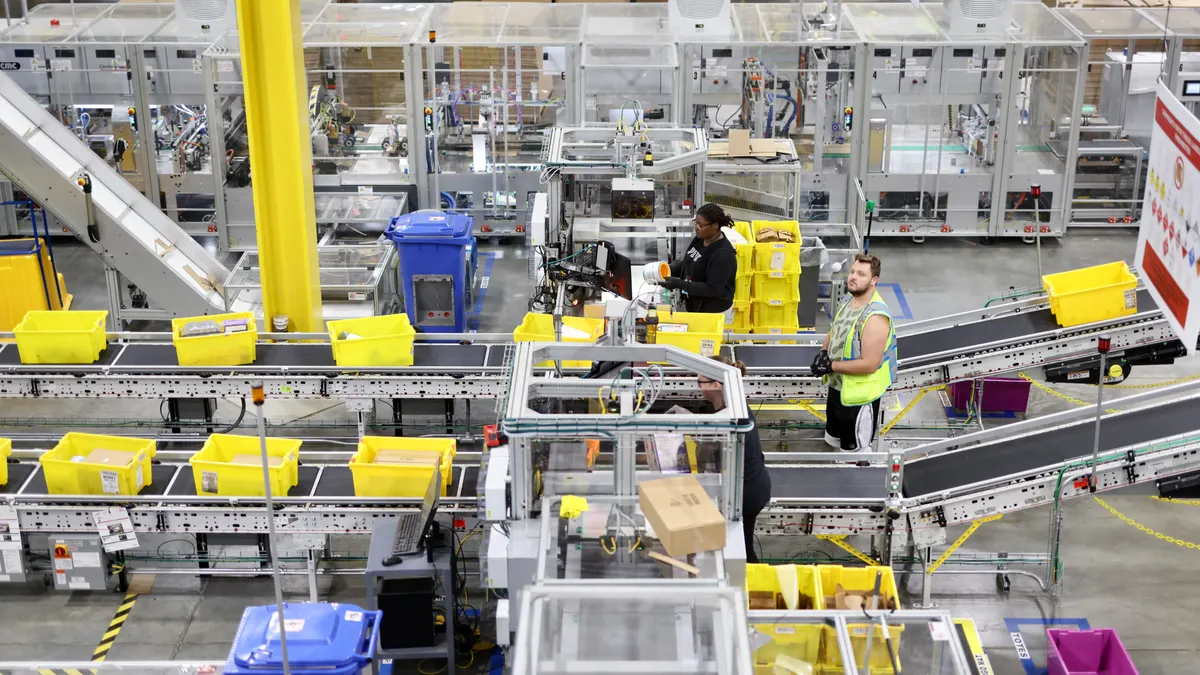
Amazon's new AI-powered warehouse robot is raising fresh questions about the future of entry-level work as businesses across the economy look for ways to increase productivity without adding staff at the same pace.
While the technology is being marketed as a tool that helps employees work more efficiently, it also highlights a growing reality facing workers in logistics, retail and manufacturing: the jobs available tomorrow may require very different skills from the ones employers are hiring for today.
The company unveiled its next-generation Proteus robot during an event in Dartford, England, as part of a €10 billion investment in its European fulfillment network. Unlike traditional warehouse robots that rely on specialist systems and trained operators, Proteus can take conversational instructions from workers. Employees simply tell the robot what needs doing and it determines the route, timing and priorities itself. Amazon plans to begin deploying the technology across Europe in 2027 alongside other advanced automation systems already being introduced into its warehouses.
Businesses have strong incentives to move in this direction. After years of rising labor costs and heavy investment in artificial intelligence, executives are under increasing pressure to show that new technology can improve efficiency and reduce operational bottlenecks. Investors are looking for returns on enormous AI spending commitments, and automation is increasingly being presented as the answer. The race is no longer just about innovation. It is about proving that those investments can deliver measurable productivity gains.
The implications reach far beyond Amazon's warehouses. When robots can be directed through ordinary language rather than specialist software, the relationship between workers and automation changes. Tasks that once depended on physical labor increasingly involve overseeing, correcting and managing automated systems. Some employees will adapt and move into higher-skilled roles. Others may find the ladder becoming steeper just as employers begin demanding different capabilities.
Warehouses have long offered one of the fastest routes into stable work for people without degrees or specialist training. That has made the sector an important source of employment during periods of economic uncertainty. As robotics becomes more capable and easier to deploy, employers may place greater value on judgment, supervision and decision-making than on routine physical tasks. New jobs are likely to emerge, but they may not arrive quickly enough or in the same places as the positions being transformed.
The timing of Amazon's announcement also reflects a broader trend running through the corporate world. Companies are spending heavily on AI infrastructure and automation while simultaneously searching for ways to control costs and improve margins. Workers, meanwhile, are watching technology take on responsibilities that were once handled by people. The tension between those two realities is becoming increasingly visible as more businesses reshape their operations around machine-led systems.
Amazon maintains that robotics can create new opportunities rather than simply eliminate existing roles. The company points to billions of dollars invested in workforce training and says advanced automation has generated entirely new job categories in some facilities. It plans to expand its European fulfillment workforce and continue investing in skills linked to engineering, logistics and technology. Even so, transitions of this scale rarely happen smoothly. Workers often need to retrain before replacement opportunities fully materialize, creating uncertainty during the period in between.
The larger issue is the direction businesses are taking. Faced with slower growth, tighter margins and relentless competition, more employers are turning to automation to solve problems that were previously addressed by hiring additional staff. As that approach spreads, the most secure roles may increasingly belong to workers who can manage and work alongside technology rather than compete directly with it.
Warehouses have often been a fallback source of stable work during uncertain economic periods. As robots take on more responsibility and employers rethink how work is organised, that safety net may start looking very different from the one many workers have relied on for years.