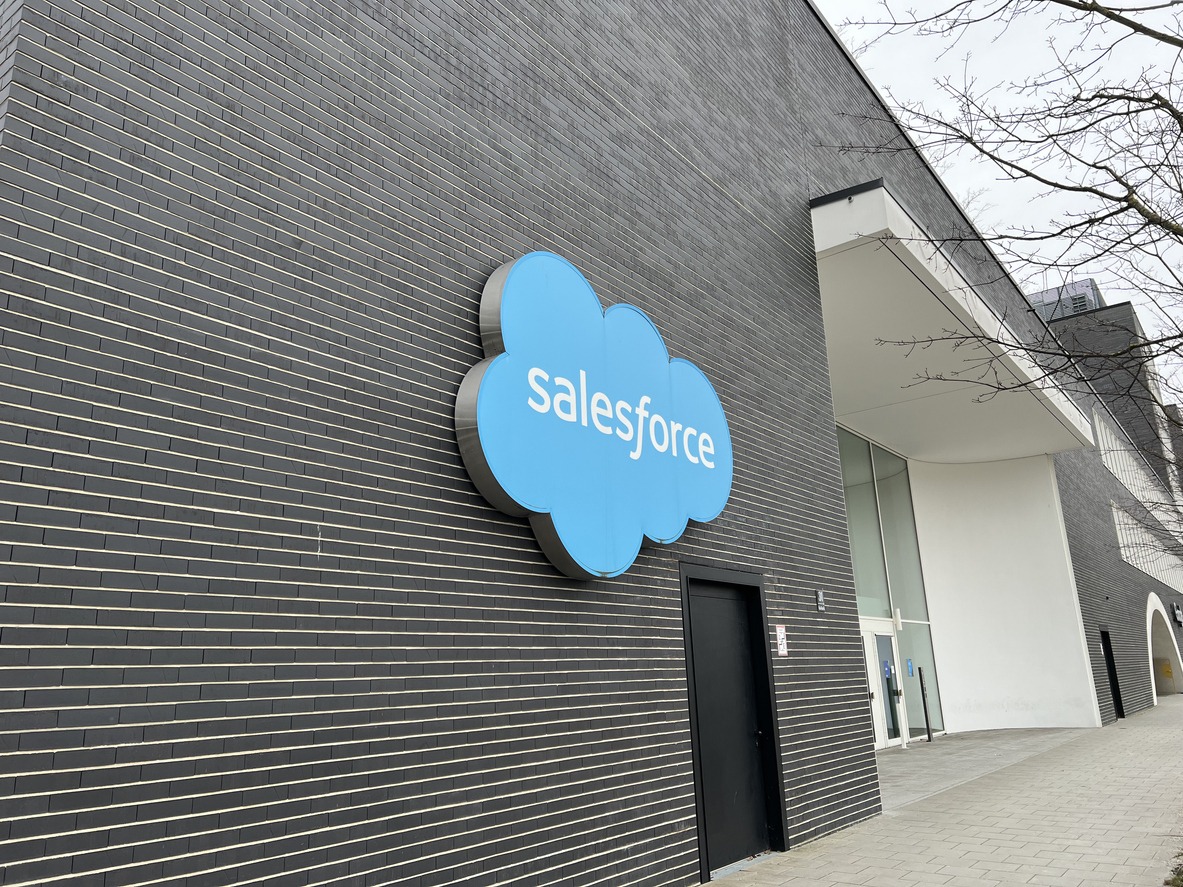
Salesforce has signed a definitive agreement to acquire Fin, the AI customer-service agent platform formerly known as Intercom, for approximately $3.6 billion, the company announced on 15 June 2026. The price is subject to customary purchase price adjustments, and the deal is expected to close in the fourth quarter of Salesforce's fiscal year 2027, with no change expected to the company's forecast or capital return program.
Fin's core product is an autonomous AI agent that resolves customer queries end-to-end, without human intervention, across live chat, email, WhatsApp, SMS, phone and Slack, drawing on a proprietary model the company calls Apex. The acquisition brings more than 30,000 companies as customers and feeds Salesforce's Agentforce platform, which reached $1.2 billion in annual recurring revenue in the first quarter of fiscal 2027, a 205% increase year-on-year. Chief executive Marc Benioff framed the purchase as a way to serve organisations at every stage of AI adoption, from small businesses needing rapid deployment to large enterprises requiring tailored implementations. Fin chief executive Eoghan McCabe said joining Salesforce would accelerate the company's ability to scale globally.
The deal continues an aggressive acquisition run. Salesforce's largest purchase remains the more than $27 billion acquisition of Slack, which closed in 2021, and recent buys include the roughly $8 billion Informatica deal and Convergence.ai. The pattern reflects a wider consolidation: enterprise-software vendors are racing to embed autonomous agents directly into the platforms enterprises already run, paying revenue multiples for proven technology and the engineering teams behind it rather than building in-house. Competition to roll out usage-based digital workers across customer service, sales and back-office functions is intensifying across the sector.
This is a cost-structure shift, not just a software-procurement story. An agent that resolves support queries end-to-end without human intervention is, in effect, a variable-cost alternative to headcount, and consumption-based pricing means spend scales with volume rather than sitting as a fixed licence. That changes how finance teams budget for technology and labour together. Modelling the trade-off between agent consumption costs and the staffing they displace becomes a finance responsibility, as does testing whether the promised resolution rates translate into genuine margin rather than simply adding a new line of technology spend on top of existing operations.
The forward implication is that agentic AI is becoming a cost item finance teams own, not merely a tool the IT department buys. As vendors embed autonomous agents into core enterprise platforms, finance leaders will need frameworks to evaluate consumption-based AI spend, forecast its volatility, and judge return on a per-resolution basis. The organisations that build that discipline early will be best placed to adopt these tools without losing control of the cost base.
More From Finance Monthly: American Express buys Tripadvisor's TheFork for $700m to deepen dining network