
The downfall of Chinese billionaire Miles Guo is no longer an abstract courtroom story. It is now etched into brick, marble, and disappearing price tags.
Guo, the controversial Chinese exile convicted of orchestrating one of the largest fraud schemes in recent U.S. history, has been forced to slash $14 million off the asking price of his sprawling New Jersey mansion. Once listed at $33 million, the historic estate is now priced at $19 million, a steep reduction that reflects both market reality and the financial wreckage left behind by his criminal case.
For a man who once portrayed himself as a fearless billionaire dissident with endless resources, the rapid devaluation of one of his crown jewel assets offers a stark visual of just how far his fortune has fallen.
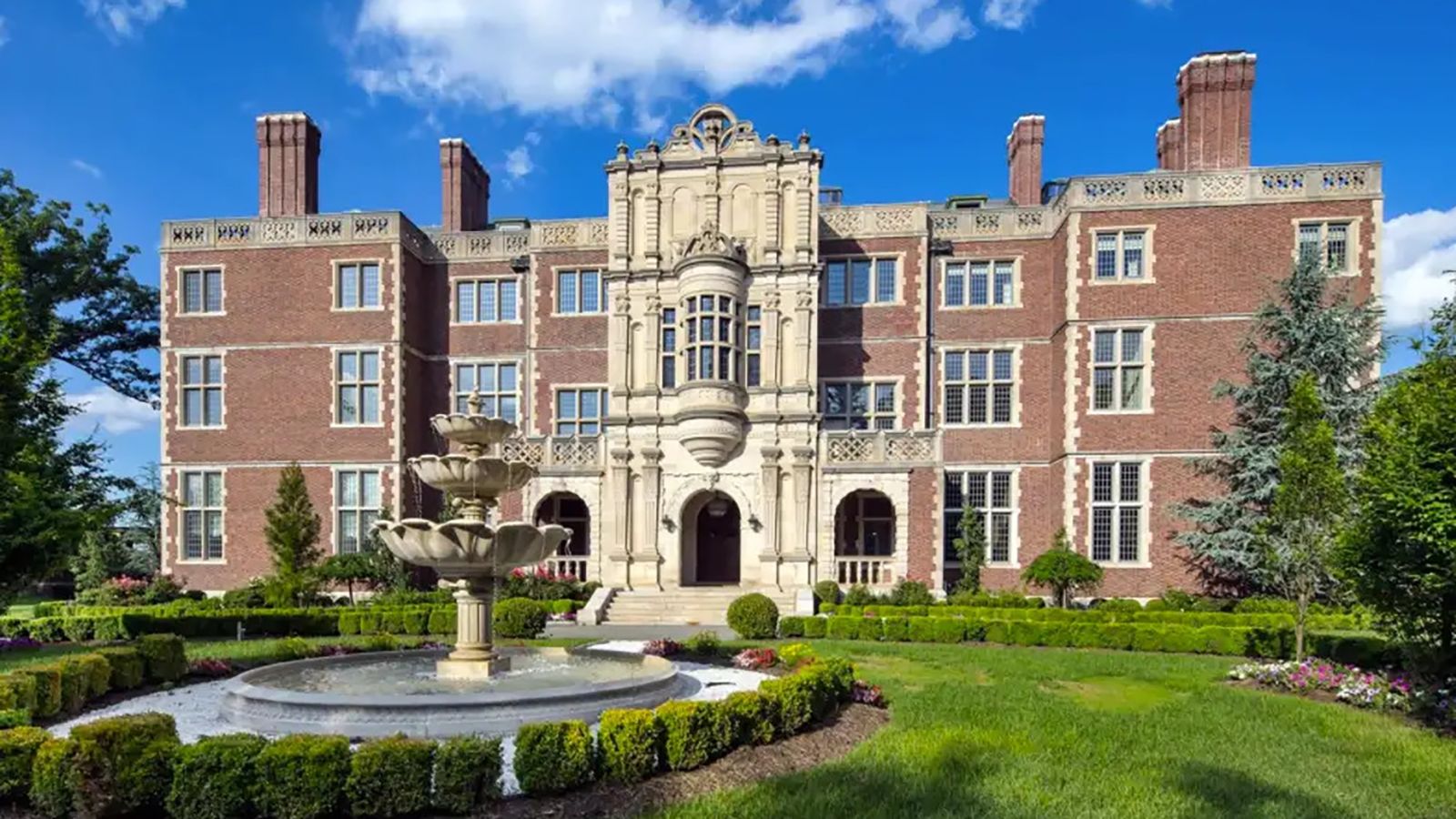
The imposing front exterior of Miles Guo’s New Jersey mansion, once a showpiece of his billionaire lifestyle and now a court-seized asset marked by steep price cuts.
From billionaire exile to convicted fraudster
Miles Guo, also known as Guo Wengui and Ho Wan Kwok, built an online following by presenting himself as a wealthy Chinese tycoon turned political exile. He promised supporters access to exclusive investment opportunities and positioned himself as a financial and ideological force standing up to Beijing.
Behind the scenes, federal prosecutors say a very different story was unfolding.
In 2024, a New York court convicted Guo on multiple counts including wire fraud, securities fraud, money laundering, and racketeering conspiracy. Authorities concluded that Guo and his associates defrauded online followers out of more than $1 billion, money that was allegedly diverted into luxury homes, private jets, superyachts, high end vehicles, and extravagant renovations.
The conviction shattered the image Guo had carefully cultivated and triggered a cascade of asset seizures that are still playing out.
A mansion that symbolized excess
At the center of Guo’s material world sat the Crocker McMillin mansion in Mahwah, New Jersey.
Built in the early 1900s by a railroad heir, the Gilded Age estate spans roughly 50,000 square feet across 12 acres in the Ramapo Mountains. The property features 21 bedrooms, 29 bathrooms, a spa, billiards hall, tearoom, tennis court, formal gardens, fountains, and an eight car garage. Inside, the home is filled with rare woodwork, historic detailing, and Old World craftsmanship rarely seen in modern builds.
Guo purchased the estate in 2021 for $26 million. Prosecutors later revealed that he poured an additional $18 million into renovations and décor, including more than $1 million spent on Persian and Chinese carpets alone. When purchase and upgrades are combined, Guo’s total investment in the property approached $44 million.
That figure makes the current $19 million listing price especially painful. Even if the mansion sells at asking, the loss would be massive.

The grand main living room of Miles Guo’s Gilded Age mansion, where soaring ceilings and opulent details reflected a lifestyle later undone by fraud convictions and asset seizures.
A $14 million price cut and a forced reality check
According to Realtor.com, the mansion’s price was reduced repeatedly over the past year as Guo’s legal situation deteriorated. What began as a $33 million listing in early 2025 fell steadily, landing at $19 million by December.
This was not a discretionary decision driven by market timing. It was a forced reckoning.
Guo declared Chapter 11 bankruptcy in 2022, and federal authorities moved quickly to seize assets following his arrest in 2023. The New Jersey estate, along with his Central Park penthouse, Connecticut mansion, $37 million superyacht, two private jets, and a $3.5 million Ferrari, became part of a sweeping asset recovery effort tied to his fraud conviction.
The proceeds from these sales are expected to go toward repaying victims and recouping funds prosecutors say were used to bankroll Guo’s lavish lifestyle. In total, authorities estimate more than $1.3 billion was spent or diverted.
A shrinking fortune under court supervision
While Guo once claimed billionaire status, his current financial reality is far more constrained.
The bankruptcy filing and subsequent seizures have placed much of what remains of his wealth under court control. Any sale of major assets now occurs within a tightly supervised legal framework, limiting Guo’s ability to influence pricing or timing. The delayed auction of his holdings underscores how complex and distressed the situation has become.
The mansion’s steep discount is not just about luxury real estate conditions. It reflects urgency, legal pressure, and the diminished bargaining power of an owner who no longer controls his estate in the traditional sense.
A public unraveling with global resonance
Guo’s case has drawn international attention because it sits at the intersection of politics, finance, and online influence. Prosecutors argued that he weaponized digital platforms to cultivate trust and loyalty, then exploited that trust to extract massive sums from supporters who believed they were backing legitimate ventures.
For many observers, the sale of the New Jersey mansion represents something tangible in an otherwise complex financial crime. It is a visible marker of loss. A symbol of how quickly paper wealth and performative billionaire status can collapse when exposed to legal scrutiny.
Once designed to impress guests and project power, the mansion now stands as an asset waiting to be liquidated.
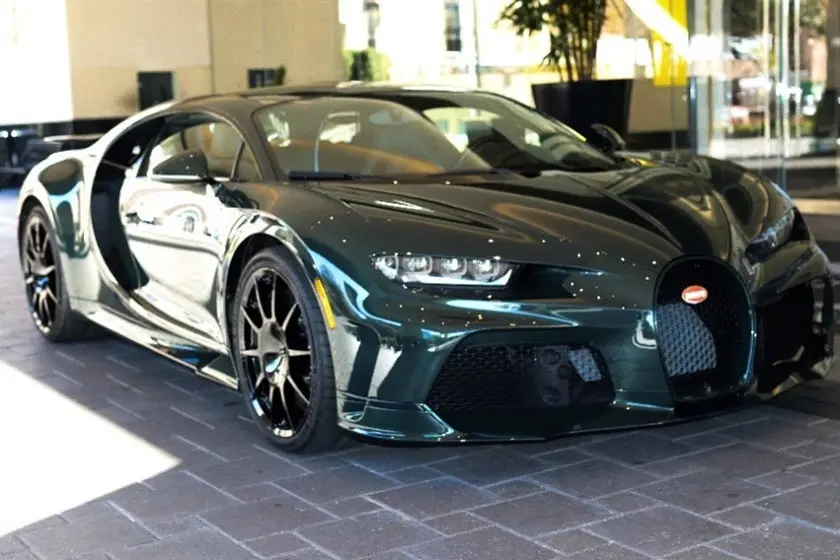
A custom Bugatti once driven by jailed Chinese billionaire Miles Guo, one of several ultra-luxury assets seized as part of the federal fraud and bankruptcy case.
Waiting for sentencing behind bars
Guo is currently being held in a Brooklyn jail while awaiting sentencing. The court has not yet determined the length of his sentence, but the financial consequences are already clear. Properties are being sold. Assets are frozen. Control has shifted away from the man who once claimed near limitless resources.
As the Crocker McMillin mansion sits on the market at a sharply reduced price, it serves as a quiet counterpoint to Guo’s former image. A reminder that even the most opulent symbols of wealth can become liabilities when fortunes are built on deception.
For a jailed Chinese billionaire who once flaunted extravagance as proof of success, the $14 million price cut is more than a real estate adjustment. It is a public accounting of how much has already been lost, and how little remains under his control.
The Key Questions That People Are Asking
How much money could victims realistically recover from Miles Guo’s seized assets?
While prosecutors allege more than $1 billion was misappropriated, victim recovery is unlikely to reach that figure. Asset liquidation typically recovers only a fraction of losses once legal fees, secured creditors, and administrative costs are paid.
Luxury properties, aircraft, and yachts often sell at discounts under court supervision, especially when sales are time-sensitive. Any recovered funds are usually distributed through a claims process, meaning smaller investors may receive only partial restitution, if any, over an extended period.
What sentence could Miles Guo face under U.S. federal law?
Federal convictions for wire fraud, securities fraud, and money laundering carry potentially severe penalties, particularly when combined with racketeering charges. Sentencing is influenced by the scale of financial loss, number of victims, and whether the conduct is deemed ongoing or organized.
In large-scale financial crime cases, sentences can extend into decades, although final outcomes depend on judicial discretion and sentencing guidelines. The financial forfeitures already imposed do not reduce potential prison time.
Why are high-profile overseas billionaires increasingly facing U.S. prosecutions?
U.S. authorities have expanded their reach over international financial crimes that touch American banks, platforms, or investors. Many overseas elites maintain U.S. real estate, financial accounts, or online fundraising operations, placing them within American jurisdiction.
Digital platforms have made cross-border fundraising easier but also easier to track. As a result, high-profile figures who once believed geographic distance provided protection are increasingly finding themselves subject to U.S. courts and asset seizures.